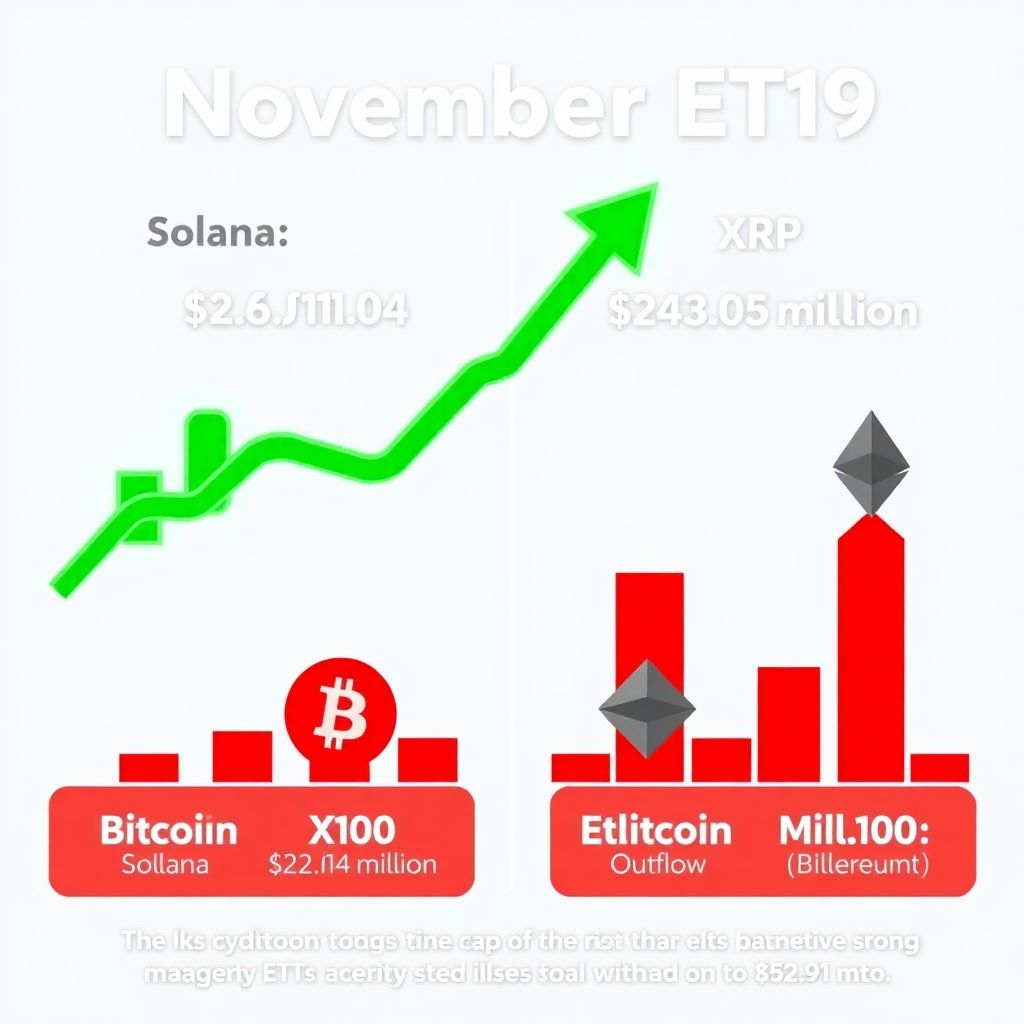
Solana and XRP-based exchange-traded funds (ETFs) continued to attract steady investor interest on November 14, bolstering their recent streak of positive inflows. In stark contrast, Bitcoin and Ethereum ETFs experienced another round of significant capital outflows, marking a sustained trend of withdrawals that has persisted over several consecutive trading sessions.
Data reveals that Bitcoin ETFs posted a staggering $492.11 million in net redemptions on November 14 alone, extending their outflow streak to three days. Ethereum ETFs followed a similar pattern, with $177.90 million in outflows on the same day. This marks the fourth consecutive day of negative flows for Ethereum-focused funds, reinforcing concerns over waning short-term investor sentiment in the two largest cryptocurrencies.
Meanwhile, Solana ETFs continued their upward momentum, registering $12.04 million in net inflows on November 14. This follows a consistent pattern of investor accumulation since late October. On the previous trading days, Solana ETFs recorded $1.49 million (November 13), $18.06 million (November 12), and $7.98 million (November 11) in inflows. The sustained interest has pushed cumulative net inflows for Solana ETFs to $382.05 million, with total assets under management (AUM) climbing to $541.31 million.
XRP ETFs, introduced to the market on November 13, saw no inflows on their first day. However, a strong debut followed on November 14, as investors poured $243.05 million into the funds through both cash investments and in-kind contributions. After just two days of trading, XRP ETFs had already amassed $248.16 million in total AUM, indicating substantial early interest despite the volatile macro conditions impacting the broader cryptocurrency market.
Looking at the broader trend, Bitcoin ETFs experienced their largest single-day withdrawal on November 13, when redemptions hit $869.86 million. This was preceded by an outflow of $277.98 million on November 12. Interestingly, these outflows reversed a short-lived period of optimism, during which Bitcoin ETFs recorded $523.98 million in inflows on November 11 and $1.15 million on November 10. Despite recent redemptions, the cumulative net inflow for all Bitcoin ETFs remains positive at $58.85 billion, with total assets under management standing at $125.34 billion as of November 14.
Ethereum ETFs mirrored this downward trajectory, with net outflows of $259.72 million on November 13, $183.77 million on November 12, and $107.18 million on November 11. While these figures are significant, Ethereum ETFs still maintain a total cumulative net inflow of $13.13 billion and $20 billion in AUM. Additionally, Ethereum ETF trading activity remained robust, with a total value traded of $2.01 billion on November 14.
The divergence between legacy crypto assets like Bitcoin and Ethereum and newer contenders such as Solana and XRP reflects a shift in investor sentiment. Market participants may be seeking alternative tokens with perceived higher growth potential or exposure to different blockchain ecosystems. The performance of newer ETFs suggests growing investor confidence in alternative layer-1 networks and their long-term viability.
Several analysts point to Solana’s recent technological developments and increasing DeFi and NFT activity as catalysts for the spike in ETF inflows. Solana’s relatively low transaction fees and high throughput have made it an attractive alternative to Ethereum, particularly for retail and institutional investors looking for efficient smart contract platforms.
XRP’s strong ETF launch may be attributed to Ripple’s recent legal victories and growing optimism around its regulatory clarity. As investor confidence in XRP improves, ETFs based on the token could continue to draw significant capital, especially if institutional adoption increases.
Meanwhile, the outflows from Bitcoin and Ethereum ETFs could be partially driven by profit-taking after recent price rallies, or a broader market shift toward diversification. Some investors may also be reallocating capital into newer crypto assets in anticipation of the next altcoin cycle or in pursuit of higher returns.
It’s worth noting that ETF flows are just one metric of market sentiment and capital movement. While they offer insight into investor behavior, they do not always reflect the underlying health of a given blockchain ecosystem. However, sustained inflows or outflows can influence short-term price trends and impact broader market psychology.
Looking ahead, the ETF landscape will likely continue to evolve as more assets receive regulatory approval and listing opportunities. With growing institutional interest and the expansion of crypto-related financial products, competition among ETFs is expected to intensify, potentially leading to further shifts in capital allocation across the digital asset space.
Finally, the overall market dynamics remain sensitive to macroeconomic factors, including interest rate policies, global liquidity trends, and regulatory developments. As such, ETF flows should be interpreted alongside other indicators to get a comprehensive view of the crypto investment landscape.
In summary, while Bitcoin and Ethereum ETFs struggle with notable outflows, Solana and XRP are emerging as strong contenders, capturing investor attention with consistent inflows and rising asset values. This transformation signals a potential rebalancing of investor priorities within the digital asset market as new narratives and technologies influence capital deployment.