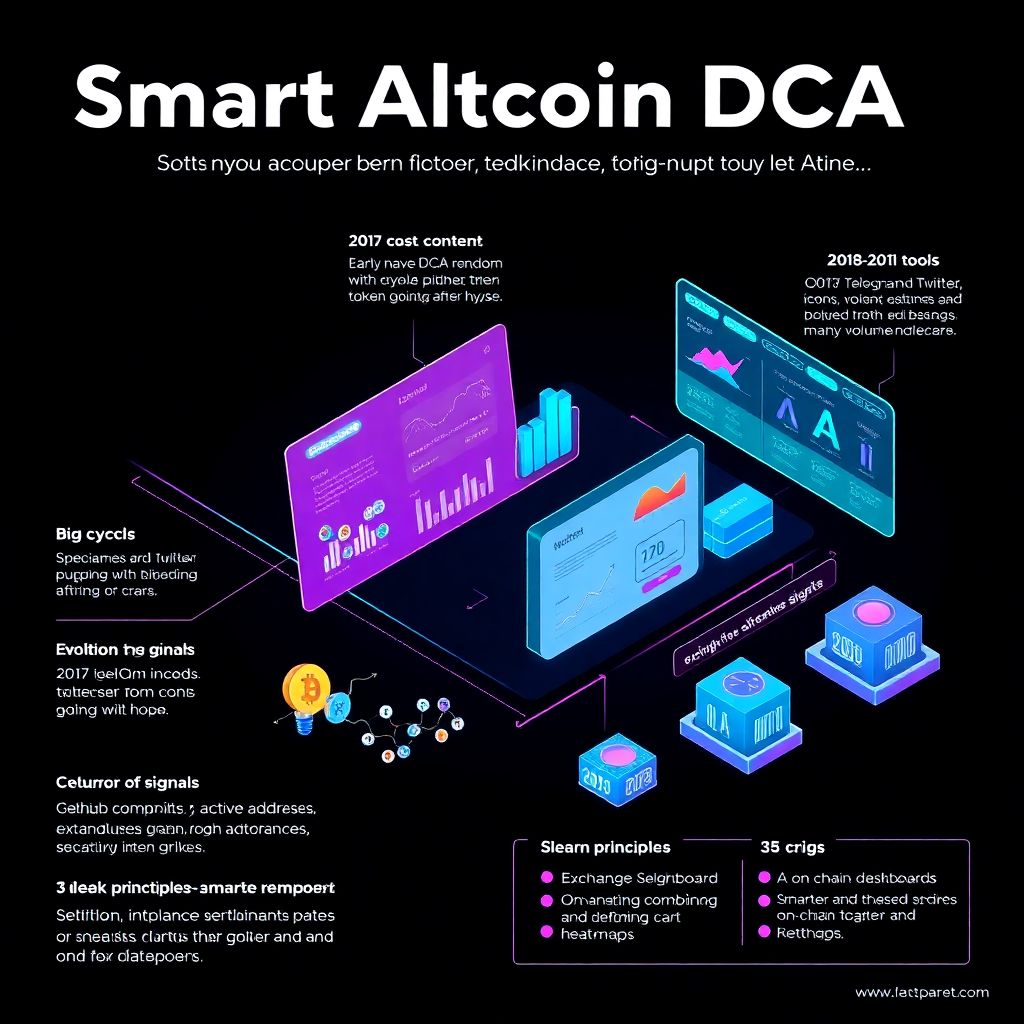
Historical context of altcoin DCA
Dollar‑cost averaging in crypto started as a direct import from traditional finance, where pension funds drip money into index funds regardless of price. When altcoins appeared, traders tried to copy‑paste the same logic and simply buy every week, assuming “time in the market” would fix bad entries. That worked in the early cycles, when almost any asset pumped with Bitcoin, but it quickly broke down as thousands of low‑liquidity tokens emerged and many went to zero after one hype phase. The need for a smarter framework became obvious: instead of blind averaging, investors began mixing on‑chain metrics, liquidity data and trend analysis into their routines, searching for the best altcoin DCA strategy that could survive multi‑year bear markets instead of just riding short euphoric runs.
Historical evolution of signals
In the 2017 cycle, most “signals” were purely speculative: Telegram groups, Twitter influencers and rough volume spikes on small exchanges. People treated any listing or partnership tweet as a green light to average in, without checking basic fundamentals or token economics. After the 2018 crash, attention shifted toward more structured crypto DCA signals for altcoins: developer activity on GitHub, growth in active addresses, exchange inflows and derivatives funding rates. By the 2020–2021 bull run, a new generation of tools appeared, combining on‑chain dashboards, sentiment indexes and order‑book analytics. This evolution pushed DCA from a naive autopilot to a semi‑systematic process, where recurring buys are allowed only when underlying network health and market structure stay within predefined ranges instead of blindly ignoring macro conditions.
Core principles of smarter altcoin DCA
Smarter DCA starts with one uncomfortable truth: not every coin deserves to be averaged into. Because most altcoins behave like high‑beta tech startups with no guaranteed cashflow, a long term altcoin investment strategy has to filter aggressively before committing capital. Instead of asking “how low is the price,” the core question becomes “is the protocol gaining real users, fees or developer traction over time?” Practical DCA rules include capping portfolio allocation per asset, requiring minimum daily liquidity and avoiding tokens with opaque vesting schedules that can flood the market. The goal is to let time diversification work for you while reducing the chance of averaging into structurally dying projects that no amount of patience will rescue.
Signal types you actually want to track
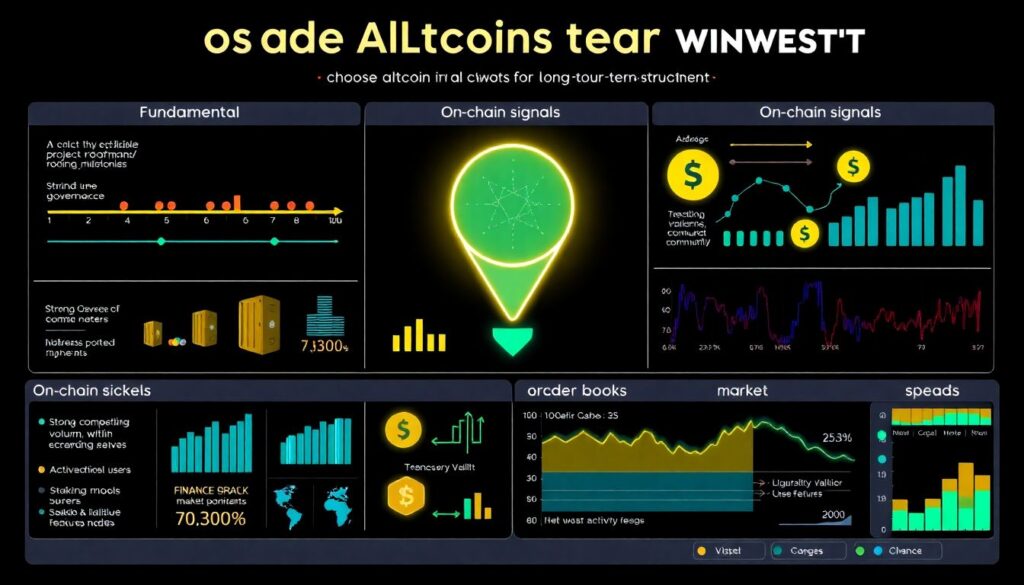
When deciding how to choose altcoins for long term investment, focus on three buckets of signals: fundamental, on‑chain and market microstructure. Fundamental signals cover the project’s roadmap credibility, governance quality, treasury runway and competitive moat in its sector. On‑chain signals look at growth in active wallets, transaction volume, protocol fees and retention of power users over several quarters. Microstructure signals include order‑book depth, slippage for mid‑size orders, derivatives open interest and funding rate stability. Smarter DCA ties recurring buys to these metrics: for example, you keep averaging while usage and liquidity trend up, but you slow or pause when addresses stagnate, liquidity evaporates or funding flips wildly positive, hinting at overcrowded speculative longs.
Practical implementation and workflows
In practice, you don’t need a hedge‑fund stack to deploy a disciplined plan. Start by defining your investment horizon and cash flow: how much fiat or stablecoins you can commit monthly without touching emergency funds. Then pick two or three sectors you understand—L1s, DeFi, infrastructure—and shortlist a handful of assets that pass baseline checks on liquidity, transparency and development. Many investors use a hybrid approach: a fixed base DCA plus a flexible overlay. The base allocates the same amount every two weeks, while the overlay adjusts plus or minus 50% based on pre‑defined metrics such as trend strength or network growth. This turns your DCA into a rules‑driven system instead of an emotional “buy every dip” reflex that often leads to overexposure near local tops.
Using external tools and signal services
You can augment your process with dashboards and curated feeds, but they should support, not replace, your own thesis. An altcoin trading signals service can be useful for surfacing unusual activity—sudden spikes in volume, whales accumulating, or liquidity moving between exchanges—but treat each alert as a research prompt, not a buy order. Combine these alerts with your watchlist metrics: if a signal points to rising open interest but on‑chain usage is flat and the token is approaching a key resistance, you might delay DCA rather than accelerate it. Automating parts of the process through APIs or exchange bots is reasonable, but always keep manual override rules: circumstances such as protocol exploits, regulatory news or founding team drama justify pausing buys regardless of what any indicator suggests.
Concrete DCA scenarios with altcoins

Imagine you want recurring exposure to a DeFi blue chip and an L2 scaling token. You might allocate a fixed monthly sum split 60/40, buying every two weeks. Your rule set could say: continue full‑size DCA while protocol fees and active addresses maintain a three‑month uptrend and daily spot volume stays above a certain floor. If on‑chain shows fees dropping 40% over a quarter or developer commits halt for a month, you cut buys to half until metrics stabilize. Conversely, if price drops 30% but user metrics and liquidity remain strong, you temporarily scale up allocations within your risk budget. This conditional logic is what turns mechanical averaging into the best altcoin DCA strategy for your personal constraints instead of a one‑size‑fits‑all template copied from social media threads.
Common misconceptions and risk management
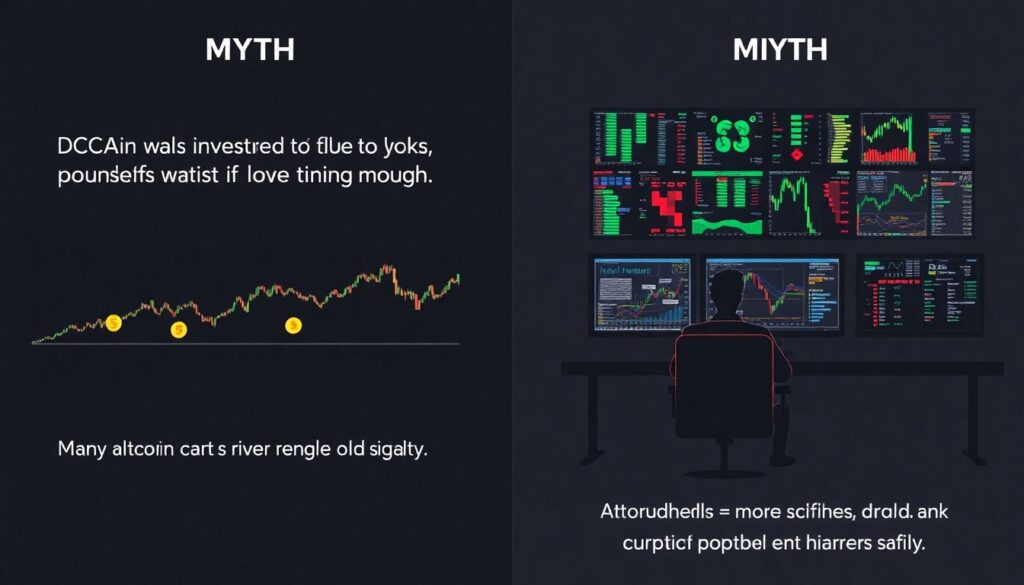
One popular myth is that DCA “always works if you wait long enough.” That statement only holds when underlying assets have a durable edge; in altcoins, many charts never revisit old highs. Another misconception is that more signals automatically mean more safety—overfitting dozens of indicators can create false confidence and constant tweaking. Focus instead on a small, robust set that you truly understand. Finally, some assume that a long term altcoin investment strategy eliminates the need for risk management. In reality you still need hard rules: maximum portfolio drawdown, per‑asset caps and predetermined exit conditions such as broken fundamentals or governance failure. DCA is a risk‑smoothing tool, not a guarantee of profits, and it works best when combined with humility, ongoing research and a willingness to stop averaging into narratives that no longer make structural sense.