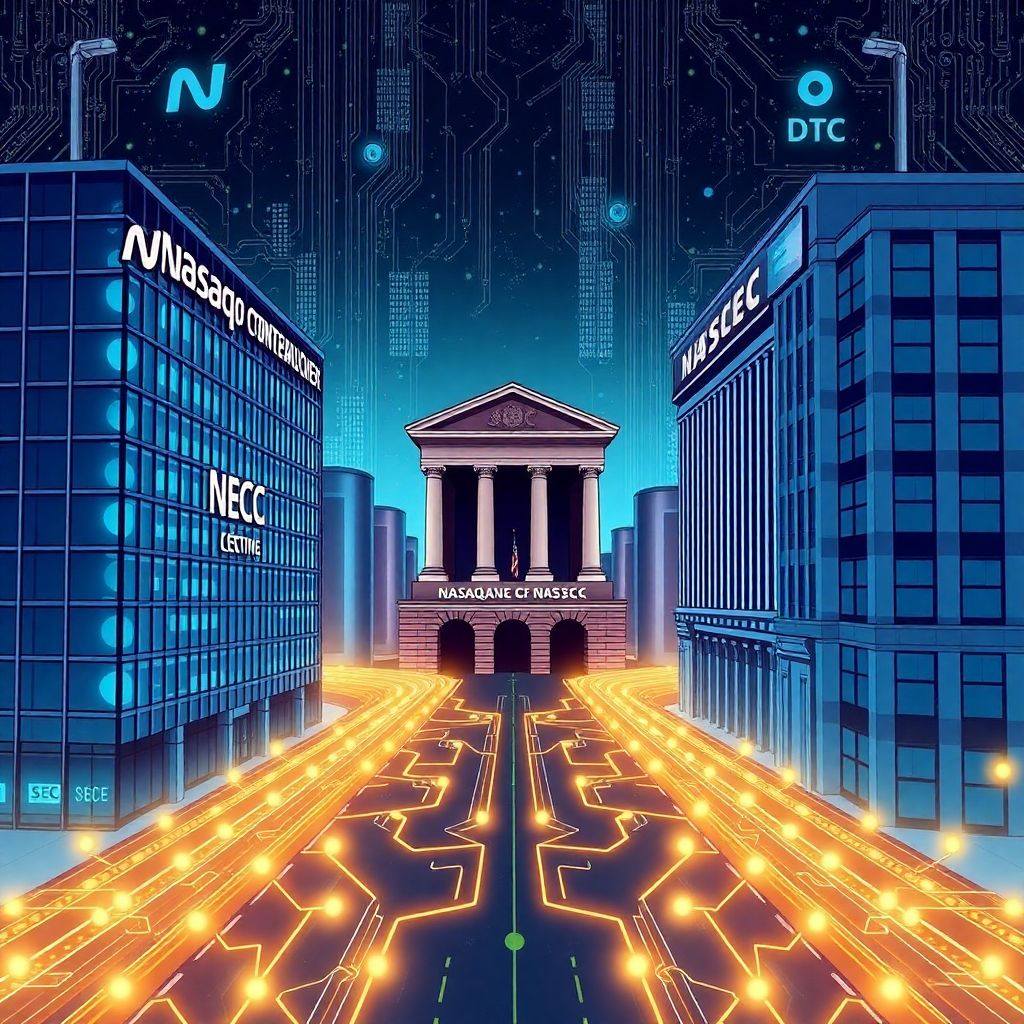
SEC scrutiny puts Nasdaq’s tokenized stock plan to its first major test at DTCC’s doorstep
The U.S. Securities and Exchange Commission has launched a formal review of Nasdaq’s proposal to list and trade tokenized securities, putting one of the most ambitious attempts to merge blockchain technology with traditional stock markets under the regulator’s microscope.
According to regulatory filings, Nasdaq is seeking approval to list equities and exchange-traded products (ETPs) in tokenized form, alongside their conventional counterparts. The plan would not replace existing systems but layer tokenization on top of the current market infrastructure, forcing regulators, exchanges, and clearinghouses to confront how far blockchain can be integrated without disrupting the core plumbing of U.S. equity markets.
What Nasdaq is proposing
Nasdaq’s filing asks the SEC to approve rule changes that would allow:
– Traditional stocks and ETPs to be issued and traded in tokenized form
– Tokenized and conventional versions of the same security to trade on the same order book
– Investors in tokenized shares to have the same economic and voting rights as holders of traditional shares
In this model, the token is essentially a digital wrapper representing ownership of a regular security. The underlying asset and its legal structure remain unchanged; only the way ownership is represented and recorded is modernized.
Critically, clearing and settlement would still run through the Depository Trust and Clearing Corporation (DTCC), the backbone of U.S. post-trade processing. Blockchain would be introduced primarily as an operational layer designed to streamline processes such as reconciliation, record-keeping, and corporate actions, rather than to displace DTCC’s central role.
Same book, same rights, new rails
Under the proposal, tokenized shares would not be segregated into a separate market. Instead:
– Orders for tokenized and non-tokenized versions of the same security would interact in a single order book
– Prices, market data, and liquidity would be unified, helping to prevent fragmentation
– Tokenized holders would enjoy identical shareholder protections, dividends, and voting rights
This “parallel trading” approach aims to demonstrate that tokenization can be introduced without forcing investors or brokers to operate different systems or open new types of accounts. For many end users, the experience might look identical to regular stock trading, even if the underlying representation of ownership is different.
SEC launches formal review, seeks feedback
The SEC has opened a formal review of the proposed rule change and requested public comments. Regulators are examining several core questions:
– How do tokenized representations of securities fit within existing securities laws and market structure rules?
– Can blockchain-based records be reconciled reliably with DTCC’s central ledger and existing clearing processes?
– What new risks, if any, arise for investors, brokers, and market stability?
Officials have emphasized that the current step marks the beginning of a detailed evaluation, not a signal of imminent approval or rejection. The outcome will likely serve as a reference point for future tokenization proposals across equities and other asset classes.
What would change for investors and brokers?
If the SEC approves Nasdaq’s framework:
– Investors could gain exposure to tokenized versions of regular stocks without leaving the traditional brokerage environment
– Firms would not need to build entirely separate trading or custody systems to handle tokenized assets
– Settlement would still depend on DTCC, preserving existing risk controls, netting mechanisms, and clearing guarantees
In other words, tokenization would be introduced as an incremental enhancement to the current market infrastructure, not a wholesale replacement. For regulators, that incremental approach offers a way to test blockchain’s benefits while maintaining familiar safeguards.
Divided reaction from market participants
The proposal has sparked mixed reactions across the industry.
Supportive industry groups argue that:
– Tokenization can streamline back-office operations and reduce manual reconciliation
– Immutable blockchain records could improve transparency and reduce operational errors
– Modernized post-trade infrastructure could lower costs and shorten settlement timelines over time
Their stance is reinforced by broader regulatory signals. The U.S. Commodity Futures Trading Commission recently authorized a pilot program that allows certain tokenized assets to be used as collateral in derivatives markets. That initiative is widely seen as a sign of growing regulatory comfort with blockchain-based financial instruments, at least in controlled settings.
However, not all market players are ready to move forward at Nasdaq’s proposed pace.
Ondo Finance and Cboe Global Markets have publicly urged the SEC to hold off on greenlighting the framework. Their concerns center on:
– The continued dependence of all tokenized trades on DTCC’s settlement infrastructure
– A perceived lack of clarity from DTCC on how tokenized transactions will be processed, reconciled, and risk-managed
– The risk of introducing tokenization features before the post-trade details are fully specified and tested
These critics are not necessarily rejecting tokenization outright. Instead, they want settlement and operational guidelines from DTCC to be finalized and transparent before the SEC signs off on large-scale trading of tokenized equities on major exchanges.
Why DTCC sits at the center of the debate
DTCC’s role is crucial. Despite the blockchain branding, the Nasdaq proposal does not bypass central clearing; it anchors tokenized shares squarely within DTCC’s ecosystem.
This raises several practical questions:
– How will DTCC map blockchain-based ownership records to its own books and records?
– Will DTCC treat tokenized and non-tokenized shares identically for margin, netting, and risk calculations?
– If discrepancies arise between blockchain records and DTCC’s official ledger, which will prevail legally?
Until DTCC’s operational and legal frameworks for tokenized securities are fully articulated, some participants fear that the market could be exposed to reconciliation issues or legal disputes in the event of system failures, trading halts, or bankruptcies.
Tokenization as an evolutionary, not revolutionary, step
The review highlights a broader shift in how traditional markets are thinking about blockchain. Early visions often depicted public blockchains as direct competitors to central infrastructure like DTCC. Nasdaq’s approach suggests a different path: using tokenization as an incremental upgrade within the existing architecture.
Potential advantages of this evolutionary model include:
– Minimizing disruption to existing regulatory, legal, and operational frameworks
– Allowing gradual rollout and testing, rather than an abrupt migration
– Giving regulators more visibility and control over the pace and scope of change
At the same time, this model may disappoint purists who hoped for a fully on-chain capital markets stack, with real-time settlement and dramatically reduced reliance on centralized intermediaries.
Key regulatory concerns: law, settlement, and protection
The SEC’s review is expected to focus on three major themes:
1. Legal certainty
Regulators must ensure that tokenized representations of shares are fully aligned with existing securities law. That includes questions of beneficial ownership, custody, transfer of title, and enforceability of rights if disputes arise.
2. Settlement integrity
Any change to post-trade processes must preserve — or improve — the reliability and robustness of settlement. The SEC will assess how blockchain data interacts with DTCC’s systems and whether it introduces new operational or systemic risks.
3. Investor protection
From an investor’s perspective, tokenization should not dilute protections. The SEC will examine disclosures, risk warnings, cyber and operational security, and how brokers explain tokenized products to clients who may not understand the underlying technology.
Implications for the pace of blockchain adoption
Whatever the outcome, the Nasdaq case is likely to set a precedent for how quickly blockchain technology can move from pilot projects into the heart of mainstream equity trading.
– If approved, it could encourage other exchanges and issuers to explore tokenized versions of stocks, bonds, funds, and structured products, confident that there is a workable regulatory template.
– If delayed or rejected, it may push the industry toward smaller, contained experiments or private market initiatives until regulators are more comfortable with the operational and legal frameworks.
Market observers note that, beyond Nasdaq, a growing number of financial institutions are exploring tokenization of funds, money market instruments, and other assets, often in tightly controlled environments. The SEC’s stance on this high-profile proposal will send a powerful signal to those efforts.
How tokenized stocks could reshape market plumbing over time
Even if the initial implementation keeps DTCC at the center, tokenized equities could gradually reshape how markets function under the hood:
– More granular ownership records
Blockchain-based ledgers can, in theory, offer near-real-time insight into who owns what, reducing reliance on omnibus accounts and complex record chains.
– Simplified corporate actions
Dividends, stock splits, and voting processes could be automated using programmable logic tied to tokenized assets, lowering administrative burdens.
– Improved cross-border distribution
Tokenized representations may simplify access for foreign investors, subject to local rules, by standardizing how securities are held and transferred across jurisdictions.
Realizing these benefits, however, depends on regulators, exchanges, custodians, and clearinghouses agreeing on shared technical and legal standards.
What market participants should watch next
As the SEC’s review progresses, several developments will be particularly important:
– Any updated filings from Nasdaq detailing technical implementation, risk controls, and investor disclosures
– Public statements or technical documentation from DTCC clarifying how tokenized trades will be processed and reconciled
– Additional comment letters from broker-dealers, asset managers, technology vendors, and investor advocates, which may highlight points of consensus or contention
The interplay among the SEC, Nasdaq, and DTCC will effectively determine whether tokenized equities become a practical reality in the near term, or remain an aspirational technology waiting for regulatory certainty.
A pivotal test for blending old and new finance
The SEC’s review of Nasdaq’s tokenization bid encapsulates a broader question facing global markets: Can blockchain be woven into existing financial infrastructure without undermining the safety, predictability, and legal clarity that decades of regulation have built?
Supporters see an opportunity to modernize market plumbing, reduce friction, and open the door to more flexible financial products. Skeptics warn that, without fully resolved settlement and legal frameworks, tokenization could layer complexity on top of complexity.
However the SEC rules, the process itself marks a turning point. It is no longer about whether blockchain should be considered in public markets, but how, where, and at what speed it can be responsibly integrated into the core machinery of equity trading.