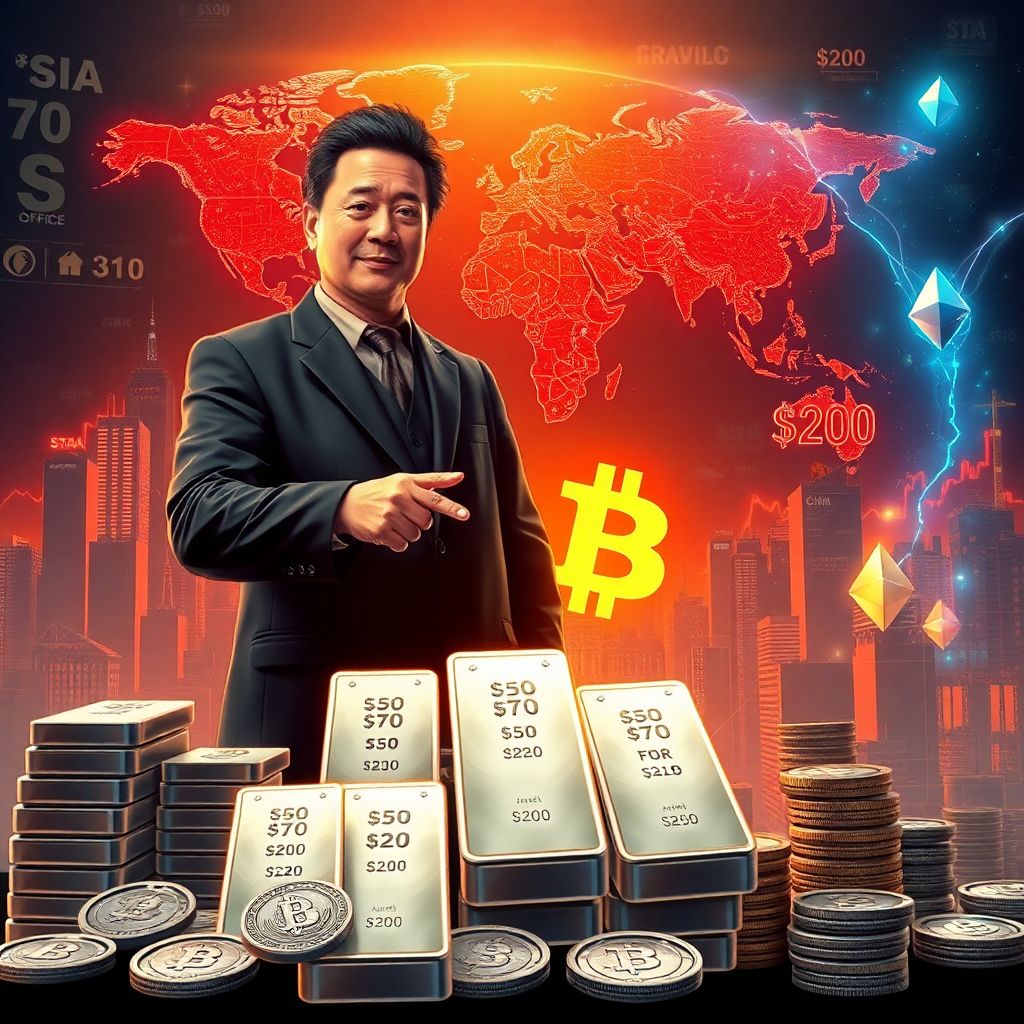
Robert Kiyosaki says silver is the safest asset as he warns of the ‘biggest crash in history’, predicts $200 silver by 2026 after major Bitcoin sale
Robert Kiyosaki, the entrepreneur and bestselling author of “Rich Dad Poor Dad,” is once again sounding the alarm on global markets. He claims that the “biggest crash in world history” is no longer a future threat but has already begun, and he is pointing to silver as the single safest bet for investors hoping to protect – and even grow – their wealth.
According to Kiyosaki, silver is currently massively undervalued. With the metal trading around $50, he predicts it will first climb to $70 in the near term and then surge to around $200 by 2026. In his view, that makes silver the most attractive opportunity among traditional safe-haven assets and even among leading cryptocurrencies.
Kiyosaki has long warned that the global financial system is fragile, but he now insists that his earlier forecasts are coming to pass. Back in 2013, he released the book “Rich Dad’s Prophecy,” in which he predicted a historic meltdown in financial markets. He now argues that this moment has arrived, not just in the United States but across Europe and Asia as well.
He links part of the looming crisis to rapid technological change. Kiyosaki believes artificial intelligence will trigger a massive wave of job losses. As employment declines, he expects demand for both office space and residential housing to drop sharply, putting severe downward pressure on real estate prices. In his scenario, rising unemployment, falling asset values, and overleveraged economies combine into a historic crash.
To navigate this environment, Kiyosaki continues to advocate for what he calls “real” or “hard” assets. He urges investors to accumulate gold, silver, Bitcoin (BTC), and Ethereum (ETH) as hedges against currency debasement, market volatility, and systemic risk. Among these, however, he singles out silver as “the best and the safest” choice today, arguing that its current market price does not reflect its true scarcity or its role in both industry and finance.
Kiyosaki emphasizes that crashes do not affect everyone equally. While he warns that “millions will lose everything,” he also insists that those who prepare in advance can come out of the downturn significantly wealthier. In his eyes, a crisis is both a destruction of wealth and a generational opportunity for those holding the right assets at the right time.
His latest warnings coincide with a major move in his own portfolio. Just two days before reiterating his call on silver, Kiyosaki revealed that he sold $2.25 million worth of Bitcoin at roughly $90,000 per coin. He had acquired those coins years earlier at around $6,000, locking in substantial profits on the trade.
Rather than sitting on that windfall in cash, Kiyosaki is recycling the capital into what he calls “cashflow businesses.” Specifically, he is using the proceeds to fund two surgery centers and a billboard business. Based on his projections, those investments will generate around $27,500 per month in tax-free income by February 2026.
This approach reflects a core principle of his broader philosophy: use gains from volatile, high-growth assets to acquire stable, income-producing businesses. He calls this his long-term “get rich plan” – a strategy that combines capital appreciation (from assets like Bitcoin, gold, and silver) with steady cash flow from operations and real estate.
Despite taking profits on Bitcoin, Kiyosaki stresses that he remains “very bullish and optimistic” about the cryptocurrency’s long-term prospects. He says he plans to gradually buy more Bitcoin again, but this time using the positive cash flow created by his new business investments, rather than simply reallocating existing savings.
Kiyosaki also mentioned that people close to him advised against publicly sharing details about his Bitcoin sale and subsequent business acquisitions. He suggested that being transparent about substantial wealth and investment moves can attract unwanted attention, hinting at security and privacy concerns.
From his perspective, silver stands out for several reasons. First, it is both a monetary metal and an industrial one, used in electronics, solar panels, medical devices, and many other applications. That dual role creates persistent demand, even when investor interest fluctuates. Second, compared to gold, silver’s market is relatively small, which means inflows of capital can have a dramatic impact on price. Third, Kiyosaki believes that chronic underinvestment in mining and rising industrial needs have set the stage for a potential supply squeeze.
He also argues that silver is far more accessible to everyday investors than gold or Bitcoin. With a much lower price per unit, individuals can build a meaningful position in silver with modest amounts of money. For Kiyosaki, this accessibility makes silver an ideal “starter asset” for those looking to protect themselves from inflation and financial instability.
In the broader context of his economic outlook, Kiyosaki sees fiat currencies as being slowly eroded by inflation and irresponsible monetary policy. Central banks’ repeated use of money printing and ultra-low interest rates, he argues, has inflated asset bubbles in stocks, bonds, and real estate. When those bubbles finally burst, he believes, only those holding hard assets will be truly protected.
At the same time, he is not predicting a simple, one-directional collapse. Kiyosaki expects heightened volatility – violent swings up and down across markets – rather than a smooth decline. That’s why he advocates for a combination of defensive positions (gold, silver, select cryptocurrencies) and offensive ones (cashflow-generating businesses, well-chosen real estate) to ride out turbulence and exploit mispricings.
His focus on income-generating assets is also a response to what he sees as one of the biggest risks in coming years: job insecurity. If AI and automation do remove large numbers of traditional jobs, the value of having independent streams of cash flow becomes even more critical. Business ownership, royalties, and rental income – not wages alone – are at the heart of his resilience strategy.
Investors considering Kiyosaki’s silver call often ask how realistic a move to $200 per ounce might be. Historically, silver’s nominal peak near $50 occurred during periods of intense inflation fears and speculative mania. Kiyosaki’s thesis is that a combination of monetary debasement, industrial demand, and a crisis of confidence in financial assets could propel silver well beyond its prior highs. He frames $70 as a reasonable interim target and $200 as a possible outcome if the crisis deepens and capital floods into precious metals.
Yet, even as he shares bold price targets, Kiyosaki typically stresses education and preparation over blind speculation. He encourages individuals to study monetary history, understand the difference between assets and liabilities, and build a personal financial plan that does not depend solely on job income or government support.
Against the backdrop of his “biggest crash” narrative, his message is ultimately twofold. First, he believes the global financial system is entering a dangerous phase marked by debt, technological disruption, and structural imbalances. Second, he insists that those who are informed, diversified across hard assets, and focused on cash flow can turn that danger into a once-in-a-lifetime opportunity.
In that framework, silver is not just a short-term trade but a strategic cornerstone. By his account, owning silver today is both a defensive hedge against crisis and an offensive play on the future revaluation of real assets. Combined with disciplined reinvestment of profits into businesses and productive assets, Kiyosaki sees it as one of the clearest paths to not only surviving the coming turmoil, but emerging from it significantly wealthier.