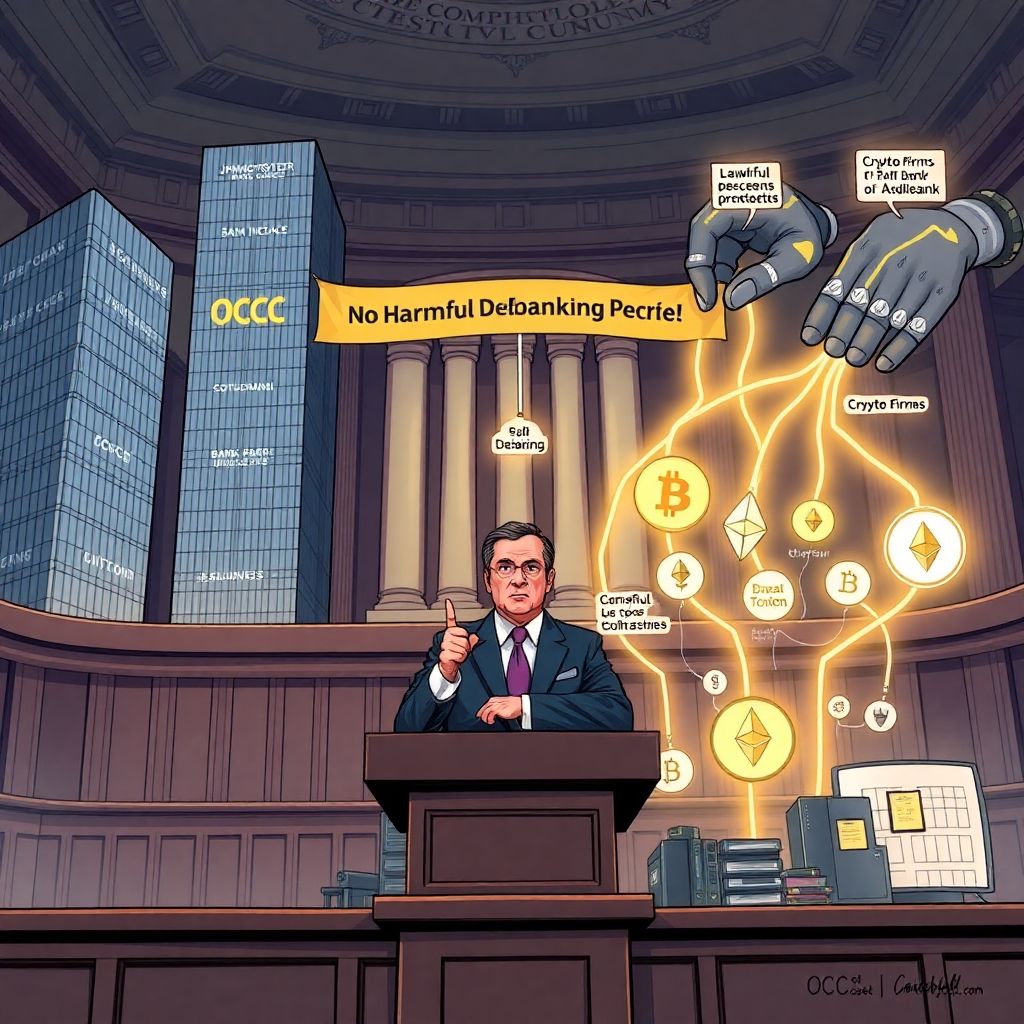
OCC Flags Alarming ‘Crypto Debanking’ Trend At Largest US Banks
The Office of the Comptroller of the Currency (OCC) has put the spotlight back on the relationship between major banks and the crypto industry, warning that some of the country’s biggest financial institutions may be engaging in “harmful debanking” practices.
In a supervisory review released on Wednesday, the OCC examined nine of the largest national banks under its oversight: JPMorgan Chase, Bank of America, Citibank, Wells Fargo, US Bank, Capital One, PNC Bank, TD Bank, and BMO Bank. The review covered the period from 2020 to 2023 and focused on how these institutions treat customers engaged in certain lawful but politically or socially sensitive industries — with digital assets prominently included.
Unwarranted Distinctions Between Lawful Businesses
According to the OCC’s preliminary findings, the banks appeared to draw improper distinctions between customers based not on legal compliance or risk profiles, but on the nature of their legitimate business activities.
Many of the institutions had adopted internal policies that either:
– Restricted access to standard financial services, or
– Imposed heightened reviews, approvals, or other extra hurdles for certain categories of clients.
Crucially, these restrictions were often applied even though the underlying activities were fully legal under US law.
One of the banks, the OCC reported, had formal policies limiting services to various sectors it deemed “contrary to [the bank’s] values.” The sectors singled out included:
– Oil and gas exploration
– Coal mining
– Firearms-related businesses
– Private prison operators
– Tobacco and e-cigarette companies
– Adult entertainment
– Digital asset and crypto-related firms
The OCC said that variations of these restrictive approaches appeared across all nine banks studied, though not always in identical form.
Crypto Industry Caught In The Crosshairs
Digital asset firms were specifically affected by these policies. The review found that many banks had imposed strict limitations on crypto-related activities, often under the banner of managing financial crime risks — such as money laundering, fraud, and sanctions evasion.
While managing such risks is a core obligation for banks, the OCC’s concern is that, in practice, the measures may have crossed the line into blanket denial of services based on sector, rather than on individualized risk assessment.
For crypto businesses, this can manifest as:
– Denials of basic business checking accounts
– Abrupt account closures with vague or no explanations
– Refusal to process wire transfers or fiat on/off-ramps
– Excessive documentation demands that go far beyond standard KYC/AML requirements
These dynamics have fueled long-standing fears in the digital asset community of an informal, coordinated effort to isolate crypto from the traditional banking system — a phenomenon often dubbed “Operation Chokepoint 2.0.”
OCC: Banks Are Misusing Their Charters
Comptroller Jonathan V. Gould did not mince words in responding to the findings. He criticized the idea that the largest US banks could use their scale and government-granted banking charters to quietly steer capital away from specific lawful industries.
“It is unfortunate that the nation’s largest banks thought these harmful debanking policies were an appropriate use of their government-granted charter and market power,” Gould said.
He also called out the discrepancy between public messaging and actual practice. While some banks have publicly insisted they were not engaged in debanking, the OCC found that, at a policy or implementation level, they were indeed imposing targeted restrictions on entire industries, including crypto.
Rejecting The ‘Weaponization Of Finance’
Gould stressed that the OCC is committed to preventing the financial system from being turned into a tool for pursuing political, ideological, or moral agendas — whether by regulators or by the banks themselves.
The agency said it is still working through “thousands of complaints” alleging debanking on political and religious grounds. Those cases go beyond crypto, but they reinforce a broader theme: access to the banking system should not depend on whether a bank approves of a customer’s lawful viewpoints, affiliations, or line of business.
The OCC plans to publish additional findings from this wider investigation “in due course,” and it has signaled that banks could face consequences if they are found to have engaged in unlawful discriminatory practices.
Parallel Move: Green Light For Crypto Transactions At National Banks
The debanking review landed just one day after another significant move from the same regulator. On Tuesday, the OCC issued a letter clarifying that national banks may engage in “riskless principal transactions” involving cryptocurrencies.
Under this model, a bank can buy and sell cryptocurrencies for its customers’ accounts without taking open directional positions itself. In practice, the bank acts as an intermediary that:
– Receives a crypto order from a client
– Immediately offsets that order with another market participant
– Completes the trade while maintaining neutral market exposure
This structure is designed to let banks provide crypto access in a tightly controlled, lower-risk way that fits within existing prudential standards.
The shift is notable for two reasons:
1. It gives customers a pathway to access digital assets directly through well-regulated national banks, rather than relying exclusively on crypto-native exchanges or offshore platforms.
2. It undercuts the narrative that US regulators want to fully shut crypto out of the formal financial system. Instead, the OCC appears to be encouraging a more structured, supervised integration.
A Tension At The Heart Of US Crypto Policy
Taken together, the OCC’s actions highlight a core tension in US crypto policy: regulators are simultaneously pushing banks to manage real risks associated with digital assets, while warning them not to overcorrect by cutting off the sector entirely.
For banks, that tension creates a challenging balancing act:
– Overly permissive policies could expose them to compliance failures, reputational harm, or enforcement actions.
– Overly restrictive or categorical bans could trigger accusations of unlawful discrimination, regulatory scrutiny, and missed business opportunities.
The OCC’s message suggests that the way forward lies in risk-sensitive, customer-specific assessments, not broad, values-based exclusions.
What This Means For Crypto Firms In Practice
For companies operating in the digital asset space, the OCC’s stance offers both a potential shield and a roadmap:
– Shield: By explicitly calling out harmful debanking and promising accountability, the OCC gives crypto businesses stronger grounds to challenge arbitrary account closures or blanket refusals of service, especially when they are compliant with AML, KYC, and sanctions rules.
– Roadmap: The regulator’s support for riskless principal transactions signals that crypto firms willing to partner with banks in transparent, well-structured models may find more stable access to fiat rails over time.
In the near term, affected businesses could:
– Document and escalate debanking incidents to the OCC and other appropriate oversight bodies.
– Emphasize their compliance controls, audits, and licensing when seeking banking relationships.
– Explore partnerships with banks that are actively building compliant crypto offerings, rather than those quietly exiting the space.
Implications For Consumers And Investors
For retail users and investors, the OCC’s moves have several practical implications:
– Over time, it may become easier to buy and hold digital assets directly through familiar national banks, in the same way many people currently purchase stocks or mutual funds.
– Greater bank involvement typically means more robust consumer protections, clearer disclosures, and stricter anti-fraud measures than those found at lightly regulated or offshore crypto platforms.
– However, users may also face stricter identity verification, transaction monitoring, and reporting requirements, as banks import their traditional compliance frameworks into the crypto realm.
If executed well, this could reduce counterparty risk and high-profile exchange failures, while still preserving access to digital assets for mainstream investors.
Why The ‘Operation Chokepoint 2.0’ Fears Persist
Despite the OCC’s explicit criticism of harmful debanking, concerns about a de facto “Operation Chokepoint 2.0” continue to circulate in the industry. Several factors fuel this perception:
– Patterns of simultaneous account closures or refusals across multiple large banks.
– Public risk warnings from various regulators that, in practice, may be interpreted by banks as signals to avoid crypto clients altogether.
– A history of pressure on banks to reconsider relationships with other controversial yet legal sectors, which makes the crypto industry wary of being treated similarly.
The OCC’s latest review implicitly acknowledges that some of these concerns are not imaginary: at least some banks have indeed gone beyond risk-based supervision into values-based exclusion.
Whether this new scrutiny is enough to reverse those trends will depend on how aggressively the OCC follows through with enforcement, and how clearly it differentiates between legitimate risk controls and discriminatory debanking.
The Road Ahead For Banks
For major banks, the message is clear: they cannot simply hide behind generic references to “reputational risk” or “values” when excluding entire categories of lawful businesses.
Looking ahead, large institutions are likely to:
– Revisit internal policies that single out specific sectors, including crypto, firearms, and others named by the OCC.
– Strengthen processes that document objective risk criteria and individualized due diligence, rather than relying on broad sector bans.
– Develop more formal frameworks for offering crypto services within the riskless principal or similar tightly controlled models endorsed by regulators.
Those banks that adapt early may secure an advantage in capturing the next wave of institutional and retail interest in digital assets.
Toward A More Regulated But More Accessible Crypto Market
The OCC’s dual approach — condemning harmful debanking while opening a clearer path for regulated crypto activities — points toward a future where digital assets are more tightly integrated into the mainstream financial system, but under stricter oversight.
For the crypto ecosystem, that likely means:
– Less reliance on opaque or offshore platforms.
– More interaction with traditional banks and established regulatory regimes.
– A shift in competitive advantage toward firms that embrace compliance, transparency, and collaboration with regulators.
Whether this evolution preserves the open, permissionless ethos that attracted many early crypto adopters remains an open question. But from a regulatory and institutional standpoint, the OCC is signaling that the answer is not to suffocate the industry, but to channel it into responsible, supervised channels — and to ensure that “values-based” debanking does not become an unaccountable substitute for law.