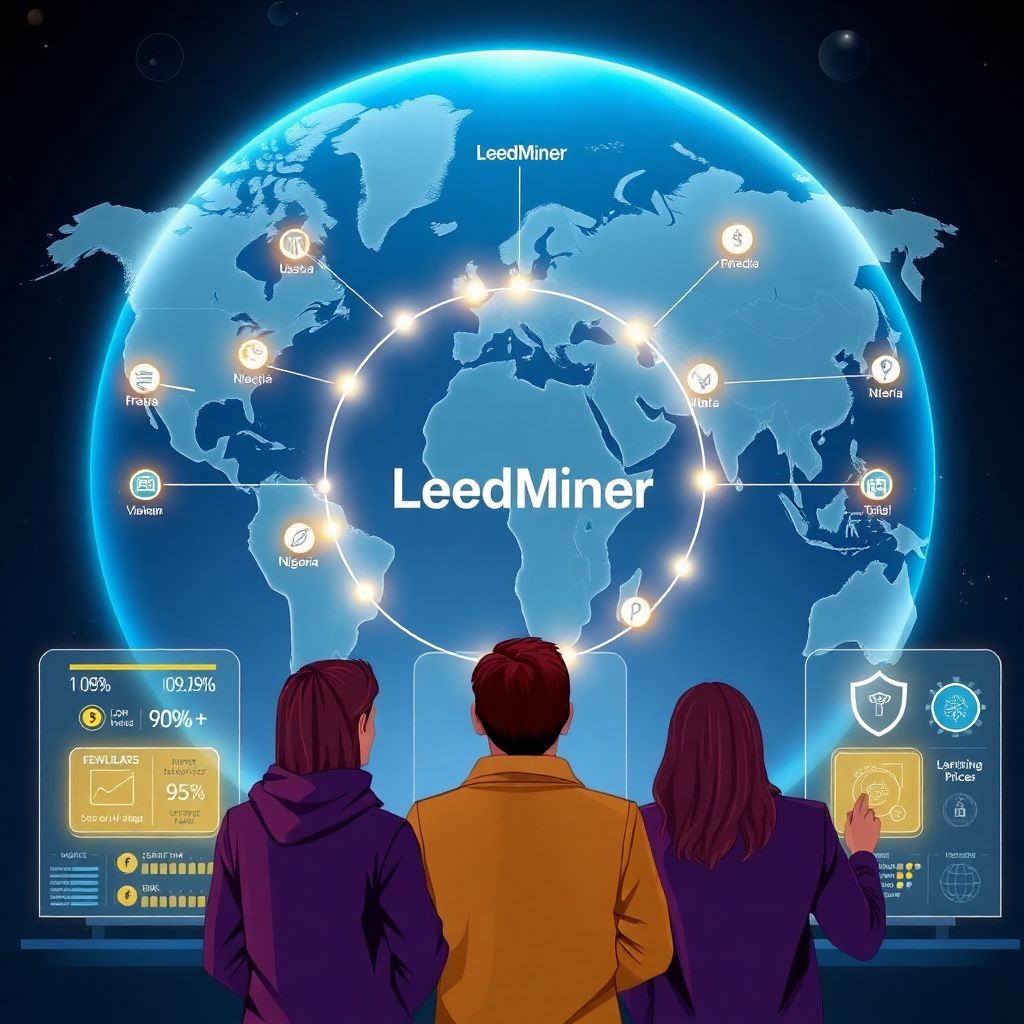
LeedMiner unveils a global hosting-match platform that links cryptocurrency miners with secure, cost-efficient, and fully compliant mining facilities around the world. By aggregating high-quality hosting resources and using an intelligent matching engine, LeedMiner helps miners of all sizes find locations with low power prices, reliable infrastructure, and stable regulations.
Why hosting has become critical for miners
The mining sector is entering a new phase of expansion. Institutional players are moving in: Eric Trump has joined forces with Hut 8 Corp. to launch “American Bitcoin,” while USDT issuer Tether has publicly stated its ambition to become the world’s largest Bitcoin mining company by the end of 2025. Established operators continue to scale, pushing global Bitcoin network hashrate into the zettahash (ZH) era.
For small and mid-sized miners, as well as individual participants, the economics are far more fragile. The single most important variable for return on investment is electricity cost. At the same time, the global race in artificial intelligence and the renewed rush into Bitcoin mining are straining power grids and driving energy prices up. Under these conditions, achieving a profitable payback period is increasingly difficult without access to cheap, stable power.
Hosting provides a way out: miners can deploy their hardware in regions with significantly lower electricity rates than those available locally, without having to build or manage their own sites.
The hidden complexity of self-built mining farms
Electricity is only the starting point. Running a mine involves a long list of capital expenditures and operational hurdles:
– Leasing or constructing appropriate industrial space
– Designing and implementing efficient cooling systems
– Installing and maintaining robust security and monitoring systems
– Managing local permits, licenses, and ongoing compliance checks
– Ensuring stable network connectivity and redundancy
On top of that, mining regulations vary drastically between jurisdictions. Some countries heavily tax mining, limit the import of ASICs, or suddenly reverse policy and ban mining outright. Because of these uncertainties, building a facility in the wrong location can quickly turn into a stranded, unprofitable investment.
For many newcomers and even seasoned operators, hosting has therefore become the preferred strategy to minimize operational, regulatory, and geopolitical risk.
Real-world pain points when choosing a hosting provider
Despite the clear advantages of hosting, miners face a maze of practical challenges when selecting a partner.
Trust and fraud risk
The first concern, particularly for beginners, is whether a hosting provider is legitimate. The market has seen numerous fraudulent sites: miners send funds, but machines are never energized, or worse, hardware disappears entirely. Verifying that a hosting company is real, solvent, and properly operating is far from trivial for someone sitting in another country.
Balancing cost with safety and stability
Even when a miner finds a seemingly trustworthy provider, the next question is where to host. The cheapest electricity is not always the smartest choice. Political risk, local crime, grid reliability, quality of infrastructure, climate, and rule-of-law all affect the long-term security of hardware and revenue.
Opaque pricing and hidden fees
Miners also worry about whether the advertised electricity price is truly all-in. Some providers add undisclosed charges for maintenance, cooling, networking, or “management” that quietly erode profitability.
Operational performance and uptime
A headline electricity rate is irrelevant if poor cooling or weak maintenance causes frequent downtime or reduced hashrate. Operators must ensure that facilities can sustain full-load operation, manage ambient heat and dust, and handle power fluctuations without constant interruptions.
Customs, import, and shipping hurdles
For miners in countries with strict regulations, high import duties, or outright mining restrictions, simply getting ASICs in and out of the country becomes a major obstacle. They need partners who can manage logistics, customs documentation, and tax issues, and in many cases, bypass the home country altogether by shipping directly to foreign hosting centers.
These intertwined issues create a high barrier to entry and make professional, curated hosting solutions especially valuable.
LeedMiner’s “Global Hosting Integration + Smart Matching” service
LeedMiner responds to these challenges with its “Global Hosting Integration + Smart Matching Service,” a platform specifically designed to simplify and de-risk the hosting decision for miners worldwide.
Instead of forcing miners to evaluate dozens of unknown providers alone, LeedMiner aggregates thoroughly vetted hosting facilities in multiple regions and uses a structured process to match clients with sites that best fit their budget, risk tolerance, regulatory needs, and expansion plans.
Key elements of this service include:
– A curated global network of verified hosting partners
– Transparent electricity pricing, typically in the range of $0.05–0.08 per kWh
– Facilities consistently delivering more than 95% miner uptime
– Capacity options ranging from under 10 machines to 3–5 MW and above
– Dedicated hosting consultants who provide end-to-end communication and ongoing reporting
By transforming a scattered, opaque market into an organized marketplace with checks and balances, LeedMiner aims to reduce friction and uncertainty for miners at every stage.
Deep roots in mining hardware and operations
LeedMiner has been active in the mining ecosystem since 2017 as an authorized distributor for major ASIC manufacturers. Over the years, the company has supplied mining hardware to almost 5,000 clients located in more than 100 countries.
This long-term exposure to miners’ day-to-day challenges revealed a consistent pattern: while many could afford machines, they struggled to find trustworthy, efficient, and compliant hosting. That insight pushed LeedMiner to expand beyond simple hardware sales into a full-stack hosting-matching service.
Over eight years, the team has built relationships with compliant facilities around the globe and conducted on-the-ground inspections in regions including the United States, Dubai, Vietnam, Nigeria, Norway, Finland, and Canada. During these visits, LeedMiner evaluates:
– Real-world electricity pricing and contractual stability
– Local climate and its impact on cooling efficiency
– Power infrastructure, including transformers and distribution systems
– Operational standards and staffing
– Regulatory environment and licensing status
The result is a refined pool of hosting partners that have passed both technical and compliance scrutiny.
Comprehensive facility verification and risk control
Every hosting center in LeedMiner’s network undergoes a multi-layer verification process before being recommended to clients.
Physical and remote audits
LeedMiner conducts on-site inspections wherever possible, supported by video audits to verify that the facility layout, capacity, and equipment match what is advertised. This includes checking rack conditions, airflow design, security measures, and the physical integrity of transformers and switchgear.
Technical performance tests
Facilities are evaluated under high-load operating conditions to ensure stable voltage, sufficient cooling, and reliable network performance. The goal is to confirm that miners can run at full hashrate for sustained periods without frequent thermal throttling or unplanned outages.
Compliance and energy sourcing checks
On the regulatory side, LeedMiner reviews licenses, power purchase agreements, and energy sourcing arrangements. Particular attention is paid to whether electricity comes from legitimate, contractually stable sources and whether the facility adheres to local regulations on data centers, energy usage, and, where applicable, cryptocurrency mining.
This structured vetting process is designed to mitigate the risks of fraud, abrupt shutdowns, or regulatory violations that could threaten miners’ capital.
Maintenance, monitoring, and equipment security
Hosting is not just about plugging machines in. How they are managed day-to-day has a major impact on long-term profitability.
Partner facilities working with LeedMiner provide:
– Regular dust cleaning and maintenance to prevent overheating and hardware degradation
– Real-time monitoring of hashrate, temperature, and power consumption
– Rapid troubleshooting for offline machines or unstable units
– Secure access control systems and on-site surveillance to protect against theft or tampering
LeedMiner’s dedicated hosting consultants keep miners informed with status updates and performance reports. This transparency allows clients to verify that their equipment is not only powered but also performing at or near its optimal efficiency.
Tailored solutions for restrictive or high-tax countries
For miners in jurisdictions that impose mining bans, strict import controls, or high duties on ASIC hardware, traditional importing is often uneconomical or impossible. To address this, LeedMiner offers a direct-to-hosting delivery model.
Under this approach, a miner can purchase hardware through LeedMiner and have it shipped directly to a selected overseas hosting facility, bypassing the need to bring devices into their home country. This can:
– Eliminate or significantly reduce import duties and logistics delays
– Lower the risk of customs confiscation or regulatory interference
– Simplify insurance and documentation, as equipment moves directly from vendor to data center
This model unlocks global-scale mining for individuals and firms who previously could not operate due to domestic regulatory barriers.
Why miners choose LeedMiner over going it alone
Several factors differentiate LeedMiner’s service in a crowded hosting market:
1. End-to-end expertise – Years as an authorized ASIC distributor and close interaction with thousands of clients give LeedMiner practical insight into both the technical and business aspects of mining.
2. Curated facilities, not open listings – Instead of a loose directory of providers, LeedMiner works with a restricted set of verified partners, reducing the chance that clients end up with unreliable operators.
3. Scale flexibility – Whether a miner runs a handful of units or a multi-megawatt farm, LeedMiner can propose suitable options and support future expansion planning.
4. Transparency and communication – Dedicated consultants, clear pricing, and ongoing reporting help miners understand their cost structures and operational status.
5. Global reach with local nuance – LeedMiner’s knowledge of regional regulations, climate, and infrastructure allows for nuanced recommendations rather than generic advice based solely on electricity price.
By handling the complex groundwork, LeedMiner allows miners to focus on strategy, hardware optimization, and financial planning instead of wrestling with logistics and regulatory surprises.
Strategic hosting selection in a changing energy landscape
As energy markets evolve under the combined pressure of AI compute demand, industrial electrification, and policy-driven changes, miners must think several steps ahead. A location that is cheap today might face grid constraints or unfavorable policy shifts tomorrow.
LeedMiner’s approach takes into account:
– Long-term power price trajectories in each region
– Government attitudes toward digital assets and energy-intensive industries
– Infrastructure investments that may improve or degrade grid stability
– Climate considerations, including baseline temperatures and seasonal extremes
This broader perspective helps miners avoid short-term decisions that might lead to forced relocation or prolonged downtime in the future.
Future vision: a standardized, transparent global hosting market
LeedMiner’s longer-term vision is to help bring more transparency and standardization to the global mining-hosting ecosystem. By continuously expanding its network of vetted partners, refining evaluation criteria, and integrating performance data over time, the company aims to make hosting selection resemble choosing from a set of audited, benchmarked infrastructure providers rather than taking a leap of faith.
In the coming years, miners can expect:
– More granular matching based on machine type, noise tolerance, and cooling preferences
– Enhanced performance analytics for comparing facilities on uptime, efficiency, and response times
– Wider availability of renewable and low-carbon hosting options as sustainability pressures increase
As institutional capital and regulatory scrutiny continue to intensify, the need for professional, compliant, and well-documented hosting solutions will only grow. LeedMiner positions itself as a bridge between miners seeking stable returns and the global infrastructure that can support them.
Important notice
Nothing in this article constitutes investment, financial, or legal advice. All information is provided for educational and informational purposes only. Cryptocurrency mining involves significant financial risk, including but not limited to market volatility, regulatory changes, and operational hazards. Each reader should conduct independent research and consult qualified professionals before making any mining or hosting decisions.