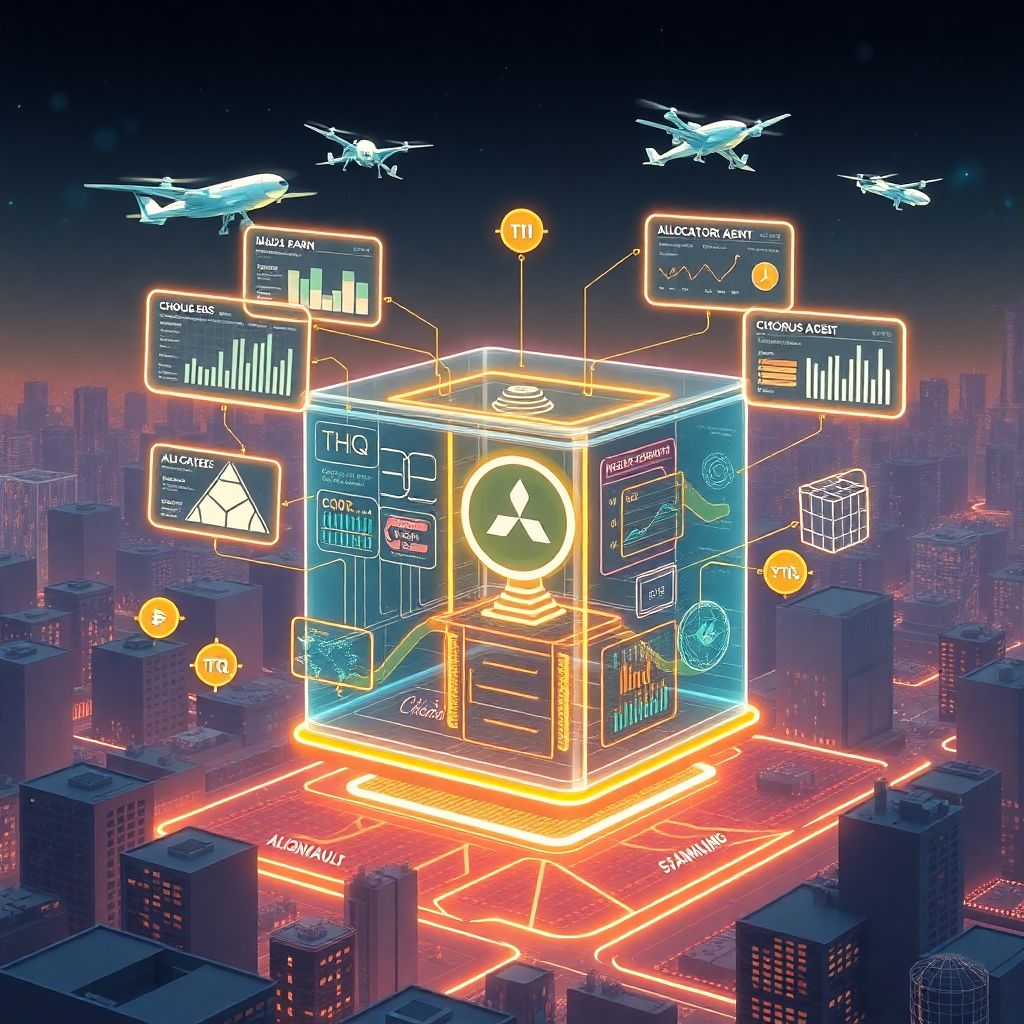
Interview | How Theoriq turns AI agents into accountable yield machines
Theoriq is attempting to solve one of DeFi’s oldest contradictions: so‑called “passive” income that, in practice, demands constant monitoring, complex strategy shifts, and a deep understanding of onchain risk.
Its answer is AlphaVault, a fully autonomous, AI‑powered DeFi vault that not only reallocates user capital across yield opportunities in real time, but also explains every move it makes. The goal is simple but ambitious: transform AI agents from opaque black boxes into transparent, accountable yield machines.
To accelerate adoption, Theoriq is launching a TVL Bootstrapping phase that rewards early depositors with points redeemable for the project’s native token, THQ. One percent of the total THQ supply is set aside for this phase, giving early participants a direct stake in the protocol’s long‑term evolution.
Behind this launch is an architecture that has already been battle‑tested in simulation: 2.1 million wallets, 65 million AI requests, and a multi‑agent system designed to withstand real‑world complexity without exposing users to uncontrolled AI behavior.
At the center of this system is the Allocator Agent, a specialized AI that dynamically routes capital between yield sources such as Lido Earn’s stRATEGY Vault and Chorus One’s MEV Max. Every action is constrained by strict onchain policy “cages,” which hard‑code risk parameters and prevent the AI from ever stepping outside predefined bounds.
We spoke with Pei Chen, Executive Director and COO of Theoriq, about how THQ is designed to align incentives, what “accountable AI” actually looks like in DeFi, and how AlphaVault aims to stand out in a rapidly crowding field of AI‑driven protocols.
—
How $THQ shapes agent behavior and accountability
Q: Can you elaborate on how the $THQ token will influence AI agent behavior and accountability?
Chen: The THQ token is the core economic primitive that governs how agents behave. We’re designing a three‑tiered token system that directly links an agent’s economic outcomes to its performance and reliability.
First, any agent that wants access to the protocol must stake sTHQ. This is the agent’s “skin in the game” and acts as collateral that can be affected if it violates core rules.
Second, agents can receive delegated αTHQ from users and community members. The amount of αTHQ an agent attracts determines both its operational capacity and its fee tier. In practice, higher delegation lets an agent manage more capital, execute more complex strategies, and potentially earn greater fees.
Third, agents are subject to slashing. If an agent misbehaves, consistently underperforms relative to benchmarks, or violates clearly specified policies, a portion of its staked tokens can be permanently burned. That isn’t just a reduction in yield – it is an irreversible financial penalty that tightens the link between behavior and consequences.
Better agents attract more αTHQ, gain access to more execution bandwidth and better economics. Poor agents lose delegation, face slashing, and see their economic footprint shrink. Over time, this creates a market‑driven reputation layer where capital naturally gravitates toward trusted agents with verifiable performance.
—
Guardrails against manipulation and abuse
Q: What measures are in place to prevent manipulation or abuse of the staking/slashing system for AI agents?
Chen: Delegation and slashing are not live yet – they’re planned for rollout next year – and we are taking our time to design these mechanisms carefully. The goal is to make slashing predictable, rules‑based, and resistant to both social attacks and coordinated manipulation.
One of the central design principles is risk isolation. Slashing is scoped to the specific αTHQ delegated to an individual agent. That means losses are not socialized across all token holders or all agents. If one agent fails, the damage is contained to its own delegation pool, which promotes more precise risk assessment by users.
We’re also building structural guardrails:
– Cooldowns: Delegations and undelegations may be subject to cooldown windows to reduce flash‑coordination and short‑term manipulation.
– Uptime and performance requirements: Agents will need to meet minimum availability and reliability thresholds. Failing these could trigger penalties or limit their ability to attract future delegation.
– Transparent rules: The conditions for slashing will be encoded and published ahead of time. Agents and delegators will know exactly what behaviors trigger penalties.
– Dispute processes: There will be mechanisms to challenge or review slashing events where ambiguity exists, with the aim of minimizing arbitrary or malicious triggers.
As we refine these details, we plan to expose the specification for review and stress‑testing. The purpose is to end up with a mechanism that is robust enough for adversarial environments but still fair and predictable for honest participants.
—
Evolving token utility as TVL and agent networks scale
Q: How do you see the token’s utility evolving as TVL grows and new agents are onboarded?
Chen: THQ’s utility is designed to be progressive. It starts with basic staking and protocol alignment and gradually expands into a full economic and governance layer that touches every part of the system.
As TVL grows, protocol‑level fees increase. These fees are a primary source of rewards for THQ stakers, so more assets in the system naturally deepen the yield that flows back to token holders.
At the same time, onboarding more agents intensifies competition for αTHQ delegation. Each agent needs delegated αTHQ to unlock better execution capacity and more favorable fee tiers. That creates structural demand for THQ, which is converted into its staked derivatives (sTHQ and αTHQ) for use in the system.
Over time, we plan several phases of utility expansion:
– Phase 1 – Baseline staking: Simple staking with fee‑sharing and alignment incentives.
– Phase 2 – Delegation and agent‑specific rewards: THQ stakers allocate αTHQ to specific agents and share in the fees those agents generate.
– Phase 3 – Onchain fee splitting: More granular routing of protocol fees, where different products and strategies can have distinct fee flows tied to performance.
– Phase 4 – Governance and policy: THQ becomes the backbone of parameter governance – such as risk limits, whitelisting of strategies, and adjustments to slashing rules.
As we expand into additional asset classes and build partnerships with external protocols, THQ will also sit at the center of multiple fee streams. That diversification is important – it reduces dependence on a single product, while reinforcing THQ’s role as the coordination and accountability layer of the entire ecosystem.
—
What makes AlphaVault different from other AI‑DeFi experiments?
Q: How do you see AlphaVault differentiating itself from other AI-driven DeFi platforms entering the space?
Chen: There are two main differentiators: architecture and execution.
Architecturally, AlphaVault is a “vault of vaults.” It doesn’t just deploy into a single yield source – it routes user capital across a curated set of underlying vaults and strategies. This meta‑layer is managed by the Allocator Agent, an autonomous system that makes allocation decisions based on a constant stream of data.
That data pipeline is powered by AlphaSwarm, our flagship multi‑agent infrastructure. Rather than a single monolithic AI model making all decisions, we rely on specialized agents that gather, clean, and interpret different types of information – from onchain metrics and liquidity conditions to yield opportunities and risk signals. The Allocator Agent sits on top of this swarm, synthesizes their outputs, and then executes precise onchain actions.
The second differentiator is infrastructure. We have invested heavily in the tooling required to bridge the gap between AI reasoning and secure onchain execution. It’s not enough for an agent to propose a smart strategy – it must be able to act within strict policy boundaries, in a gas‑efficient way, and with full transparency for users.
Scalability is built in via a modular design. New agents, new vaults, and even new blockchains can be integrated without redesigning the entire system. This modularity allows us to expand across variables – assets, yield partners, and networks – while keeping the core policy framework intact.
—
Measuring success: performance, risk, and transparency
Q: What metrics will you track to evaluate AlphaVault’s performance and the behavior of its AI agents?
Chen: We look at performance on three levels: financial outcomes, risk management, and behavioral integrity.
On the financial side, we track:
– Net yield versus benchmarks (e.g., ETH staking rates, simple LP strategies)
– Risk‑adjusted returns, not just raw APY
– Capital efficiency and utilization across integrated vaults
For risk management, key metrics include:
– Drawdown profiles during market stress
– Exposure limits per strategy, protocol, and asset
– Adherence to predefined risk limits enforced by onchain policy cages
Then there is behavioral integrity, which is particularly important for AI agents:
– Policy violation attempts, even if blocked
– Frequency and nature of agent proposals that get rejected by safety layers
– Uptime, responsiveness, and robustness across different market regimes
We also place a strong emphasis on explainability. The system is designed to surface human‑readable rationales for allocation decisions: why capital moved, what risks were considered, and which data informed the change. Over time, we plan to formalize these explanations as part of the metrics stack, so users can evaluate not only outcomes but also the quality of decision‑making itself.
—
Turning “autonomous” into “trustworthy”
Alpha‑chasing automation has been attempted before in DeFi, but most AI‑driven experiments failed to gain lasting trust. Either they behaved like opaque black boxes, or they couldn’t handle live market complexity without manual overrides.
Theoriq’s approach is to treat autonomy and accountability as inseparable. Agents have freedom to optimize within well‑defined constraints, but that freedom is:
– Economically bounded by staking and slashing
– Technically bounded by onchain policy cages
– Socially bounded by delegation patterns and reputation
This tri‑layered structure reduces reliance on blind trust. Users don’t need to believe in a particular model or team; they can instead rely on verifiable rules, observable track records, and hard‑coded limits.
—
From “set and forget” to “set, verify, and understand”
One of the most practical implications for users is the shift in how “passive” income really works.
Traditional DeFi “set and forget” strategies often break down when conditions change: yields migrate, incentives expire, and new risks emerge. Keeping up requires hours of monitoring and constant portfolio surgery.
AlphaVault aims to compress that operational burden into an autonomous layer, but without hiding the complexity. Users can deposit once and let the Allocator Agent manage rebalancing, but they retain:
– Full visibility into where their assets are deployed
– Real‑time insights into why strategies change
– Clear risk parameters that are enforced by code
For more advanced users, this architecture can become a powerful tool: they can evaluate and delegate to specific agents, optimize their exposure across different strategies, and participate directly in shaping policy through THQ.
—
The road to mainstream adoption
For AI‑managed finance to move beyond early adopters, user experience has to be as important as yield optimization. That means:
– Simple onboarding flows that abstract away most of the technical underpinnings
– Clear, non‑technical explanations of what the vault is doing and what risks exist
– Predictable fee structures that don’t require a deep understanding of tokenomics
Projects like AlphaVault are also launching into a more mature regulatory environment. While Theoriq’s agents operate permissionlessly at the protocol level, the team is conscious of the need to design with compliance in mind: transparent reporting, auditable logic, and controls that prevent agents from venturing into obviously non‑compliant behaviors in certain jurisdictions.
If this balance is achieved, AI‑driven vaults could serve as an accessible entry point for users who find DeFi’s strategy complexity overwhelming but still want onchain yield without surrendering custody.
—
Beyond yield: a broader AI financial stack
Although AlphaVault is framed around yield, the underlying architecture is broader. The same multi‑agent, policy‑caged approach could extend to:
– Structured products that automatically adapt to volatility regimes
– Dynamic hedging strategies that mitigate downside risk
– Cross‑chain liquidity routing and arbitrage within preset risk budgets
– Institutional‑grade mandates, where the “investment policy statement” is encoded directly into the agents’ allowed action space
In that sense, THQ and the agent network function as an operating system for autonomous financial services. Yield aggregation is the first expression of this stack because it’s a clear, high‑demand use case; but the long‑term vision is a full spectrum of AI‑managed products, each governed by transparent constraints and reputation‑driven incentives.
—
Why accountable AI could finally deliver on DeFi’s promise
DeFi promised democratized access to complex financial strategies, but the reality has often been the opposite: sophisticated tools for a small subset of technically fluent users, and confusing risk for everyone else.
By binding AI agents to economic stakes, explicit rules, and open‑source behavior metrics, Theoriq is trying to flip that script. AlphaVault is an experiment in whether automation can coexist with transparency – and whether yield‑seeking AI can be held to standards that are legible to the humans whose capital it manages.
If that experiment succeeds, it won’t just mean better vaults. It would mark a step toward a financial landscape where users can rely on autonomous systems not because they are magical, but because they are accountable, explainable, and shaped by the very people whose value they are entrusted to grow.