Historical context: from fixed income to staking mania
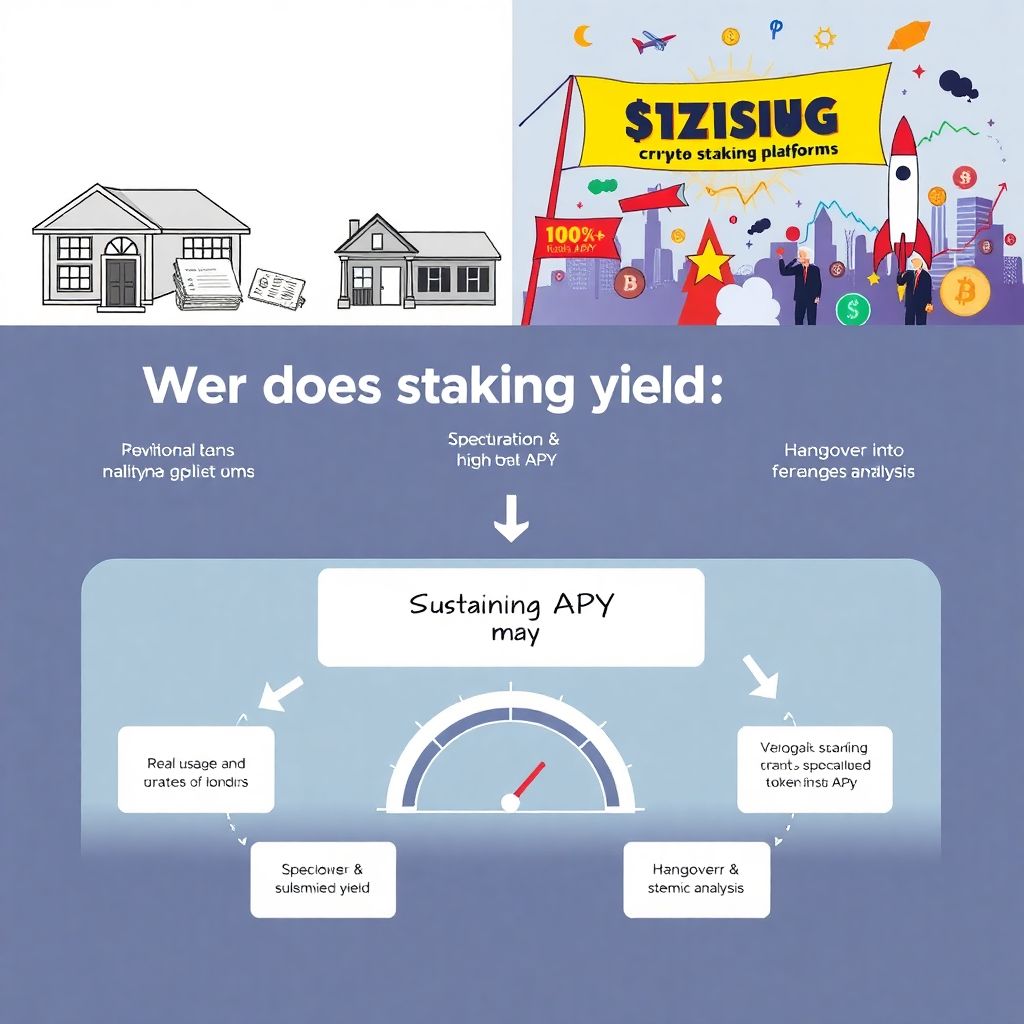
In traditional finance, yield came from fairly transparent sources: coupons on bonds, dividends on equities, or money‑market rates, all anchored to identifiable cash flows and risk models. Crypto staking turned that on its head by mixing protocol‑level inflation, transaction fees and sometimes opaque tokenomics into something marketed as “passive income.” Early PoS networks like Peercoin and Nxt paid modest, bond‑like returns. Then DeFi summer and the race for “liquidity” pushed platforms to advertise triple‑digit APY, often subsidised by freshly minted tokens with no long‑term demand. A lot of “best crypto staking platforms high apy” banners in 2020–2022 were effectively short‑term marketing budgets disguised as yield, which is why evaluating staking returns now requires more forensic thinking than just reading the APY label on a dashboard.
Short version of that history: yields used to be tied mostly to real usage, then speculation took over and APYs exploded, and now we’re in a hangover phase where you have to separate genuine protocol economics from temporary bribes. If you don’t, you’re not “investing,” you’re farming other people’s exit liquidity without knowing it.
Core principles: where does the staking yield actually come from?
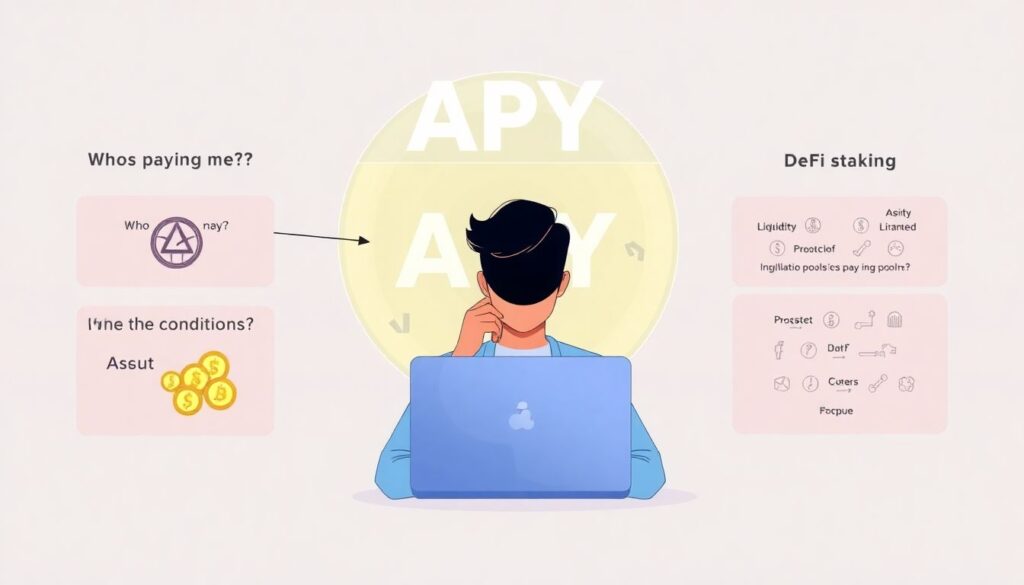
When you look at a staking offer, ignore the APY number for a moment and ask three questions: who is paying me, with what asset, and under what conditions? For base‑layer staking, the payer is usually the protocol itself via inflation plus users via transaction fees. For DeFi staking, it can be a mix of protocol inflation, trading fees, borrowing interest or even external incentive programs. To find the safest crypto staking with sustainable yields, you want rewards dominated by organic fees and moderate, predictable inflation, not by huge subsidy programs that end on a specific date. A healthy design looks boring: single‑digit or low double‑digit APY, clearly documented emissions schedule, and no “magic” sources of extra yield that can’t be traced to either usage or a transparent balance sheet.
The lazy rule “higher APY = better” is exactly what gets people wrecked. In a sane market, yield roughly tracks risk and the cost of capital; if something offers multiples of the prevailing rate with no additional, clearly explained risk, the missing risk is usually hidden in smart‑contract complexity, governance centralisation or illiquidity that only shows up in a crisis.
Practical framework: how to sanity‑check staking offers
Instead of blindly trusting dashboards, treat every new staking opportunity like an on‑chain credit analysis. First, decompose the APY: protocol inflation, fee share, external incentives, leverage or rehypothecation. If the project doesn’t break this down, that’s a red flag by itself. Second, look at sustainability under stress: simulate what happens to yield if token price falls 50%, on‑chain volume halves, or incentives end. Tools that look like a “crypto staking rewards calculator realistic returns” are useful only if they let you input pessimistic assumptions, not just extrapolate last week’s bull‑market data. Third, examine dilution: high nominal APY from heavy inflation can leave you with a bigger slice of a rapidly debasing pie. The real metric is your share of network ownership and your return in a hard‑currency benchmark like USD or BTC over a full cycle, not just 30‑day APY screenshots.
One useful hack: invert the problem and ask, “Who is funding my yield and why are they okay with that?” If the only honest answer is “future speculators,” you’re looking at a bubble, not a business.
Choosing assets: reliability over hype
If you’re wondering how to choose reliable staking coins for passive income, start with base‑layer protocols that already clear significant daily transaction value and have been battle‑tested across multiple market cycles. Prioritise assets with: stable or decreasing inflation schedules, credible decentralisation of validators, and clear economic roles for the token beyond speculation (gas, collateral, governance with teeth). Cross‑check staking ratio (percentage of supply staked), average validator commission, and historical slashing events. High staking ratio with low real usage often means rewards are mostly inflation, while low ratio with high fees can actually be healthier. Your goal is not the loudest community but a token whose demand is tied to real utility and whose supply growth you understand line by line from the docs and the code.
A quick heuristic: if you can’t explain in two sentences why the token should accrue value from actual network activity, you don’t own an asset; you’re holding a coupon for future marketing campaigns.
Implementation examples: from ultra‑conservative to experimental
Let’s sketch three distinct setups. First, the “bond proxy”: stake a major PoS asset through a reputable non‑custodial provider, keep self‑custody of keys, use no leverage, and auto‑restake. This is one of the purest low risk crypto staking strategies for stable income; yields won’t impress your friends, but they tend to survive bear markets. Second, the “fee farmer”: provide liquidity or secure an app‑chain where the majority of rewards comes from transaction or trading fees; here you actively monitor volume and can exit if fees collapse or incentives become the main driver. Third, the “structured degen”: build a barbelled portfolio where a fixed percentage (say 70–80%) sits in conservative staking, while a capped slice experiments with higher‑yield DeFi strategies behind strict risk limits. You treat that slice like R&D spend, not rent money, and predefine loss thresholds and time horizons.
The non‑obvious move is to keep an explicit “shutdown script” for each strategy: clear conditions under which you will unwind a position, regardless of emotions or community narratives.
Hidden assumptions in calculators and dashboards

Most staking interfaces and portfolio tools quietly assume things will stay roughly as they are today: token price stable or rising, network usage flat or up, no slashing, no smart‑contract exploits. That’s why blindly trusting any crypto staking rewards calculator realistic returns interface is dangerous; it’s only as honest as its input assumptions. Dig into the documentation: does it factor in validator downtime risk, variable commissions, dynamic inflation curves, or potential protocol governance changes? Does it model compounding realistically with claim fees and gas costs, or does it assume frictionless reinvestment? If a tool can’t handle negative scenarios, replicate them yourself with a spreadsheet and stress‑test: slash the APY in half, cut the token price in half, add a delay to withdrawals, then check if the strategy still fits your risk profile and liquidity needs.
The actionable mindset: treat UI numbers as marketing, and your own, manually stressed figures as reality.
Frequent myths and how to dismantle them
A common misconception is that “staking = guaranteed interest like a savings account.” In reality, you’re taking protocol risk, governance risk, and often counterparty risk when using centralized platforms, even if they advertise themselves as the safest crypto staking with sustainable yields. Another myth: “non‑custodial staking is always safe.” Poor validator choices, abusive commission structures, or concentrated stake with a few operators can all erode returns or increase the probability of slashing. People also confuse liquidity: liquid staking tokens feel like cash because they trade on DEXes, but during market stress, discounts to underlying value can spike, effectively turning a supposedly safe staking position into a leveraged directional bet on both protocol and liquidity conditions.
The quickest myth test: ask what has to go wrong for you to lose 50%. If nobody can give a concrete pathway, you haven’t found safety; you’ve found ignorance.
Non‑obvious tactics to avoid unsustainable APYs
Here are a few unconventional but very practical habits. First, benchmark against “risk‑free” on‑chain yields: native staking on blue‑chip PoS chains or reputable money‑market protocols. Anything paying more than, say, 3–5x that baseline demands a written explanation you can show to a skeptical friend. Second, time‑diversify entries: instead of locking a full amount into a shiny new pool on day one, average into the position over several weeks and watch how APY behaves as incentives decay and early speculators leave. Third, design your personal “platform risk budget”: cap how much of your portfolio can sit on a single service, even if it’s listed among the best crypto staking platforms high apy, because concentration risk can wipe you out even when APY math looks correct. Finally, keep one cold, boring, never‑touched core position whose only job is to survive; use that to resist the urge to chase every new yield fad.
The counter‑intuitive edge is boredom: sustainable staking usually feels slow and uneventful, while unsustainable APYs tend to come wrapped in urgency, novelty and social pressure.