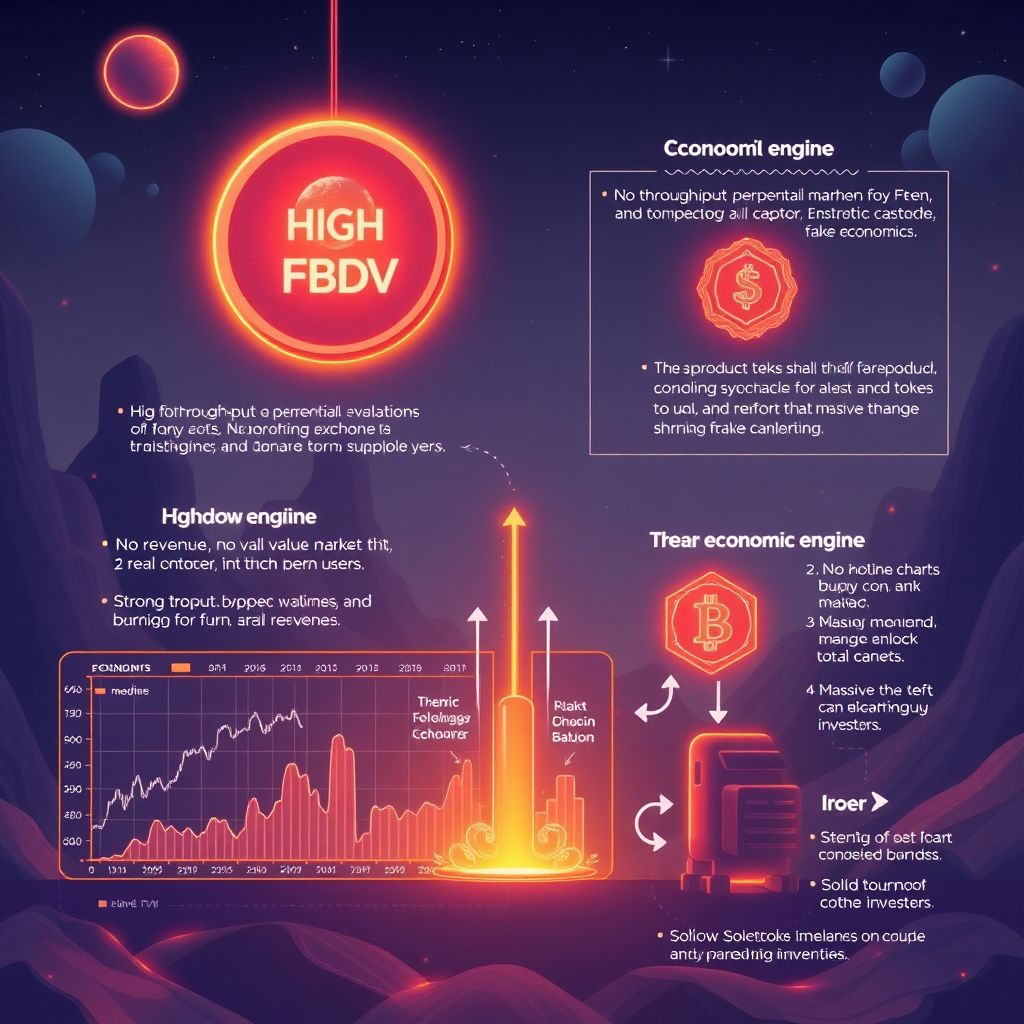
Don’t fear high FDV: without real revenue, every token model is hollow
High fully diluted valuations (FDV) terrify a lot of crypto investors — often for good reason. A token launches, only a tiny fraction of the supply actually trades, yet the market assigns it a multibillion-dollar FDV based on all future tokens that will one day unlock. To anyone watching the chart, that looks like a ticking time bomb: a massive wave of supply hanging over the market, waiting to crush price as it drips into circulation.
The instinctive reaction is: “The FDV is the problem.” But in many cases, the FDV is just a symptom. The real disease is an economic design that isn’t backed by a product generating durable, predictable cash flows.
High valuations are not inherently broken. What’s broken is launching a high FDV token with no credible plan to translate protocol success into tokenholder value. When there’s no real revenue, no value capture, and no mechanism to neutralize future supply, FDV is simply a number attached to an empty shell.
A different approach is starting to stand out — one where a high FDV is not a red flag, but a feature of a deliberate, revenue-first design. This emerging model rests on three non‑negotiable pillars:
1. A real, working product with strong product-market fit and sustained user demand.
2. Robust, on-chain, real revenue (fees, spreads, or other cash flows) that scale with usage.
3. A transparent value-capture mechanism — typically a buyback-and-burn engine or its equivalent — directly linking protocol performance to token value.
When these three components operate together, the structural fears around FDV shift. The token is no longer a claim on uncertain, abstract future expectations. It becomes tied to a functioning economic engine that can systematically absorb supply, reduce dilution, and reward long-term participants.
Hyperliquid as a proof of concept
Hyperliquid is one of the clearest examples of this blueprint in action. From day one, its token carried a high implied valuation. Under the old mental framework, that would be a warning sign: “Too expensive, too early, too much supply to come.”
But the context mattered. Hyperliquid did not launch a token first and look for a business model later. It built a high-throughput perpetuals exchange that was already processing significant volume and generating substantial real-time fees before and at launch.
This changes everything. High FDV in that setting wasn’t purely an act of speculative faith. It reflected the observable velocity of the underlying business: trades executed, fees collected, users retained. The market wasn’t just pricing in a dream; it was pricing in a functioning machine.
Because the protocol already had strong revenue, it could immediately route part of those cash flows into a buyback mechanism. That internal engine — not narrative alone — gave the token a path to long-term sustainability. The large future supply overhang didn’t vanish, but it gained a credible counterweight: a continuous, programmatic buyer funded by actual economic activity.
In other words, it wasn’t the FDV that made the token safe or unsafe. It was the presence of a robust revenue stream and a clear system to channel that revenue back to tokenholders.
Buyback and burn: a standing pact with the community
At the core of this model is the buyback-and-burn (or equivalent) design. It is more than a tokenomics trick; it is a public, on-chain covenant that says: “If the protocol thrives, tokenholders will see direct, verifiable value accrual.”
Here’s how the engine operates in its strongest form:
1. Buyback: perpetual buy-side demand
A defined portion of the protocol’s real revenue — often denominated in stablecoins or major assets like ETH — is reserved for purchasing its own token on the open market. Crucially, this is not a sporadic marketing stunt. It is systematic, transparent, and ideally automated.
This constant buy-side presence acts as a structural source of demand. Every unit of protocol activity that generates fees can, in part, translate into proportional buy pressure. For tokenholders, this means that as usage grows, so does the strength of this invisible buyer supporting the market.
2. Burn: hard-coded scarcity
The purchased tokens are then sent to an irrecoverable address and effectively destroyed. They are removed from the circulating and total supply forever.
Each burn is a permanent reduction in the number of claims on the protocol. Over time, as more tokens are removed from circulation, every remaining unit represents a larger fraction of the network. Holders who don’t sell watch their ownership share of the ecosystem creep upward as the denominator shrinks.
The combined effect is powerful: growing protocol revenue fuels continuous buybacks, while every buyback event tightens supply. Instead of dilution being a one-way street — with emissions and unlocks relentlessly flooding the market — the protocol introduces a countercurrent that can offset or even overtake that flow.
For the community, this model is intuitive and emotionally legible. People can see that the more they use the product, the more value is recycled back into the token they hold. The interests of users, builders, investors, and long-term supporters begin to align around the same engine: revenue.
The airdrop: why share a “high FDV” asset?
The final piece is the airdrop — often the most controversial element in a high-FDV launch.
Skeptics ask: “If the token is already valued so highly, why give away a large part of the supply? Isn’t this setting up recipients to be exit liquidity once vesting kicks in? Why should newcomers care about owning a small slice of something that already looks ‘fully priced’?”
Under the legacy model, those concerns are justified. Many tokens with lofty FDV and tepid revenue simply airdrop to create hype and distribute short-term rewards, not to build an aligned, long-term stakeholder base. Once the excitement fades, there is nothing substantial to support price, and the selling pressure from recipients can overwhelm a weak market.
In a revenue-first, buyback-driven framework, the logic flips:
– The airdrop is not just a marketing event; it’s a way to seed ownership among actual or potential users whose actions directly influence protocol revenue.
– Recipients are not merely being handed a speculative instrument. They are being invited into a system where their activity — trading, staking, referring, building — strengthens the same revenue engine that buys back and burns the token they hold.
– Even if the FDV is already high, the upside no longer depends solely on “multiple expansion” or a greater-fool dynamic. It comes from growth in real usage, higher fee generation, and an increasingly scarce supply base.
In this context, a high-FDV airdrop is less about dumping tokens into the market and more about extending the protocol’s economic engine to a broader group of aligned stakeholders.
Why high FDV feels scary — and when that fear is justified
Investors instinctively worry about high FDV for several reasons:
– Tiny float, massive unlocks: Only a small percentage of the supply trades, while the majority is locked for teams, investors, or future incentives, creating looming sell pressure.
– No proven product: The token’s value is based on roadmaps and narratives rather than a live, revenue-producing system.
– Weak or absent value capture: Even if the protocol succeeds in attracting users, there is no clear link between that success and tokenholder benefit.
In such a setup, fear is rational. You’re effectively holding a claim on future tokens and future adoption, with no hard evidence that either will be managed responsibly or monetized effectively.
But if you reverse those conditions — strong product-market fit, visible revenue, and a rigorous buyback or fee-sharing architecture — then FDV becomes a function of discounted future cash flows, not pure storytelling. At that point, the core question is not “Is the FDV high?” but “Is the economic engine robust and transparent enough to sustain and justify it?”
The discipline real revenue imposes
A revenue-centric design also disciplines teams and investors. Hype can push prices temporarily, but only real, recurring income can sustain buybacks or other reward mechanisms over the long term. That has several knock-on effects:
– Teams are incentivized to ship features that drive usage and fees, not purely cosmetic updates that look good in slide decks.
– Large stakeholders have a direct stake in long-term health rather than quick unlock-driven exits, because the greatest value accrues when revenue compounds over time.
– Tokenomics discussion shifts from “How do we maximize launch price?” to “How do we maximize lifetime cash flows and align them with holders?”
In other words, the need to generate and share real revenue crowds out short-termism and shallow token games.
Not all buybacks are created equal
It’s important to note that “buyback and burn” is not a magic incantation. Its effectiveness depends on:
– Source of funds: Buybacks must be funded by genuine protocol revenue, not by recycling treasury tokens or inflating supply under another name.
– Predictability: Clear, stable rules — for example, a fixed percentage of fees used for buybacks — build trust and reduce uncertainty.
– Transparency: On-chain execution and open reporting let market participants verify that the system works as advertised.
A buyback that is discretionary, opaque, or funded by unsustainable sources doesn’t solve the structural problem; it only masks it temporarily. The point is not to copy the label, but to implement the substance: tying real income to real, provable reduction in supply or real, provable distribution to stakeholders.
Alternative value-capture models
While buyback-and-burn is the cleanest expression of this philosophy, it isn’t the only one. Other viable structures include:
– Fee sharing or dividends: A portion of protocol revenue is periodically distributed to stakers or locked tokenholders.
– Staking incentives funded by fees: Rewards for securing or governing the network are drawn from earned revenue rather than pure inflation.
– Treasury growth and strategic reinvestment: Fees accumulate in a treasury that is transparently deployed to enhance long-term protocol value, indirectly benefiting holders.
What unites these approaches is not the exact mechanic, but the principle: value generated by the protocol flows back, in a measurable way, to those who hold and support the token.
Designing launches around economic reality, not optics
For teams planning a launch, the lesson is stark: FDV debates often distract from the real work. The primary questions should be:
– Is there a compelling, validated product with real users?
– How does every unit of usage translate into revenue?
– How does that revenue reach tokenholders — via buybacks, burns, dividends, or another clearly defined channel?
– How do unlock schedules and emissions align with the pace at which the revenue engine can absorb supply?
If those answers are solid, a high FDV can be defensible, even healthy. It can reflect market confidence in a cash-flow-generating asset rather than ungrounded speculation. If those answers are weak or missing, even a “low” FDV can be dangerous, because there is no foundation beneath the number.
For investors: what to look for beyond the headline FDV
For market participants evaluating new tokens, the checklist should shift from “Is the FDV scary?” to more nuanced questions:
– Does the protocol already generate meaningful, on-chain revenue?
– Is there a credible path for that revenue to grow with user adoption?
– Is there a transparent, enforceable value-capture mechanism?
– Are buybacks or distributions funded by real economics, not by hype or dilution?
– Do unlock schedules respect the pace at which real revenue can offset new supply?
When you find projects where those boxes are ticked, a high FDV can sometimes be not a trap, but a signal of strong underlying fundamentals priced in early.
The real risk isn’t high FDV — it’s fake economics
Fear of FDV is understandable, but it can be misleading. Valuation multiples come and go; what endures is whether a protocol generates sustainable cash flows and whether those cash flows are structurally wired to benefit the token.
Without that, even the most modest FDV is balancing on narrative alone. With it, high FDV can be the early market expression of something that actually deserves to be large: a durable, revenue-generating network that treats its token not as a marketing coupon, but as a genuine economic stake.
In that world, the right thing to fear isn’t a big number on a dashboard. It’s a token with no product, no revenue, and no hard-coded way to make success flow back to the people who believe in it.