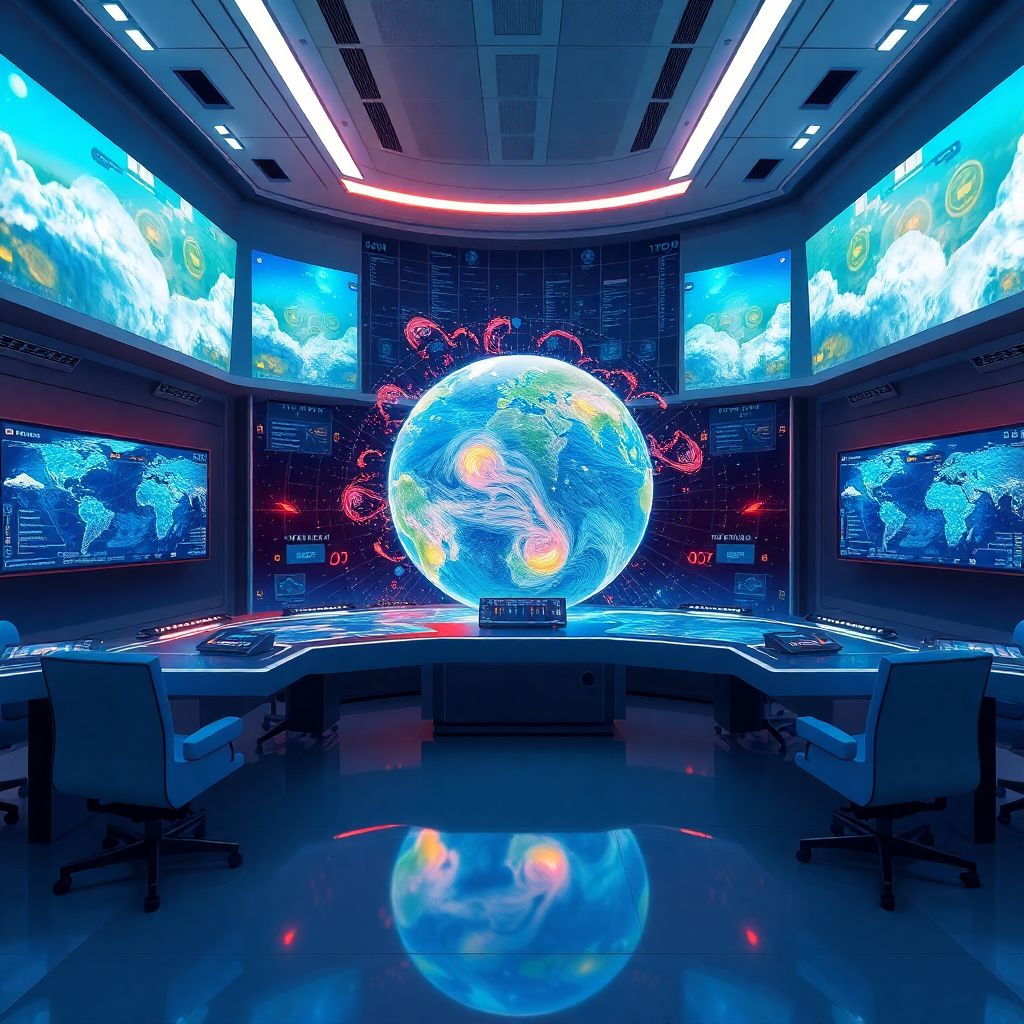
Google has unveiled an advanced version of its AI-powered weather forecasting system, WeatherNext 2, promising significantly faster and more precise weather predictions. Developed by DeepMind, a subsidiary of Google, this cutting-edge model is now integrated into several Google platforms, including Search, Gemini, Pixel’s Weather app, and Google Maps, expanding the reach and functionality of weather forecasting for users worldwide.
WeatherNext 2 represents a major leap forward in meteorological modeling. Unlike traditional weather models that rely on complex physical simulations and often require hours of supercomputing resources, this AI-driven system can produce global weather predictions up to eight times faster. It achieves this by leveraging Google’s custom-built Tensor Processing Units (TPUs), which allow it to simulate hundreds of potential weather scenarios within mere seconds, all from a single initial data point.
The model doesn’t just offer speed — it’s also impressively accurate. DeepMind reports that WeatherNext 2 consistently outperforms conventional forecasting models, especially in predicting short-term weather patterns and severe weather events such as storms and cyclones. This is particularly crucial in today’s era of climate volatility, where rapid and reliable information can save lives and mitigate damage.
One of the standout capabilities of WeatherNext 2 is its performance in cyclone prediction. Traditional models often struggle with the chaotic nature of cyclones, but the AI model’s probabilistic approach — generating multiple possible outcomes — allows it to better anticipate storm paths, intensity, and development. This capability is especially valuable for disaster preparation and response efforts, giving agencies more time to act and improving the accuracy of early warning systems.
WeatherNext 2 is also designed to be accessible and scalable. Because it requires less computational power than older models, it can be deployed more widely, including in regions with limited access to high-end infrastructure. This democratization of advanced weather forecasting could be a game-changer for developing countries that are often disproportionately affected by climate-related disasters.
The integration of WeatherNext 2 into Google’s ecosystem is already enhancing user experience. For example, when someone checks the weather on their Pixel phone or asks Gemini (Google’s AI chatbot) about tomorrow’s forecast, the response is now backed by WeatherNext 2’s sophisticated modeling. On Google Maps, users can see more dynamic and accurate weather overlays, helping them make informed travel decisions in real time.
But the benefits of this technology extend beyond convenience. With the increasing frequency of extreme weather events — from wildfires and floods to heatwaves and hurricanes — the need for faster and more precise forecasts has never been greater. WeatherNext 2’s approach, grounded in deep learning and neural networks, represents a necessary evolution in how we respond to environmental challenges.
Moreover, this AI model supports ensemble forecasting, a method in which multiple models are run simultaneously to assess the range of possible outcomes. By embracing this approach, WeatherNext 2 not only provides a single forecast but also offers insight into the likelihood of various weather scenarios. This is particularly helpful for sectors like agriculture, aviation, and emergency management, where understanding uncertainty is just as important as the forecast itself.
As climate change continues to alter historical weather patterns, AI models like WeatherNext 2 could become central to global adaptation strategies. Their ability to analyze vast amounts of data and deliver rapid, high-resolution forecasts makes them ideal tools for anticipating climate-related risks. For instance, early warnings of droughts or heatwaves can help communities prepare, manage water resources, and avoid crop failure.
In addition, the use of AI in meteorology opens up possibilities for real-time, hyperlocal forecasting. Future iterations of WeatherNext may be able to deliver street-by-street predictions, tailored to the user’s exact location and needs. This level of granularity would be transformative for urban planning, outdoor events, and even daily commuting.
Google’s announcement also signals a broader shift in the tech industry’s role in addressing environmental issues. By investing in AI technologies that enhance public safety and climate resilience, companies like Google are not only demonstrating innovation but also contributing to global sustainability goals.
Looking ahead, continued collaboration between tech firms, meteorological agencies, and governments will be essential to ensure that AI-powered forecasting models are accurate, transparent, and ethical. Questions around data privacy, model bias, and equitable access must be addressed to maximize the societal benefits of systems like WeatherNext 2.
As AI continues to evolve, its application in weather prediction may soon extend beyond Earth. Researchers are already exploring how similar models could be used to simulate atmospheric conditions on other planets, potentially aiding future space exploration missions.
In sum, Google’s WeatherNext 2 marks a significant milestone in the intersection of artificial intelligence and climate technology. By delivering faster, smarter, and more accessible forecasts, it stands to redefine how societies prepare for and respond to the increasingly unpredictable forces of nature.