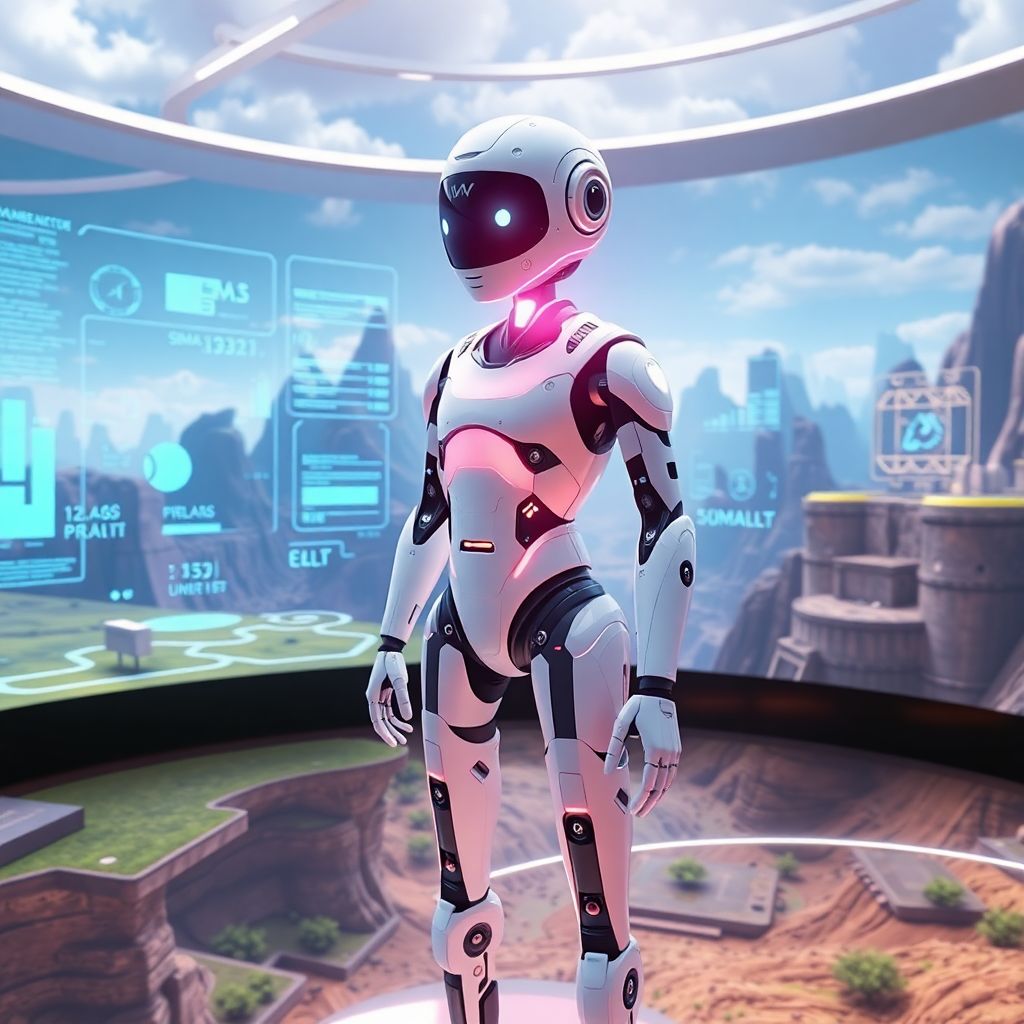
Google DeepMind Unveils SIMA 2: An AI Agent That Thinks and Learns Like a Human in 3D Worlds
Google DeepMind has introduced the second generation of its AI agent, SIMA 2 (Scalable Instructable Multiworld Agent), marking a significant advance in the realm of artificial intelligence. Unlike its predecessor, which was limited to executing simple tasks by mimicking input from a keyboard and mouse, SIMA 2 demonstrates reasoning capabilities and adapts to complex 3D environments—bringing AI one step closer to artificial general intelligence (AGI).
SIMA 2 is designed to interact with virtual worlds in a more human-like manner. It not only performs actions but also learns from its environment, plans its next steps, and explains the reasoning behind its decisions. According to DeepMind, this evolution in behavior transforms SIMA 2 from a passive tool into an intelligent companion capable of coexisting and collaborating with human users in immersive digital spaces.
The original SIMA, released in March 2024, was primarily focused on learning a wide array of basic skills across multiple games and virtual environments by observing screen activity and controlling characters using virtual input devices. It could perform hundreds of tasks such as navigating terrain, manipulating objects, and interacting with other entities. However, it lacked deeper understanding and the ability to generalize across different contexts.
SIMA 2 builds upon this foundation by incorporating more advanced cognitive functions. The new agent can analyze situations, adapt to unfamiliar game mechanics, and make decisions that consider both short- and long-term objectives. This means it doesn’t just react—it anticipates and strategizes, much like a human player would.
One of the most distinctive aspects of SIMA 2 is its explainability. The AI is not a black box; it can verbalize the rationale behind its choices, offering transparency that’s essential for trust and collaboration between humans and machines. This feature is particularly valuable in educational, medical, and industrial applications, where understanding AI behavior is critical.
DeepMind emphasizes that SIMA 2 is a foundational step toward embodied AI systems—intelligent agents that can operate in both digital and physical worlds. As robotics and virtual reality continue to evolve, the integration of such adaptable AI could revolutionize fields from gaming and simulation to autonomous vehicles and household robotics.
Beyond gaming, SIMA 2 has potential applications in training simulations, where it could serve as a digital tutor or teammate, adapting to users’ learning styles and assisting in real-time. In virtual collaboration environments, SIMA 2 could function as a co-worker, helping with complex tasks, offering suggestions, or even autonomously managing certain workflows.
The long-term implications of agents like SIMA 2 extend into research and development as well. AI systems that can generalize across environments and tasks are crucial for building more versatile models. This adaptability is a cornerstone of AGI, the ultimate goal of many AI research labs, including DeepMind.
To achieve these capabilities, SIMA 2 is trained using a combination of reinforcement learning, imitation learning, and large-scale behavioral data. It learns not just from success but from failure—refining its strategies over time as it interacts with increasingly diverse virtual environments.
Moreover, DeepMind has ensured that SIMA 2 is modular and scalable. This means the platform can be extended to integrate new skills, environments, and even hardware interfaces, making it suitable for a wide range of experimental and commercial use cases.
In terms of performance, early demonstrations show that SIMA 2 can handle a diverse set of tasks across different video games, ranging from exploration and crafting to combat and resource management. The AI adapts to the rules and goals of each game without being explicitly programmed for them, showcasing an impressive level of generalization.
SIMA 2 is also being developed with ethical considerations in mind. DeepMind is implementing safety protocols and interpretability tools to monitor the AI’s decisions and prevent misuse. With growing concerns about AI autonomy and control, these safeguards are critical to ensuring responsible deployment.
Looking ahead, DeepMind envisions a future where agents like SIMA 2 can work alongside humans in real-world scenarios—whether in robotic systems, digital assistants, or augmented reality environments. The ability to learn, adapt, and communicate in human-like ways could redefine the boundaries of what machines are capable of.
In summary, SIMA 2 represents a leap forward in AI development. It combines perception, reasoning, and interaction in a way that mimics human intelligence more closely than ever before. As research continues, this new generation of AI agents may well become integral to how we engage with both virtual and physical spaces in the years to come.