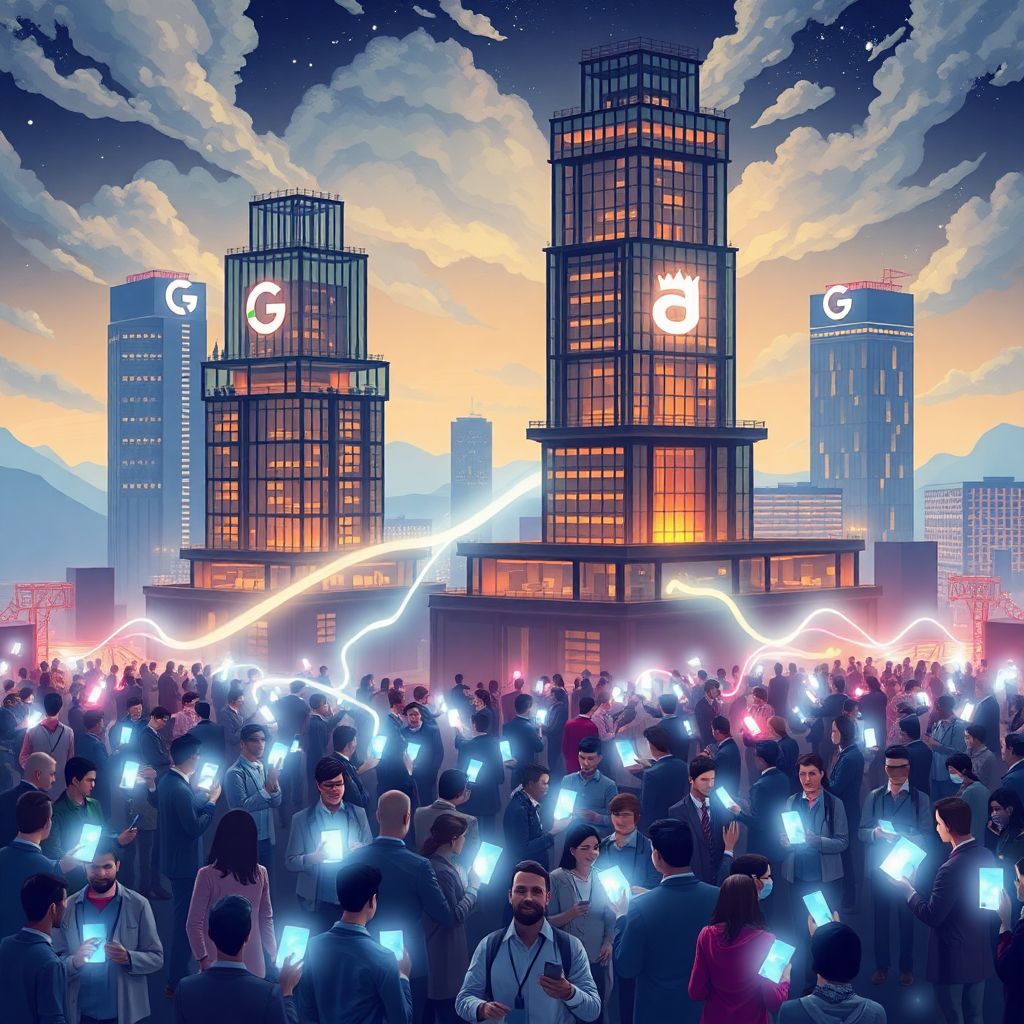
Feudalism 2.0: why platforms act like kingdoms
There is a particular kind of swagger with which today’s tech giants move through the world. It’s not the cautious confidence of a private company afraid of regulators or competitors. It’s the quiet certainty of something closer to a state.
Google filters and orders what counts as knowledge. Meta shapes how billions of people talk, argue, fall in love, grieve, and organize. Amazon choreographs global consumption and logistics. These are no longer “just platforms.” They function as empires — and, like empires throughout history, their primary activity is extraction.
The metaphor is not accidental. We are living in a digital form of feudalism. The castles are glass headquarters and cloud data centers, the lords are executives and major shareholders, and the peasants are everyone whose lives and livelihoods now depend on these systems. The land is no longer soil — it is infrastructure. And our harvest is not grain but data.
Every swipe, tap, search, photo upload, voice command, GPS ping, and time spent online is harvested as raw material. It feeds machine learning models, ad-targeting systems, recommendation engines, and behavioral prediction tools. The result is a planetary-scale apparatus designed to capture attention, convert it into data, and turn that data into profit — often without meaningful consent or understanding.
A new feudal order
Traditional feudalism didn’t just lock people to land physically; it locked them into a worldview in which dependency felt natural, inevitable, almost sacred. The lord protected, the peasants obeyed, and the system was justified as the way things simply were.
Big Tech has reproduced this logic with disturbing precision. We do not truly own our data; we generate it in fields we do not control. We do not own our digital identities; we access them on rented terms, subject to arbitrary suspension, algorithmic misclassification, or a sudden policy change. We rarely give explicit, informed consent to the deeper layers of extraction; instead, we are guided through dark patterns, opaque settings, and frictionless defaults designed to maximize sharing, not autonomy.
The usual defense is familiar: “If you don’t like it, use another service.” But this is less a genuine option and more a modern version of telling a medieval peasant to “just leave” the estate. Theoretically possible, practically impossible. Try participating in contemporary life without search, email, messaging apps, digital payment systems, navigation, or cloud storage. Try applying for a job, managing finances, accessing education, or even verifying your identity while fully unplugged.
What we politely call “user retention” is often dependency by design. Once a technology becomes so central that withdrawing from it means social isolation, economic penalty, or bureaucratic invisibility, it stops being “just a product.” It steps into the realm of sovereign power — the ability to shape what people can or cannot do.
Platform empires and post-national power
The most unsettling aspect of this techno-feudalism is its political geography. Governments act inside borders; platforms operate above them. Nation-states pass laws; platforms update terms of service.
Maps applications quietly redraw contested borders depending on who is looking, subtly affirming or denying territorial claims. Social platforms decide which political narratives are amplified, which are downranked, which are flagged, and which quietly vanish. Global marketplaces and logistics networks rival or surpass the economic capacity of entire countries.
We did not elect these companies. We cannot vote their leadership out. Yet their algorithms and policies condition our information diets, our economic opportunities, and even our sense of reality. This is power after the nation-state: borderless, immensely concentrated, structurally unaccountable, and deeply motivated to keep extracting at scale.
Our identities — the sum of our habits, locations, communications, preferences, biometrics, histories — are not just “profiles.” In techno-feudalism, they are the mines.
Web3 as an industrial revolution, not a casino
The last time a deeply entrenched feudal order began to crumble, it wasn’t because people wrote angry manifestos. It was because technology and new economic models altered who could hold leverage. The Industrial Revolution armed individuals and new classes with tools, capital, and legal rights that slowly undermined the old hierarchy.
If it is built with care and integrity, web3 could play a similar role for the digital age. Not as branding fluff. Not as a speculative arena for quick profits. But as a structural reconfiguration of how power, ownership, and coordination work online — an Industrial Revolution for the internet itself.
Decentralized technologies — blockchains, distributed storage, smart contracts, self-sovereign identity — can, in principle, shift control away from gatekeepers and toward users, communities, and smaller organizations. Just as machines once redistributed physical labor, these tools can redistribute aspects of digital power: who owns data, who sets rules, who earns from value creation, who can be excluded.
The goal is not to smash technology but to rewire its governance. Because the core question is no longer whether the future will be digital. It will. The real question is: digital under whose terms? Under the rule of a handful of corporate kings — or under frameworks where the people generating value hold meaningful control?
Retail adoption: reclaiming everyday agency
For ordinary people, the revolution does not start with trading tokens or collecting speculative JPEGs. It starts with something that sounds almost boring: genuine ownership of digital identity and data.
Right now, losing access to a major email address or social account can be more catastrophic than misplacing your front door keys. Your logins are often your gateway to banking, healthcare, education, government services, professional networks, and social ties. If an opaque moderation system or automated flagging mechanism locks you out, your “appeal process” may boil down to hoping a support queue takes pity on you.
That vulnerability is a symptom of dispossession. We built our lives on land we do not own.
Web3 tools propose a different foundation. Identity wallets could allow you to hold verifiable credentials — proofs about who you are or what you’re entitled to — without handing full control to a central database. Ownership-based logins could let you access services because you control a cryptographic key, not because a corporation endorses your existence. Data vaults under your command could let you decide which apps see what, under what conditions, and for how long.
Retail adoption, in this context, is not about everyone becoming a day trader. It is about people gradually realizing:
– They can carry their identity between services instead of re-creating it from scratch each time.
– They can grant revocable, selective access to their information instead of giving platforms permanent ownership.
– They can participate in systems where their contribution is recognized and rewarded, not invisibly harvested.
When users start expecting that level of control as a baseline, the economic logic of surveillance and extraction begins to wobble.
Institutional adoption: breaking the monopolies
Individuals alone cannot overturn techno-feudalism. Institutions — from startups to universities, from cities to cooperatives — also need alternatives to the current platform oligopoly.
Web3 offers these institutions new coordination and governance tools. Decentralized autonomous organizations (when thoughtfully designed, not rushed) can allow stakeholders — users, workers, partners — to have a real say in how digital infrastructure is run and how revenue is shared. Shared data layers on open protocols can reduce the lock-in that keeps small businesses chained to a single platform’s rules and fees.
Imagine a social network owned and governed by its users, where moderation rules, revenue-sharing models, and feature roadmaps are transparently debated and collectively decided. Imagine supply chains where every participant can verify provenance and terms directly, without a single dominant intermediary owning the entire map. Imagine academic or scientific databases where contributors retain rights and earn ongoing rewards for the knowledge they add.
Institutional adoption of these kinds of systems does not mean abandoning regulation; it means giving regulators and public-interest groups new levers. Public blockchains and auditable smart contracts can, in principle, make it easier to detect corruption, favoritism, or discriminatory practices. Instead of sending polite letters to opaque platforms, authorities could inspect open, verifiable rulesets.
What web3 must avoid to matter
None of this is guaranteed. Web3 can easily replicate the old order with shinier branding. If a few giant companies end up controlling the main wallets, the largest chains, the dominant layer-2s, and the most popular dApps, the result will not be liberation. It will be Feudalism 2.1, only with more buzzwords and slightly different gatekeepers.
A meaningful alternative requires:
– Real decentralization, not just on paper: no single company or small cartel should be able to unilaterally rewrite rules or seize assets.
– Usability for non-experts: tools that require a PhD in cryptography or constant fear of losing keys will never become mainstream rights infrastructure.
– Economic models beyond speculation: systems must reward real contributions — creativity, curation, computation, verification — rather than pure financial gambling.
– Embedded protections: privacy by default, strong cryptography, and governance mechanisms able to adapt and correct abuse.
Without these, web3 will remain a niche casino layered on top of the same old empires.
Why opting out is not enough
Some argue the solution is simple: just leave the platforms, use smaller services, or go offline. In practice, “digital self-sufficiency” today functions a bit like trying to be landless in a feudal world: theoretically noble, practically punishing.
You can delete accounts, install privacy tools, and limit your footprint — and many should. But as long as the core infrastructure of work, governance, and social life runs through a handful of corporate pipes, individual resistance has hard limits.
The more realistic strategy is dual:
1. Minimize your own dependency where possible, and
2. Help build and demand systems where dependency is not weaponized in the first place.
That second part is where web3-oriented thinking becomes political in the deepest sense — not because it aligns with a party or ideology, but because it asks who should own and govern the rails on which modern life runs.
From users to stakeholders
In Feudalism 2.0, we are “users” — a passive word. We log in. We interact. We accept. In a genuinely decentralized ecosystem, the aspiration is that we become stakeholders.
Being a stakeholder means:
– You can see the rules that govern you.
– You can participate, directly or via representatives, in changing those rules.
– You share in the upside created by the networks you help sustain.
– You have portable rights — tied to your identity and contributions, not the goodwill of a single company.
This shift is not just technical; it is cultural. People must come to expect that their relationship with digital infrastructure is mutual, not hierarchical — more like a membership than a tenancy.
The revolution will be decentralized — or it will not happen at all
Revolutions in the digital age will not look like crowds storming physical palaces. They will look like millions of quiet migrations from closed systems to open ones, from black-box algorithms to transparent protocols, from rented identities to self-controlled credentials.
Decentralization is not a magic word; it is a design choice with trade-offs. It can be messy, slower, and less tidy than top-down control. But it is also the only credible counterweight to empires whose power feeds on centralization.
If we continue to accept platforms as inevitable sovereigns of the digital world, techno-feudalism will harden into something like a permanent order. The longer that happens, the more our rights, expectations, and imaginations will shrink to fit the narrow confines of terms-of-service documents we never read.
If, instead, we treat web3 and related technologies as the early scaffolding of a new digital constitution — one that prioritizes user ownership, interoperability, transparency, and shared governance — we have a chance to break the pattern.
The question is not whether Big Tech has already become the new kings. In many respects, it has. The real question is whether we are willing to remain digital serfs — or whether we will insist, through the systems we build and choose to use, on something closer to citizenship.