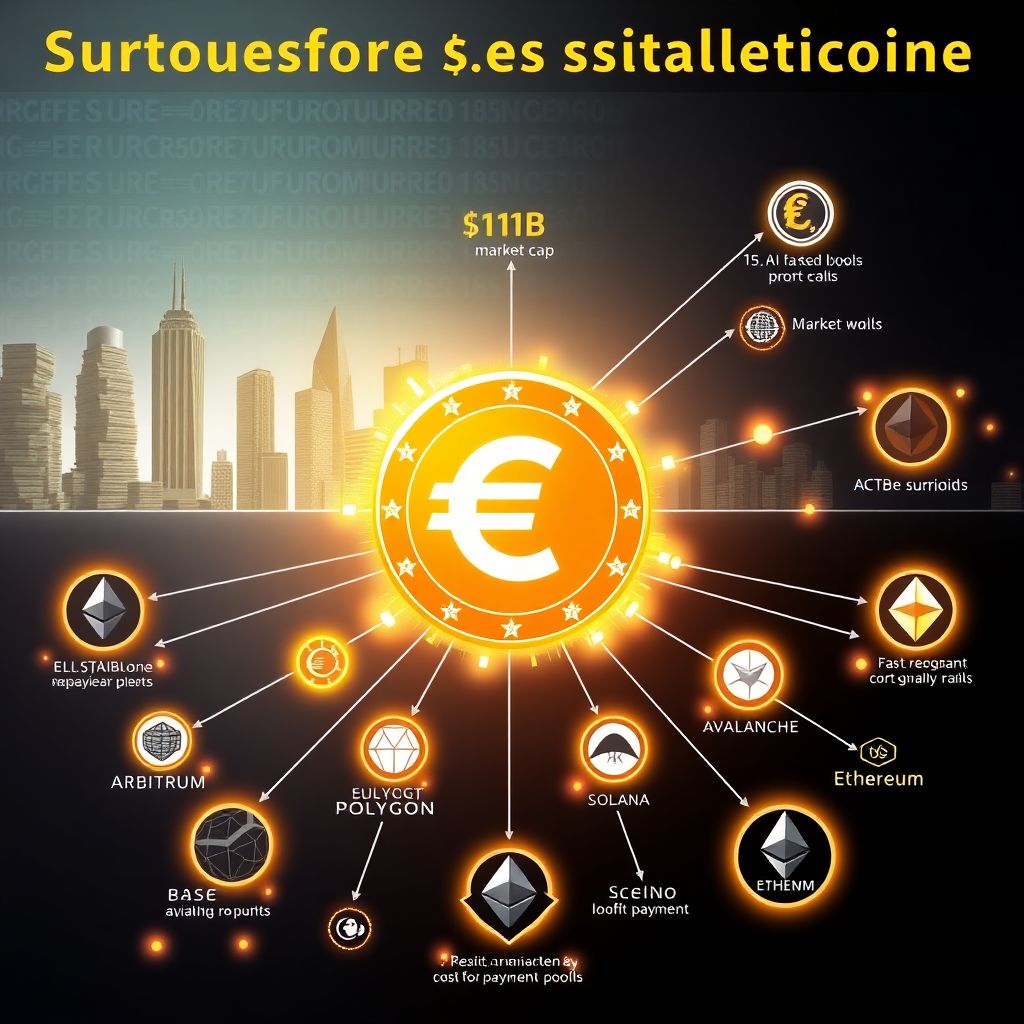
Euro-denominated stablecoins break $1B, still barely visible in Eurozone money supply
Euro-pegged stablecoins have quietly crossed a symbolic threshold, with their combined circulating supply now hovering around $1 billion. Despite the milestone, tokenized euros remain almost invisible when compared with the scale of the traditional European financial system.
Data aggregators estimate the eurozone’s M2 money supply at roughly $15.5 trillion. Against that backdrop, the entire euro stablecoin sector represents only about 0.006% of the region’s broader money stock — effectively a rounding error in macroeconomic terms. In other words, while on-chain euros are growing fast inside crypto, they are still a microscopic slice of the real economy.
From niche experiment to early growth phase
For most of 2020 and 2021, tokenized euros saw minimal adoption and limited market capitalization. Activity was largely confined to a handful of experiments and small-scale payment use cases. That picture began to change in late 2023, when the pace of issuance accelerated sharply. The upward trajectory continued through 2024 and into 2025, signaling that euro stablecoins are moving from a proof-of-concept phase into an early, though still modest, growth cycle.
Market data shows a clear inflection point: after years of stagnation, new issuers entered the space, existing projects scaled up, and integration into wallets, exchanges, and payment platforms increased. Yet even with this rapid percentage growth, the absolute numbers remain small when measured against both traditional money and the dominant dollar stablecoin market.
Ethereum leads, but euro stablecoins go multichain
Ethereum continues to host the largest share of euro-denominated stablecoin supply. The ecosystem’s maturity, deep liquidity pools, and extensive DeFi infrastructure make it the natural first home for new tokenized currencies. However, euro stablecoins are no longer confined to a single network.
Issuance and circulation have expanded across a range of blockchains, including Arbitrum, Polygon, Base, Solana, Avalanche, and Stellar. Each of these networks offers a different mix of transaction speed, cost structure, and user base, shaping how and where tokenized euros are used. Low-fee, high-throughput chains are particularly attractive for payments, remittances, and smaller transfers, while Ethereum often remains the hub for DeFi, institutional experiments, and larger settlements.
This multichain presence suggests that the market is actively testing which technical environments are best suited for everyday euro-denominated transactions, not just speculation or yield strategies.
Use cases: from payments to cross-border settlement
The spread of euro stablecoins across multiple blockchains is more than a technological detail; it reflects broadening use cases. Tokenized euros are increasingly being deployed in:
– Cross-border payments within and beyond the Eurozone
– On-chain settlements between businesses and service providers
– Merchant payments and invoicing in digital-native industries
– Trading pairs on centralized and decentralized exchanges
– Hedging instruments for European traders seeking to stay in euro exposure while remaining on-chain
For individuals, euro stablecoins can provide a way to move value instantly across borders without the fees and delays associated with traditional bank transfers or card networks. For businesses, they offer a tool for streamlining settlement, reducing counterparty risk, and integrating with programmable financial services.
Still overshadowed by dollar stablecoins
Despite the recent expansion, euro-pegged assets remain dwarfed by their dollar-based counterparts. Dollar stablecoins, led by the largest issuers, are central to crypto market liquidity and serve as the primary unit of account for trading, derivatives, and global on-chain settlement.
By contrast, euro stablecoins are still a niche product, even within Europe. Most crypto exchanges quote assets in dollars or dollar-equivalent tokens, and a large portion of global crypto volume originates from markets where the dollar is dominant. This entrenched dollar preference has created a structural headwind for euro-denominated tokens, even among European users.
Underdeveloped relative to potential
Analysts note a striking gap between the euro’s massive importance in the offline world and its modest presence on-chain. The euro is one of the world’s leading reserve and payment currencies, central to trade, savings, and lending across the continent and beyond. Yet in the digital asset economy, its tokenized form remains comparatively underbuilt.
This mismatch points to a substantial untapped opportunity. If regulatory frameworks become clearer, if European institutions begin to adopt on-chain settlement at scale, or if major payment providers roll out user-friendly euro stablecoin rails, the sector could expand rapidly from its current base.
What is holding euro stablecoins back?
Several factors help explain why euro stablecoins have lagged behind their dollar peers:
1. Regulatory uncertainty
Until recently, the European regulatory environment around stablecoins and tokenized money was fragmented and sometimes ambiguous. Many potential issuers and institutions opted to wait for clearer rules before committing resources, particularly in contrast to the more established dollar stablecoin market.
2. Dollar dominance in crypto markets
Crypto trading, derivatives, and lending have been built primarily around the dollar. Market makers, exchanges, and DeFi protocols are optimized for USD liquidity, creating strong network effects that are difficult for euro-denominated instruments to break through.
3. Limited institutional adoption
While some fintechs and startups have experimented with euro stablecoins, large banks, payment firms, and corporate treasuries have moved cautiously. Without significant institutional use, volumes remain constrained and liquidity shallow.
4. User habits and inertia
Even European traders often default to dollar stablecoins because they are more liquid, better integrated into DeFi, and widely accepted as collateral. Changing these habits requires compelling advantages or clear regulatory and cost benefits.
How euro stablecoins could grow from here
Despite these obstacles, several trends could drive further growth:
– Stablecoin-specific regulation and licensing: A clear licensing regime, capital requirements, and consumer protection rules could make euro stablecoins more attractive to regulated financial institutions, payment providers, and corporate users.
– Integration with fintech apps and neobanks: Everyday users are more likely to interact with tokenized euros through familiar apps rather than crypto-native platforms. If neobanks and payment apps embed euro stablecoins under the hood, on-chain money could scale without users needing to think about blockchains.
– On-chain treasury and cash management: Companies with digital revenue streams may turn to euro stablecoins for just-in-time payments, supplier settlement, or yield-bearing on-chain instruments, especially if they integrate easily with accounting and reporting tools.
– Programmable finance and automation: Smart contracts allow conditional payments, escrow, revenue sharing, and automated tax and fee distribution. Euro stablecoins could become a default tool for these programmable finance workflows, especially for European businesses.
Potential impact on the Eurozone financial system
At just 0.006% of the eurozone’s M2, euro stablecoins are far too small to pose systemic risks or meaningfully alter monetary conditions. However, their evolution raises several questions for policymakers and central banks:
– How will the coexistence of bank deposits, a possible digital euro, and privately issued euro stablecoins reshape the banking sector?
– Could large-scale adoption of tokenized euros affect the transmission of monetary policy if funds move more fluidly between banks and on-chain instruments?
– What standards for reserves, disclosure, and supervision are necessary to ensure stability and protect users?
For now, euro stablecoins function more as a technological testbed than as a macroeconomic force. But their architecture and regulatory treatment may set important precedents for the broader future of digital money in Europe.
Competition and complementarity with a potential digital euro
The prospect of a central bank digital currency in the Eurozone adds another layer of complexity. A digital euro and privately issued euro stablecoins could end up competing, coexisting, or even reinforcing each other, depending on design choices:
– If a digital euro is highly restricted, with limited programmability or access, private stablecoins may fill the innovation gap.
– If it is widely accessible, low-cost, and programmable, demand for some private solutions could diminish, while others evolve into value-added layers built on top of public infrastructure.
– Interoperability standards will be critical: the easier it is to move between bank accounts, digital euros, and stablecoins, the more fluid and efficient the overall system could become.
Why this matters for users and businesses
Even at a small scale, euro stablecoins are beginning to reshape how some users think about money movement:
– Freelancers and remote workers in Europe can receive payments in euro stablecoins without waiting days for international transfers.
– Startups operating across multiple EU countries can settle invoices and payroll using a single programmable euro-denominated rail.
– Traders and investors who prefer to avoid dollar exposure can stay fully on-chain while holding a currency that matches their local cost base.
As infrastructure improves — better custody solutions, smoother fiat on- and off-ramps, clearer tax treatment — these practical advantages could draw more everyday users into the euro stablecoin ecosystem.
A small market with outsized strategic significance
Measured in dollars, the euro stablecoin market is still tiny. Measured in strategic importance, it is far more significant. Tokenized euros sit at the crossroads of several major shifts: the digitization of money, the rise of programmable finance, and Europe’s effort to shape a distinct, regulated path for crypto and fintech.
Crossing the $1 billion mark and spreading across multiple blockchains does not yet make euro stablecoins a dominant force. But it does confirm that euro-denominated value is steadily moving on-chain — and that the gap between the euro’s role in the traditional economy and its on-chain footprint is unlikely to remain this wide forever.