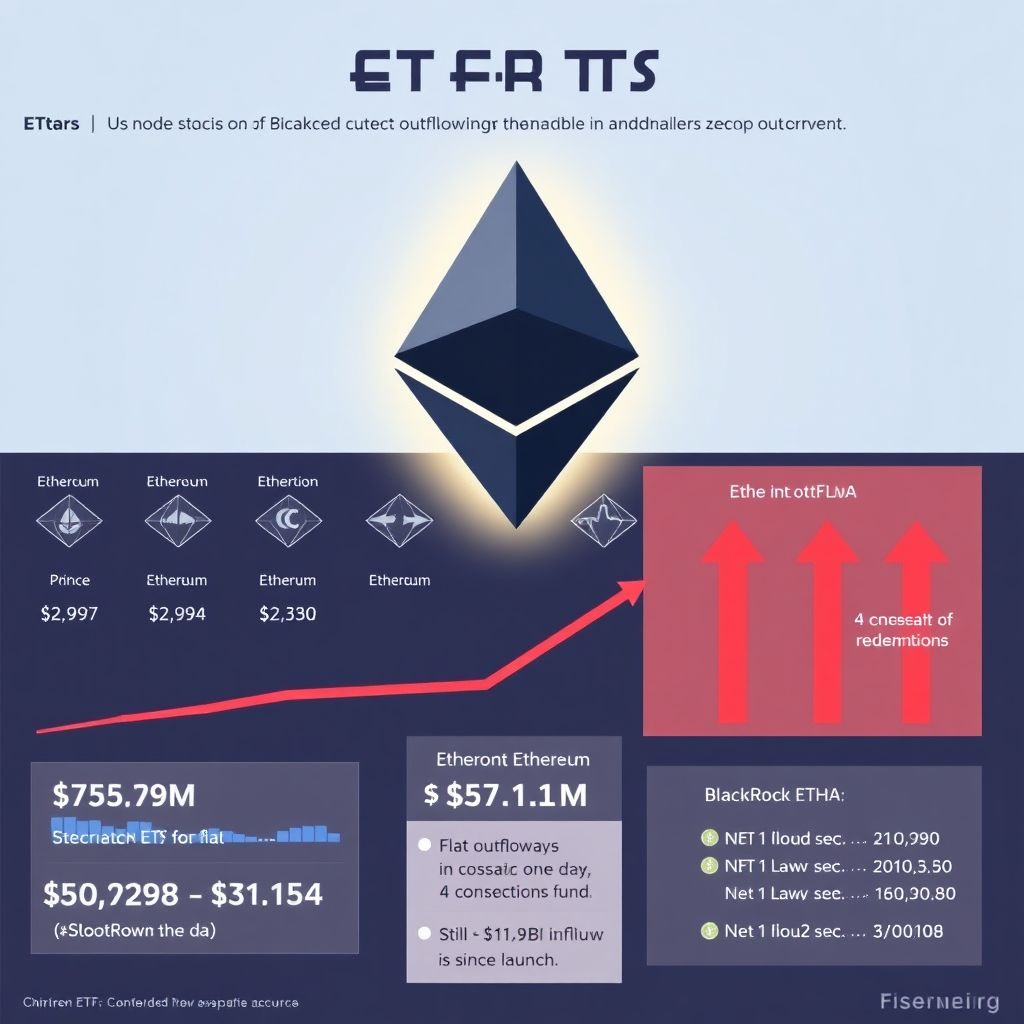
Ethereum ETFs Log $75M One-Day Exodus as Price Clings to $3,000
Ethereum exchange-traded funds (ETFs) were hit by a sharp wave of redemptions on December 5, with investors pulling out a combined $75.21 million in a single session. The move came as ETH’s spot price hovered indecisively around the psychologically important $3,000 level, failing to establish a clear trend.
All nine US spot Ethereum ETFs reported zero inflows on the day, meaning every dollar moving through the products was flowing out, not in. The selling was dominated by one issuer: BlackRock.
BlackRock’s ETHA Drives the Outflow
BlackRock’s Ethereum ETF, trading under the ticker ETHA, accounted for the entire $75.21 million in net redemptions on December 5. This marked the fourth consecutive trading day in which Ethereum ETFs, led by ETHA, have seen net outflows rather than fresh capital.
Despite the short-term pressure, ETHA remains the heavyweight of the Ethereum ETF sector. The fund still sits on approximately $13.09 billion in cumulative net inflows since launch, underscoring how strong initial demand has been even as recent sentiment has cooled.
Price Holds the Line Around $3,000
On the same day, Ethereum’s spot price traded almost flat in a tight range. ETH changed hands near $3,030, with intraday moves between $2,995.50 and $3,146.10.
Over a 24-hour period, ETH slipped around 2.7%, extending a broader decline of roughly 10.3% over the past 30 days. The repeated failure to break convincingly higher from the $3,000 region has added to the sense of hesitation among traders, many of whom are waiting for a clear directional catalyst.
Four Days of Redemptions After Brief Inflow Spike
Since December 2, Ethereum ETFs have been consistently bleeding capital with only one notable exception. The sequence of daily net outflows looks as follows:
– December 2: $79.06 million in outflows
– December 3: a rare bright spot with $140.16 million in inflows, largely driven by Fidelity’s FETH
– December 4: $9.91 million in outflows
– December 5: $41.57 million in outflows early, followed by the final tally of $75.21 million in net redemptions across the funds
That one day of heavy buying on December 3 was not enough to offset the persistent selling pressure seen across the rest of the period. It did, however, highlight that institutional interest remains present, but is currently more tactical and less sustained.
Diverging Fortunes Among Major Ethereum ETFs
The Ethereum ETF landscape is increasingly defined by a few dominant products with very different trajectories:
– BlackRock’s ETHA: largest Ethereum ETF with about $13.09 billion in cumulative net inflows, despite short-term redemptions.
– Grayscale’s ETHE: continues to see capital exiting, with roughly -$4.99 billion in net outflows since it converted from a closed-end trust to an ETF structure. A portion of these redemptions is widely interpreted as long-time holders finally unlocking liquidity after years of limited exit options.
– Fidelity’s FETH: a clear growth story, accumulating around $2.62 billion in total inflows and playing a key role in the strong inflow day on December 3.
Taken together, these products form the backbone of the Ethereum ETF ecosystem, reflecting different investor profiles: legacy holders exiting through ETHE, long-term allocators favoring ETHA, and newer institutional participants entering via FETH.
Sector Snapshot: Assets, Flows, and Volumes
As of December 5, total net assets under management (AUM) across all Ethereum spot ETFs stood at about $18.94 billion. Cumulatively, the group has attracted approximately $12.88 billion in net inflows since inception, even after factoring in the recent streak of outflows.
Trading activity remains robust. Total value traded in Ethereum ETFs reached $1.77 billion on December 5, slightly up from $1.75 billion the previous day. While the daily flow direction has swung negative in recent sessions, the steady volume is a reminder that these products are now an integrated part of the broader crypto and traditional finance markets.
Bitcoin ETFs Tell a Different Story
While Ethereum products were facing a one-way exit of capital, Bitcoin ETFs painted a markedly different picture on December 5.
Bitcoin funds registered $54.79 million in net inflows that day, highlighting a clear preference shift among some investors towards BTC over ETH in the near term. Total net assets for Bitcoin ETFs reached roughly $117.11 billion, with cumulative inflows of about $57.62 billion.
This divergence underscores a recurring theme in the current market: even when the broader digital asset class shows resilience, capital often rotates between Bitcoin and Ethereum based on relative narratives, regulatory developments, and perceived near-term catalysts.
Exchange Supply of ETH Hits All-Time Low
One of the most striking counterpoints to the short-term ETF outflows is Ethereum’s on-chain supply picture. The percentage of ETH held on centralized exchanges has dropped to a record low of 8.84% of total circulating supply.
For comparison, Bitcoin’s exchange balance stands significantly higher, around 14.8%. This contrast suggests that, structurally, ETH faces a tighter liquid supply environment than BTC, at least in terms of coins readily available for sale on major trading venues.
Market observers pointed out that ETH is increasingly moving into venues that are not typically used for active selling:
– Staking contracts on the Ethereum network
– Restaking protocols and yield layers
– Layer-2 (L2) networks for scaling and transaction activity
– Data availability (DA) and infrastructure layers
– Collateral positions in DeFi
– Long-term custody solutions
The underlying message: even as market mood appears heavy, the supply that could hit order books is quietly shrinking.
Why Supply Tightening Matters for Price
Tightening supply on exchanges does not guarantee an immediate price rally, but it changes the dynamics of future price moves. When fewer coins sit on exchanges, a surge in demand can translate more quickly into price appreciation because there is less immediately available liquidity to absorb buy pressure.
In Ethereum’s case, multiple structural forces are pulling tokens out of circulation:
– Staking economics: many holders prefer to earn yield by securing the network.
– Restaking and new primitives: advanced financial products now let ETH holders stack multiple yield streams, making it more attractive to lock up coins.
– DeFi and L2 use cases: ETH is increasingly used as collateral, gas, or a base asset across a sprawling ecosystem of applications.
This combination creates a backdrop where, even during periods of risk-off sentiment or ETF redemptions, the long-term float of ETH remains under pressure. When macro conditions or narratives shift more favorably, the price response can be amplified.
Interpreting the Disconnect: Bearish Flows, Bullish Fundamentals?
The current setup poses an apparent contradiction:
– On the surface, ETF outflows and a 10% monthly price decline point to weakening demand.
– Beneath the surface, all-time-low exchange balances and growing locked-up supply suggest strengthening fundamentals.
The way to reconcile this is to recognize that ETF flows largely reflect short- to medium-term positioning by institutions and sophisticated retail investors. These players are responsive to macro headlines, interest rate expectations, and risk sentiment.
On-chain supply trends, by contrast, move slowly and reflect structural decisions: building infrastructure, staking for the long haul, and integrating ETH into financial and application layers. Such decisions generally do not reverse just because of a few weeks of price chop.
What Could Flip the Narrative for Ethereum?
Several potential catalysts could reverse the recent pattern of ETF outflows and reignite demand for ETH:
1. Macro easing or rate-cut expectations
Lower interest rates typically make risk assets, including crypto, more attractive. A clear signal from central banks could trigger renewed allocations into both Bitcoin and Ethereum ETFs.
2. Network upgrades and scaling milestones
Past upgrades have often served as narrative tailwinds. Further improvements in throughput, fees, or data availability could highlight Ethereum’s role as core infrastructure for decentralized applications.
3. Regulatory clarity
More definitive guidance on Ethereum’s legal status or on the treatment of staking and DeFi could remove a layer of uncertainty that currently keeps some institutions on the sidelines.
4. Rotation from Bitcoin after major BTC events
Historically, after large Bitcoin-driven cycles or headline events, investors have often rotated into Ethereum and other large-cap altcoins in search of higher relative upside.
If any combination of these factors materializes while exchange balances remain near historic lows, the stage could be set for a more aggressive repricing of ETH.
How Investors Might Read the Current Environment
For short-term traders, the recent ETF outflows and stalled price around $3,000 are a clear signal of indecision and caution. Volatility events around support and resistance levels are likely, especially if macro data or regulatory news hits the tape.
For longer-term participants, the focus may be less on daily ETF flows and more on the bigger picture:
– Ethereum’s role as the backbone of DeFi and many NFT and L2 ecosystems
– The ongoing trend of reduced liquid supply on exchanges
– The continued dominance of Ethereum in smart contract activity despite competition
These investors may view pullbacks and periods of negative sentiment as opportunities to build or adjust positions in alignment with the network’s structural evolution rather than its latest headline.
The Bottom Line
Ethereum’s ETF market is currently flashing warning signs in the form of sustained outflows, led most recently by a $75.21 million one-day redemption dominated by BlackRock’s ETHA. At the same time, the ETH price is stuck near $3,000, with no decisive breakout in either direction.
Yet beneath the fragile sentiment, Ethereum’s supply base is quietly tightening to unprecedented levels, with exchange balances at record lows and more coins locked in staking, L2s, and long-term custody.
This disconnect between short-term flows and long-term fundamentals suggests that the current phase is less about Ethereum’s viability and more about macro risk appetite and near-term positioning. When those variables shift, the underlying scarcity and utility story could quickly reassert itself in price.