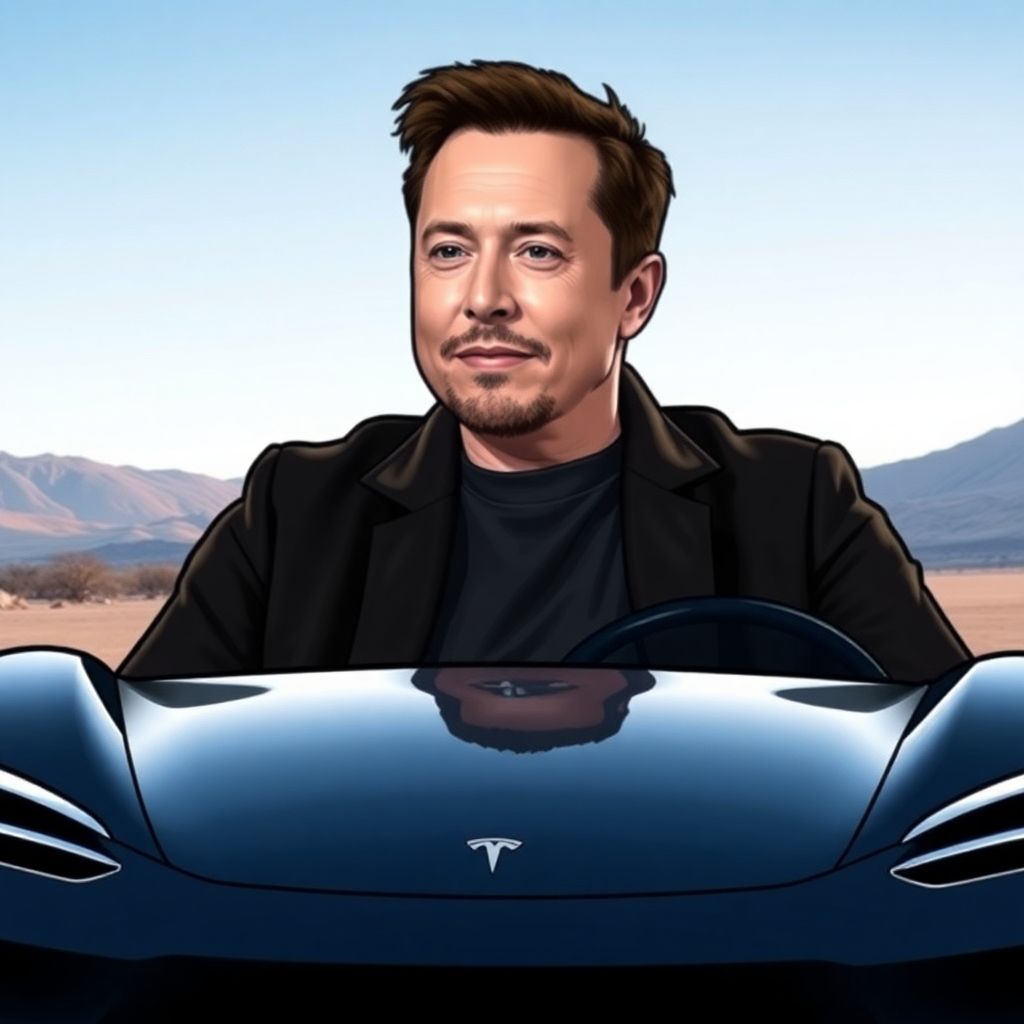
During a wide-ranging three-hour appearance on The Joe Rogan Experience, Elon Musk once again captivated audiences with a mix of bold predictions, controversial opinions, and high-tech aspirations. From the future of Tesla to the existential threat of artificial intelligence, Musk didn’t hold back. One of the most jaw-dropping revelations was his assertion that the upcoming Tesla Roadster will be capable of flight.
Musk told Rogan that the next-generation Roadster, a long-anticipated electric supercar, would include a “SpaceX package” outfitted with cold gas thrusters. These, according to Musk, would be powerful enough to allow the car to hover—if only briefly—above the ground. The SpaceX thrusters, adapted from their use in rocket maneuvering systems, would be integrated into the rear of the car and perhaps even replace the rear seats.
Though the idea of a flying car has long been a science fiction fantasy, Musk insisted the technology is not only feasible but actively in development. He admitted that safety and regulatory hurdles remain, but seemed optimistic that a hovering Roadster could hit the market within the next few years. “We’re going to do some insane stuff with this car,” he said.
The conversation then shifted to a more ominous topic: the rapid development of artificial intelligence. Musk expressed deep concern over what he called the “woke mind virus” infecting AI systems, arguing that biases embedded in training data could lead to dangerous outcomes. He reiterated past warnings that superintelligent AI, if unchecked, could pose an existential threat to humanity.
Musk didn’t mince words, stating that AI development is now advancing faster than most governments can comprehend or regulate. He voiced skepticism about regulatory bodies’ ability to keep up and warned that a lack of oversight could result in AI systems acting in unpredictable and potentially catastrophic ways. “This is not a sci-fi problem,” he said. “It’s a real-time issue.”
One of the more controversial parts of the interview came when Musk referenced the recent death of Suchir Balaji, a former OpenAI employee. Musk claimed that the circumstances surrounding Balaji’s death appeared suspicious and suggested it could have been a targeted killing. “It looks like murder,” Musk said, though he provided no concrete evidence. He also emphasized that he has no intention of taking his own life, a statement that seemed to preemptively address any future conspiracy theories involving his own well-being.
Musk also discussed his acquisition of Twitter, now rebranded as X, and explained how the platform could evolve into a comprehensive digital ecosystem. He envisions X as a place not just for social media interactions, but also for financial transactions, content creation, and even AI-driven conversation via XChat, a new product he teased during the interview.
The Tesla and SpaceX CEO didn’t shy away from criticizing government inefficiency either. He lamented the vast sums of money wasted by public institutions and claimed that bureaucratic red tape frequently gets in the way of technological progress. According to Musk, innovation is often stifled by outdated regulations and entrenched interests.
Another fascinating topic was the integration of AI into human lives. Musk predicted that within the next five to ten years, AI would become so advanced that it would fundamentally change how people work, learn, and interact. He warned that entire professions could be rendered obsolete and emphasized the need to rethink education systems to prepare future generations for an AI-dominated world.
Musk also touched on Neuralink, his neurotechnology company aiming to develop brain-computer interfaces. He expressed hopes that such technology could offer a way for humans to keep pace with AI by creating a symbiotic relationship between biological and digital intelligence. He mentioned that early human trials for Neuralink implants are already underway, sparking ethical and philosophical debates about the future of human augmentation.
As for space exploration, Musk reasserted his commitment to colonizing Mars. He believes that humanity must become a multi-planetary species to ensure long-term survival. Starbase, SpaceX’s launch site in Texas, plays a central role in these ambitions. Musk highlighted recent progress with the Starship rocket, which he believes will be key to making interplanetary travel feasible.
The conversation also veered into philosophical territory, with Musk questioning the value of empathy. He argued that while empathy is often considered a virtue, it can sometimes cloud judgment and lead to poor decision-making. Instead, he advocated for a more rational, principle-driven approach to ethics and governance.
In summary, Musk’s interview with Rogan was a whirlwind tour through the mind of one of the most influential—and controversial—figures in tech. From flying cars to AI doomsday scenarios, he painted a picture of a future filled with both exhilarating possibilities and dire risks.
Expanding on this vision, Musk’s statements reflect a growing tension between rapid technological advancement and the societal structures struggling to manage it. His emphasis on decentralization, whether through cryptocurrencies or autonomous systems, suggests a belief that traditional institutions may no longer be fit for purpose in the modern age.
He also hinted at the importance of individual resilience in a world where machines could outperform humans in nearly every domain. Musk suggested that cultivating creativity, emotional intelligence, and adaptability might be the only ways for people to remain relevant as AI becomes increasingly dominant.
The potential for AI to disrupt global power dynamics was also discussed. Musk speculated that nations developing advanced AI first could gain disproportionate control over global systems—from finance to military capabilities. This, he argued, could lead to a new kind of digital arms race, one with stakes far beyond conventional warfare.
Finally, Musk encouraged listeners to stay informed and actively engage with the future being built around them. Whether through supporting innovative companies, advocating for responsible AI development, or simply questioning mainstream narratives, he emphasized the importance of participation in shaping the world of tomorrow.
In essence, Elon Musk’s latest conversation with Joe Rogan was more than just an interview—it was a glimpse into a future that’s arriving faster than many expect. The flying Tesla may grab headlines, but the deeper message was clear: the age of AI is here, and it’s not waiting for anyone.