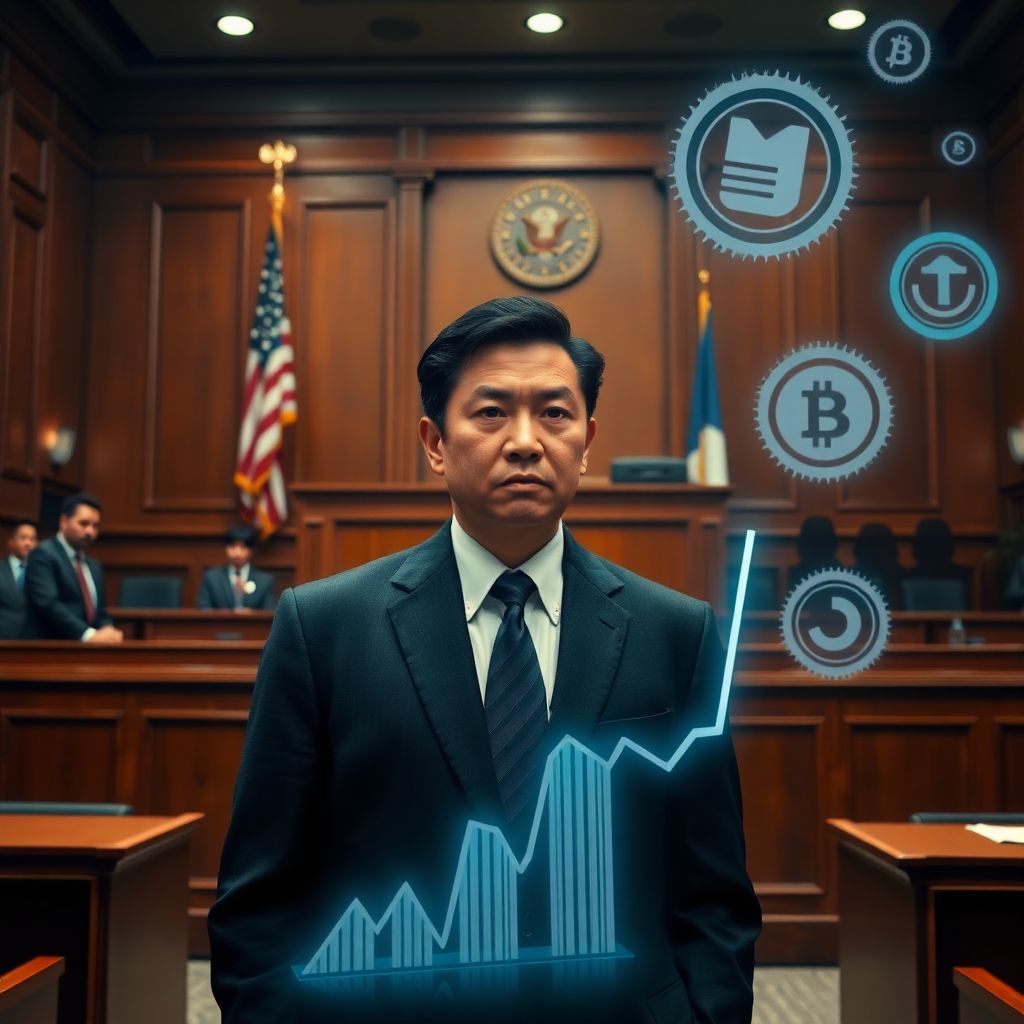
Do Kwon handed 15-year prison term over multibillion-dollar Terraform fraud
Terraform Labs co-founder Do Kwon has been sentenced to 15 years in prison by a federal court in New York for orchestrating a multibillion-dollar fraud that culminated in the spectacular 2022 collapse of the Terra ecosystem and sent shockwaves through the broader crypto market.
U.S. District Judge Paul Engelmayer described Kwon’s scheme as “a fraud of epic generational scale,” and imposed a sentence that exceeded the 12-year prison term requested by prosecutors. The judge stressed that the damage inflicted on investors went far beyond normal market risk, calling it a deliberate deception that caused unprecedented financial harm.
Kwon, now 34, became one of the most wanted figures in the digital-asset world after TerraUSD (UST) — his algorithmic stablecoin — broke its dollar peg in May 2022. The collapse wiped out tens of billions of dollars in value across Terra and its sister token LUNA, and contributed to cascading failures in other corners of the crypto sector.
For months after the collapse, Kwon evaded authorities until his arrest in Montenegro in 2023, where he was detained while attempting to travel with a falsified passport. His capture triggered a prolonged legal tug-of-war over extradition, with both the United States and South Korea seeking to bring him to trial. The U.S. ultimately secured custody first, but Kwon is still expected to be prosecuted in South Korea once his American sentence ends.
During the sentencing hearing, prosecutors argued that Kwon’s fraudulent conduct amplified the 2022 “crypto winter” and exacerbated the downfall of other major firms and figures in the industry. They pointed to the subsequent collapse of Sam Bankman-Fried’s FTX, losses tied to Celsius Network’s former CEO Alex Mashinsky, and the fallout surrounding OneCoin promoter Karl Sebastian Greenwood as part of a broader wave of failures that defined the period. Even so, prosecutors told the court that the aggregate losses in those separate scandals were still smaller than the investor damage attributed to Kwon and Terraform Labs alone.
Kwon addressed the court and apologized to victims, acknowledging that he should be held accountable for what happened to TerraUSD and LUNA holders. His defense team argued that his primary objective was to stabilize TerraUSD in the face of mounting pressure, not to mislead investors or engineer a fraudulent scheme. They requested a sentence capped at five years, characterizing his actions as misguided attempts at rescue rather than criminal intent.
Judge Engelmayer firmly rejected that framing, reportedly calling the defense’s proposed sentence “wildly unreasonable.” The court concluded that Kwon’s public assurances about TerraUSD’s stability and its technical design directly contradicted the reality of mounting systemic risk and concealed vulnerabilities in the project’s architecture.
Kwon had previously pleaded guilty to conspiracy and wire fraud charges. As part of his plea, he agreed to forfeit approximately 19.3 million dollars alongside several properties tied to the case. Prosecutors indicated that, if Kwon fully complies with the terms of the plea agreement and demonstrates good behavior, they would not oppose him serving the second half of his prison term in South Korea, where additional criminal proceedings are expected.
Despite the vast scale of the losses — estimated at around 40 billion dollars when factoring in the implosion of TerraUSD, LUNA, and related market contagion — prosecutors declined to seek formal restitution through the criminal case. They argued that identifying, verifying, and quantifying individual investor claims across numerous jurisdictions, wallets, and platforms would be extraordinarily complex and could delay the proceedings for years.
Terraform Labs, which Kwon co-founded with Daniel Shin in 2017, positioned itself as a foundational layer for decentralized finance and payments. The centerpiece of the ecosystem was TerraUSD, an algorithmic stablecoin designed to maintain a one-dollar value through market incentives and a close coupling with LUNA, rather than through traditional dollar-backed reserves. When UST lost its peg in May 2022, the feedback loop between the two tokens unraveled, leading to a rapid death spiral and wiping out the savings and investments of countless retail holders and institutional players alike.
After nearly two years in custody and legal limbo in Montenegro while extradition issues were sorted out, Kwon was transferred to the United States to face criminal charges. In parallel, civil regulators pursued him as well. In 2024, a U.S. civil jury found both Kwon and Terraform Labs liable for securities fraud, concluding that they had misled investors about the stability of TerraUSD and falsely promoted its use in mainstream applications, including its purported integration with the Korean payments platform Chai.
The sentencing does not mark the end of Kwon’s legal problems. South Korean authorities have prepared their own criminal cases involving allegations of capital markets violations and investor fraud tied to Terraform’s domestic operations. Once his U.S. sentence is partially or fully served, Kwon is expected to be transferred to face those charges, leaving open the possibility of additional prison time.
The case arrives during a period of shifting regulatory and political attitudes toward digital assets in the United States. While some recent moves by the administration have loosened or reinterpreted certain enforcement priorities — and high-profile figures such as Binance founder Changpeng Zhao have received clemency — Kwon’s lengthy sentence underscores that large-scale, investor-focused fraud remains a top target for prosecutors.
For the crypto industry, the outcome is a stark warning. The Terra implosion exposed how opaque token mechanics, aggressive marketing, and overconfidence in “algorithmic” stability can mask structural fragility. Many retail investors believed TerraUSD was a safe, dollar-like asset, only to discover that the underlying mechanism depended on continuous market confidence and complex arbitrage incentives rather than concrete reserves.
Regulators and policymakers have already cited the Terra case as a prime example of the systemic risks posed by unbacked or undercollateralized stablecoins. Discussions have intensified around strict reserve requirements, mandatory disclosures, and clearer categorizations of which crypto assets qualify as securities. The jury finding of securities fraud against Kwon and Terraform Labs may further influence how similar projects are structured and marketed in the future.
Institutional investors, too, are reassessing risk frameworks after the Terra collapse. Many funds treated UST as a low-volatility yield product, often promoting double-digit returns through staking and lending strategies built on top of the stablecoin. The rapid evaporation of those positions highlighted how correlated the entire crypto credit stack had become, and how a single failure in a widely integrated protocol could cascade across exchanges, lenders, hedge funds, and retail platforms.
For individual investors, the Kwon case underscores the importance of skepticism toward high-yield “risk-free” products and the need to understand, at least at a basic level, how a token maintains its value. Assets that rely heavily on proprietary algorithms, reflexive tokenomics, or promises of perpetual high interest rates without transparent backing are now under more scrutiny from both users and regulators.
The sentencing may also reshape how founders and developers in crypto communicate with the public. Marketing language that blurs the line between aspiration and guarantee can become evidence in court when things go wrong. Claims about “stability,” “safety,” or “cash-like” behavior are likely to be dissected more rigorously, both by watchdogs and by investors. The civil jury’s conclusion that misstatements around TerraUSD’s soundness amounted to securities fraud raises the bar for disclosure and accuracy.
Legal experts expect prosecutors around the world to lean on the Kwon precedent when going after other cases that mix complex technology with large-scale financial harm. The message is that complexity is not a shield: if courts determine that founders knowingly misrepresented risks, the size and novelty of a crypto project will not protect them from severe criminal liability.
At the same time, some industry participants worry that the severity of the sentence could have a chilling effect on innovation. They argue that the line between aggressive experimentation and criminality is not always clear in fast-evolving markets. However, the court’s emphasis on intentional deception, misrepresentation, and concealment of known vulnerabilities distinguishes Kwon’s conduct from ordinary entrepreneurial failure.
The Terra saga has also prompted renewed calls for international coordination on crypto enforcement. Kwon’s flight across borders, his arrest in a third country, and the competing extradition requests from the U.S. and South Korea highlighted how digital-asset crimes can quickly become multinational. Authorities are exploring more standardized frameworks for data sharing, asset tracing, and cross-border prosecution to prevent future fugitives from exploiting jurisdictional gaps.
For Terraform’s former users and investors, the 15-year sentence brings some measure of closure but does little to repair the financial damage. The decision not to pursue criminal restitution means that most victims will have to rely on civil litigation, bankruptcy proceedings, or write-offs. Some are still attempting to recover funds or tokens through courts and claims processes, but the complexity of the Terra ecosystem and the volatility of remaining assets make full recovery highly unlikely.
In the broader historical arc of crypto, Kwon’s downfall is likely to stand alongside other landmark cases as a turning point. It symbolizes the end of a particular era of unchecked experimentation with algorithmic stablecoins and signals a transition toward stricter oversight, more conservative design choices, and heightened personal liability for founders who make sweeping promises to the public.
As Kwon begins serving his 15-year term, the industry he once helped energize is grappling with the consequences of his legacy. Terra’s collapse and the subsequent fraud conviction have become cautionary tales — not only about the dangers of flawed token engineering, but also about the real-world impact when hype, leverage, and lack of transparency converge at scale.