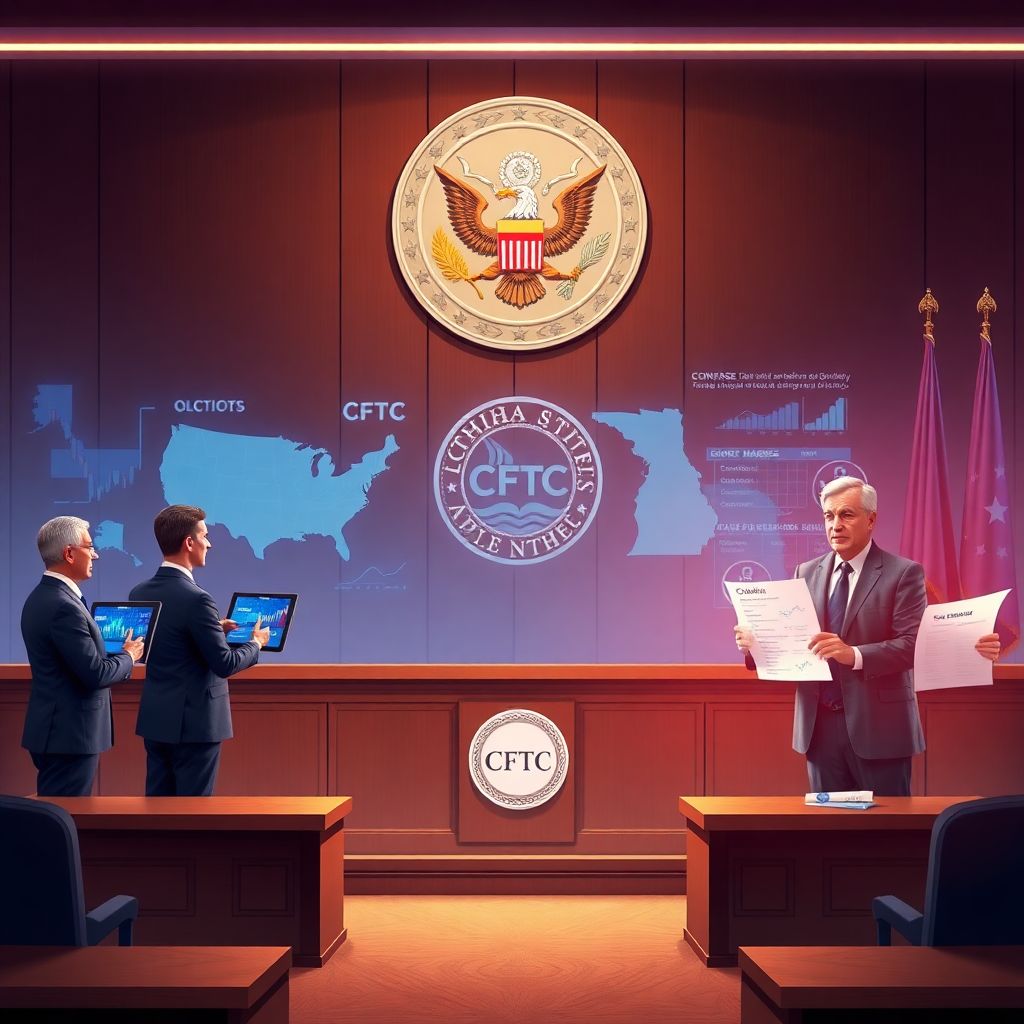
Coinbase Takes Three U.S. States to Court Over Prediction Market Crackdown
Coinbase has launched an aggressive legal offensive against regulators in three U.S. states, arguing that only federal authorities—not state gaming boards—have the power to oversee online prediction markets.
The company has filed federal lawsuits in Connecticut, Michigan, and Illinois, asking the courts to stop state officials from blocking the development and operation of prediction markets on compliant trading platforms. In its complaints, Coinbase seeks both declaratory and injunctive relief, effectively asking judges to clarify the law and bar states from enforcing what the firm calls unlawful restrictions.
At the heart of the dispute is a fundamental question: Are prediction markets a form of illegal gambling that states can regulate and shut down, or are they financial products that fall under the exclusive jurisdiction of federal commodities regulators?
Coinbase’s Core Argument: This Is Federal Territory
Coinbase’s legal team contends that prediction markets are not casino-style bets, but derivatives contracts and event contracts that belong squarely within the jurisdiction of the U.S. Commodity Futures Trading Commission (CFTC). According to the company, when users trade on outcomes of elections, economic data releases, or sports events through structured contracts, they are engaging in commodities and derivatives trading—activities governed at the federal level.
By that logic, state gaming regulators have no authority to order these markets to halt, because Congress has already assigned oversight of such products to federal agencies. Coinbase is essentially asking federal judges to affirm that state officials cannot override or duplicate this regulatory framework.
Chief Legal Officer Paul Grewal framed the issue as both a legal and innovation problem, arguing that state-level crackdowns are not only contrary to existing law but also harmful to the development of new financial technologies and markets.
Illinois and the Wider State Pushback
Illinois has been one of the most assertive states in this arena. Earlier this year, its regulators issued cease-and-desist letters to several firms, including Kalshi, Robinhood, and Crypto.com, over their offerings of sports-related event contracts and similar products. The state’s position mirrors that of many gaming commissions: if people are staking money on the outcome of an uncertain event, that activity looks like gambling and should be controlled at the state level.
Coinbase’s lawsuits directly challenge this assumption. The company argues that once these contracts are structured, cleared, and traded like financial instruments on compliant platforms, they cease to be mere “bets” and instead become part of the regulated commodities ecosystem.
If Illinois and other states succeed in treating such products as gambling, exchanges would need to navigate a patchwork of 50 different regulatory regimes, each with its own licensing requirements, restrictions, and prohibitions. Coinbase maintains that this is precisely the kind of fragmented oversight Congress sought to avoid when it empowered federal agencies to supervise national markets.
Why Prediction Markets Are Booming
The legal clash is unfolding amid a rapid expansion of interest in prediction markets. These platforms allow users to buy and sell contracts linked to real-world outcomes—elections, interest rate moves, inflation data, sports results, tech product launches, and more. Contract prices typically reflect the implied probability of an event occurring: if a contract that pays out $1 if an event happens is trading at $0.70, the market is signaling roughly a 70% likelihood.
Such markets have attracted traders, data enthusiasts, and institutions because they often generate real-time, crowd-based forecasts that can be more responsive than traditional polls or surveys. For crypto-native platforms, prediction markets also showcase how tokenization and blockchain infrastructure can support new kinds of financial instruments and global access to information markets.
This growth has pushed regulators to decide quickly how to classify these products: are they financial tools deserving of a clear, unified federal framework, or gambling mechanisms that states can license, restrict, or ban?
Innovation vs. Fragmentation
Coinbase’s suit portrays state actions as a direct threat to innovation in fintech and crypto. The company argues that if every new class of financial product can be re-labeled as “gambling” at the state level, then any derivatives market—whether based on commodities, indexes, or events—could be vulnerable to overlapping and inconsistent oversight.
From an industry perspective, the stakes go beyond prediction markets themselves. The outcome of these lawsuits could influence how regulators treat other emerging on-chain financial products that blur traditional categories, such as tokenized securities, synthetic assets, or event-based yield strategies.
A ruling that reinforces federal exclusivity in this area would likely be seen as a victory for exchanges and developers who want a single set of rules. A decision that affirms a strong state role, by contrast, could encourage more aggressive state-level intervention into other crypto and derivatives niches.
How Prediction Markets Fit Into Existing Law
The legal debate partly turns on how prediction markets are constructed and who is operating them. Under U.S. law, the CFTC oversees futures, options, and certain event contracts on commodities and economic indicators. Platforms offering these must typically register or receive exemptions, comply with market integrity rules, and implement surveillance and protections for users.
States, meanwhile, control lotteries, casinos, sports betting, and other activities traditionally classified as gambling. Their argument is that if an event contract looks and behaves like a sports bet or a wager on a political outcome, it belongs within their purview.
Coinbase’s position is that properly structured event contracts—especially those cleared, margined, and settled in line with commodities regulations—are part of the same legal family as futures and options. As such, they should not be reclassified as gambling just because the underlying reference is a sports match or an election.
Why the Outcome Matters for Crypto Users
For everyday crypto users and traders, this is not an abstract legal skirmish. The resolution of these cases will have direct consequences for:
– Which platforms are allowed to list prediction markets in the U.S.
– What kinds of events can be used as the basis for tradable contracts.
– Whether users in certain states will be able to access these products at all.
– How seamlessly these markets can integrate with other crypto trading and DeFi tools.
If federal courts back Coinbase’s position, prediction markets could become a more mainstream feature on regulated crypto exchanges, potentially with standardized rules and protections. If states prevail, access could be sharply limited or vary dramatically from one jurisdiction to another, mirroring the current landscape of online sports betting.
Possible Paths Forward
Even as Coinbase battles in court, several potential regulatory paths exist:
1. Clearer CFTC Guidance on Event Contracts
The CFTC could issue more explicit rules defining which types of event markets are permissible, under what conditions, and how they differ from gambling. Stronger federal guidance would bolster the argument that these products fall squarely under its authority.
2. Federal Legislation on Prediction Markets
Congress could intervene with targeted legislation that formally classifies and regulates prediction markets, resolving ambiguities between gaming law and commodities law. This would be the most definitive—though politically complex—solution.
3. State–Federal Compromises
Some observers expect hybrid models, where certain event categories (like macroeconomic indicators) are clearly federal, while others (such as some sports or local matters) are left to states. Coinbase’s lawsuits, however, push for a much more unified federal approach.
4. Platform Self-Restriction
Platforms might voluntarily limit the types of prediction markets they offer in the U.S., focusing on areas that most clearly fit within the CFTC’s mandate, such as economic data and certain financial indicators, while avoiding categories likeliest to trigger state scrutiny.
Broader Implications for Web3 and Financial Experimentation
Prediction markets have long been held up within the crypto world as a prime example of what decentralized and digital-native finance can do: turn collective expectations into tradable, transparent prices. They promise more accurate forecasting, better risk management tools, and new forms of hedging against real-world events.
The current legal clash will determine how far that vision can advance within the U.S. regulatory environment. If courts affirm that these markets are legitimate financial products deserving of consistent federal oversight, it could open the door to more sophisticated, integrated Web3-based markets where prediction contracts sit alongside spot trading, derivatives, and tokenized real-world assets.
On the other hand, if state regulators successfully maintain broad authority over event-based markets, innovation is likely to migrate either offshore or into strictly limited niches, and many of the more ambitious prediction applications may never fully emerge for U.S. residents.
What Comes Next
The lawsuits in Connecticut, Michigan, and Illinois are still in early stages, and it will likely take months—if not years—for the full legal process to play out, including potential appeals. During that time, exchanges and prediction platforms will be watching closely, adjusting product offerings and compliance strategies in real time.
For now, Coinbase has made clear that it is willing to take the fight to federal court to defend what it sees as both a legal principle and a critical frontier for financial innovation: the right to build and operate prediction markets under a coherent, federal regulatory framework rather than a fragmented mosaic of state-level gambling rules.