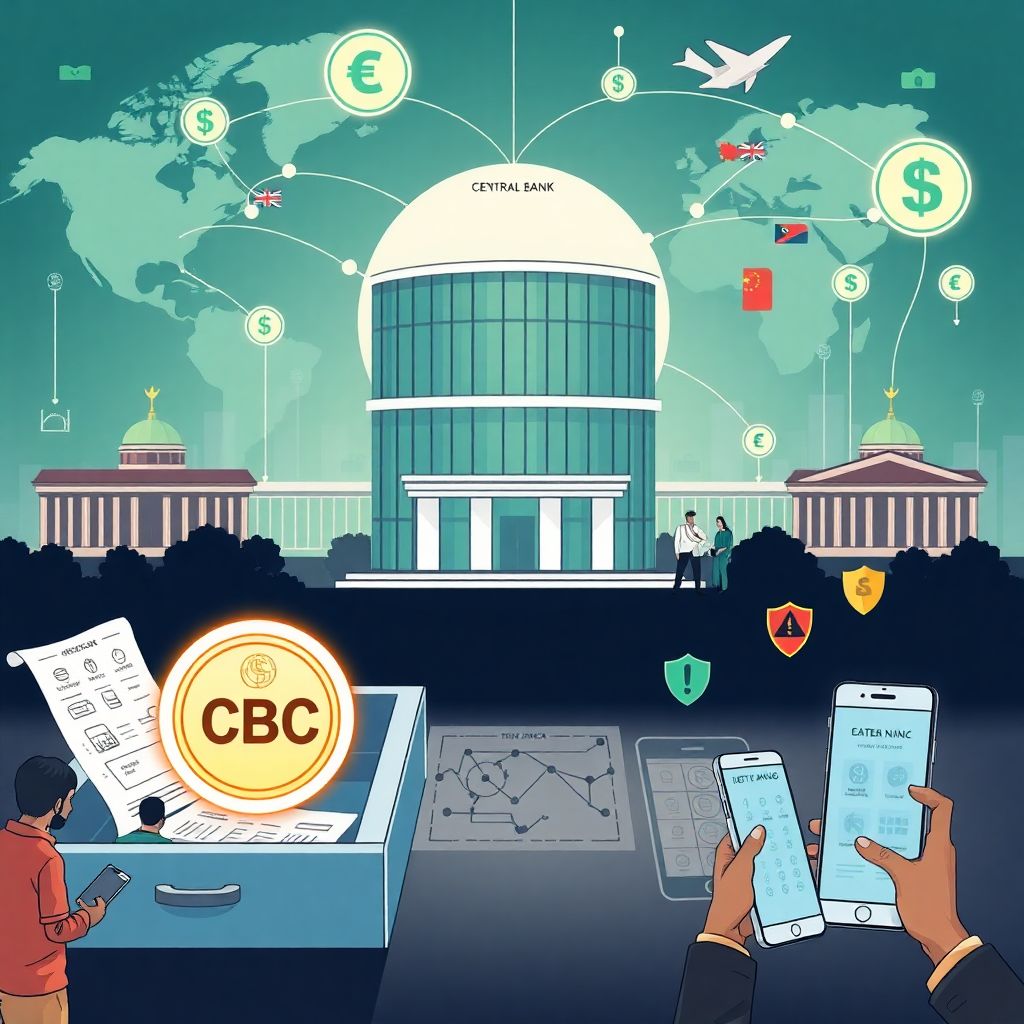
CBDC rollout stalls as central banks hit pause and rethink the risks
The global march toward central bank digital currencies (CBDCs) has slowed noticeably in 2025, as more monetary authorities step back from aggressive timelines and begin reassessing what a state‑issued digital currency would actually solve—and at what cost. Rather than a straight line toward digital cash, the landscape now looks more like a patchwork of experiments, delays, and strategic pivots.
South Africa is one of the clearest examples of this shift. The South African Reserve Bank (SARB) has decided to put its retail CBDC plans on the back burner and instead channel its energy into modernizing the country’s existing payment rails. The central bank openly acknowledges gaps in the national payment system and now believes these weaknesses must be addressed first if any future CBDC is to gain traction.
According to SARB’s own assessments, around 16% of South African adults still do not have access to formal banking services. A large segment of the population remains heavily dependent on cash for everyday purchases, remittances, and savings. For policymakers, that raises a crucial question: is a sophisticated new digital currency the right first step, or is it more realistic to improve access to basic, fast, low‑cost digital payment channels using infrastructure that already exists?
In its latest report, the central bank outlines clear criteria that any retail CBDC would have to meet before rollout could even be considered. The digital currency must mimic the defining attributes of physical cash: it should work offline, be accepted widely, be simple enough for non‑technical users, and come with strong privacy protections. Until those conditions can be met at scale, SARB sees more value in strengthening the underlying payment ecosystem—such as interbank settlement systems and connectivity between financial institutions—rather than launching a token that the market may not be ready to use.
The bank’s document also underscores that a retail CBDC might still make sense in the future, but only once the benefits clearly outweigh the implementation and maintenance costs. For now, the focus is on upgrading settlement infrastructure and improving interoperability. A better‑connected financial system, the reasoning goes, creates the foundation on which a CBDC could be plugged in later, should it become the logical next step.
South Africa’s caution is heavily informed by the experience of early adopters. Several countries that have already rolled out CBDCs have seen slower‑than‑expected user uptake, underwhelming transaction volumes, or lingering confusion about why citizens should switch from existing mobile payment apps and bank transfers. This uneven adoption pattern has become a reference point for central banks that want to avoid investing in high‑profile digital projects that fail to capture public interest.
The slowdown in CBDC deployment is not driven by a single factor, but by a convergence of concerns. Regulatory uncertainty looms large, particularly around stablecoins. As dollar‑pegged and other asset‑backed tokens grow more popular, central banks are now asking whether the private sector might already be filling many of the roles a CBDC was supposed to play—such as faster cross‑border payments or 24/7 settlement.
Some jurisdictions, like South Korea, have shifted focus from CBDC pilots to passing comprehensive rules for stablecoins and digital assets. Instead of rushing to launch a state‑controlled alternative, regulators there are trying to establish clear standards for privately issued tokens, hoping to harness innovation without undermining financial stability. In the United Kingdom, policymakers are also weighing whether improving regulation and supporting private payment solutions might achieve similar policy objectives at a lower cost than a full‑scale retail CBDC.
Economic calculus is another brake on momentum. Designing, testing, securing, and rolling out a national digital currency is a multi‑year, resource‑intensive process. At a time of global macroeconomic uncertainty, many governments prefer to direct funding and political capital toward more immediate priorities, such as fiscal support, social programs, or upgrades to legacy banking systems. When existing digital payment services are seen as “good enough” for most users, the argument for an entirely new monetary infrastructure becomes less compelling.
Central banks are also wary of how the public might react. There are persistent worries that a CBDC could be met with skepticism or even resistance if citizens perceive it as a tool for greater state surveillance or as a threat to commercial banks. If individuals decide to move large portions of their deposits from private banks into a risk‑free CBDC wallet, that could destabilize the traditional banking model and complicate credit creation. This scenario—often referred to as “disintermediation”—is at the center of many internal debates.
Another dimension is technological risk. Building a digital currency that operates reliably, remains secure against cyberattacks, and supports offline payments at scale is not trivial. A major outage, data leak, or security failure involving a CBDC platform could damage trust not just in the project, but in the central bank itself. For risk‑averse institutions, the downside of a public failure often outweighs the reputational upside of being seen as a digital pioneer.
Despite the headlines about delays, the global CBDC story is far from one‑sided. A number of emerging markets, particularly in the Middle East and across Africa, are moving in the opposite direction and accelerating their investigations and pilots. For these countries, the potential upside is substantial: CBDCs are framed as tools to expand financial inclusion, reduce reliance on cash, and bring more economic activity into the formal sector.
Competition is also a factor. China’s digital yuan is already being tested more widely, with pilot programs running in various cities and use cases expanding beyond domestic retail payments. For some governments, the growing footprint of the digital yuan, especially in cross‑border trade discussions, has become a strategic concern. They fear being left behind in a world where digital currency standards could shape future payment corridors and economic influence.
Still, among advanced economies, the dominant stance in 2025 is caution. Many of these countries are deliberately “hitting the brakes” to re‑evaluate the macroeconomic implications, fine‑tune designs to protect privacy and bank stability, and observe how regulation of stablecoins and crypto markets evolves. Rather than racing ahead, they are choosing to wait for clearer signals about demand, regulation, and technology.
One emerging trend is a growing interest in wholesale CBDCs—digital currencies used only by banks and financial institutions for interbank settlement—rather than retail versions aimed at the general public. Wholesale models are viewed as easier to control, more directly tied to existing central bank functions, and less likely to disrupt commercial banking. South Africa’s latest stance reflects this pivot, as the central bank focuses on wholesale use cases and cross‑border settlement experiments while shelving a broad retail rollout.
The debate is also shifting from “whether” to launch a CBDC to “how” to structure it. Central banks are exploring different architectures, such as token‑based versus account‑based models, and varying degrees of anonymity. Some are studying hybrid systems where private intermediaries handle customer interfaces while the central bank controls the core ledger. The goal is to strike a balance between innovation, user convenience, and monetary sovereignty.
Public communication is becoming increasingly important. Officials are learning that technical pilots and internal reports are not enough; citizens need clear explanations of what a CBDC is, what it is not, and how it would affect their day‑to‑day lives. Without a compelling narrative—whether around cheaper remittances, safer digital savings, or universal access—many people simply see no reason to change their payment habits.
At the same time, the CBDC conversation cannot be separated from broader digital finance trends. The rapid rise of real‑time payment systems, mobile money, and digital wallets has already transformed how people send and receive funds. In some markets, these tools have achieved many of the goals once associated with CBDCs, such as instant settlement and low transaction costs. This raises a strategic question for policymakers: is a CBDC still necessary, or should they double down on improving and regulating the systems that are already working?
Some experts argue that even if the immediate consumer use case is not obvious, CBDCs could play a long‑term role as foundational infrastructure. A programmable, interoperable digital base layer controlled by the central bank could enable new types of financial products, simplify compliance, and support machine‑to‑machine payments in an increasingly automated economy. Others counter that such ambitions can be met through well‑regulated private solutions and upgraded legacy infrastructure.
Geopolitics also plays a subtle but powerful role in these decisions. Countries are aware that whoever sets the standards for cross‑border CBDC use—whether for trade, remittances, or reserve management—could gain influence over global finance for decades. That is why some states proceed, even cautiously, with pilots and technical partnerships, aiming to be at the table when international norms are eventually written.
For now, the global CBDC journey resembles a long test phase rather than a switch‑on moment. South Africa’s recalibration captures the current mood: digital currencies remain a serious option, but not at any cost, and not without first securing a modern, inclusive, and resilient payment system. Whether CBDCs ultimately become everyday money, remain niche wholesale tools, or fade in relevance as private solutions dominate will depend on choices being made in this slower, more reflective phase of development.