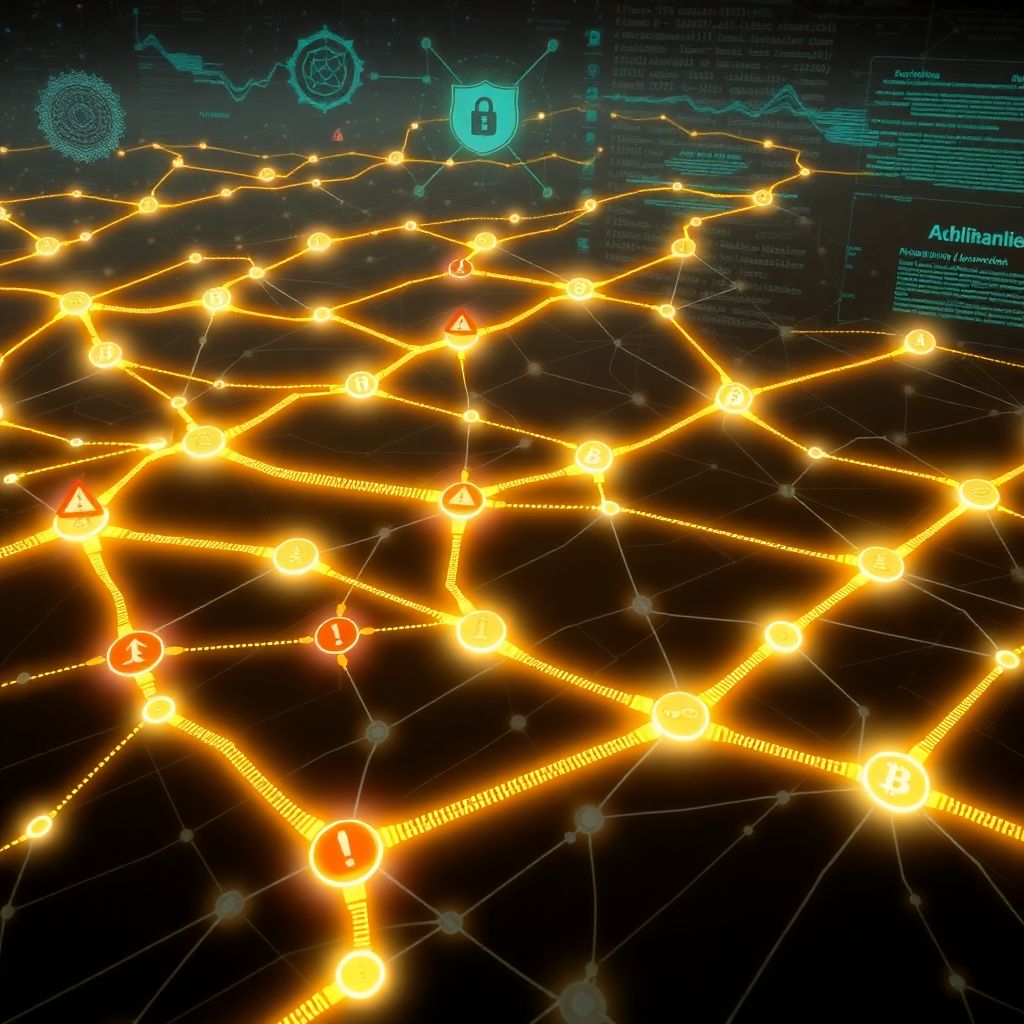
A recent investigation conducted by Lazarus Security Lab, the research division of crypto exchange Bybit, has unveiled that 16 prominent blockchain networks possess the ability to freeze users’ digital assets directly on-chain. This revelation challenges the foundational belief in blockchain’s decentralized nature, raising questions about how much control these networks can actually exert.
The report, described as the first large-scale analysis of blockchain freezing capabilities, examined 166 different networks. Of those, 16 were confirmed to have built-in mechanisms that allow asset freezing, while an additional 19 were found to have the potential to implement similar features in the future. These findings are particularly significant in the context of decentralized finance (DeFi), where user autonomy and resistance to censorship are core principles.
To uncover these capabilities, Bybit’s team employed a combination of AI-driven analysis and manual code audits. Since most blockchains do not publicly document fund-freezing features, a deep dive into source code was required. The study categorized the freezing mechanisms into three primary types, though specific technical classifications were not detailed in the public summary.
The research found that these mechanisms enable blockchain operators—such as foundations, validators, or core developers—to restrict or entirely block certain transactions. This level of control mirrors traditional financial institutions, which can freeze bank accounts under regulatory orders. While these tools are often introduced to respond to hacks or major security threats, they also introduce a layer of centralized authority that many in the crypto space find controversial.
Among the most notable real-world applications of such mechanisms was the 2025 incident involving the SUI Foundation. Following a massive exploit of the Cetus Protocol that led to over $220 million in losses, the foundation froze $162 million in assets to mitigate further damage. In response to similar risks, Aptos later integrated a blacklisting capability into its protocol.
In another major case, the BNB Chain responded to a 2022 bridge exploit—valued at $570 million—by using hardcoded blacklists to prevent the attacker from moving the stolen funds. Even earlier, in 2019, VeChain successfully froze $6.1 million worth of assets after a security breach. The report also noted that Cosmos’s modular account design could potentially support similar intervention mechanisms in the future.
These examples illustrate how freezing functions can serve as emergency response tools during high-stakes events. However, their existence also raises philosophical concerns. For a technology lauded for its decentralization and resistance to censorship, the ability to unilaterally freeze funds can appear contradictory.
Bybit emphasized that the goal of the study is not to condemn these capabilities but to promote transparency. In a rapidly evolving digital asset landscape, understanding which networks can intervene in transaction flows is crucial for risk assessment and informed decision-making for both developers and investors.
The debate surrounding blockchain governance is not new but has gained renewed urgency with the rise of DeFi and increased regulatory scrutiny. The ability to freeze assets can help platforms comply with legal requirements, such as responding to court orders or sanctions. However, critics argue that this compromises the very ethos of blockchain: trustlessness and user empowerment.
From a legal standpoint, these mechanisms could become more common as regulators push for greater accountability in the crypto sector. Countries around the world are developing frameworks that require more oversight and control, especially in cases of illicit activity. Blockchains that offer freezing functionality may be better positioned to meet these demands, but at the cost of decentralization.
Moreover, the presence of such features often goes unnoticed by retail users, who may assume that all blockchains operate under the same decentralized values. Bybit’s report aims to fill this knowledge gap and encourage more scrutiny of protocol design choices.
It’s also worth noting that not all freezing capabilities are inherently negative. In some instances, they may protect users from catastrophic losses. However, the balance between user protection and protocol control remains delicate.
As the crypto industry matures, more networks may face pressure to include emergency tools like fund freezing. Developers will need to consider how to implement these functions transparently, possibly through community governance or smart contract-based voting systems, rather than unilateral action by a centralized authority.
Future innovations could focus on hybrid models—systems that maintain decentralization under normal conditions but allow for emergency interventions through pre-approved multi-signature governance frameworks. This would preserve user trust while enhancing resilience against attacks.
Ultimately, awareness and education are key. Users must understand the trade-offs embedded in each blockchain they use. Transparency reports, technical audits, and clearer documentation will be essential in fostering accountability across the ecosystem.
Bybit’s study marks a critical step forward in opening up this conversation. As blockchain technology becomes more embedded in financial infrastructure, the industry must address the tension between decentralization and necessary oversight. The findings urge all stakeholders to reconsider what true decentralization should look like in practice—and whether absolute autonomy is always the best path forward.