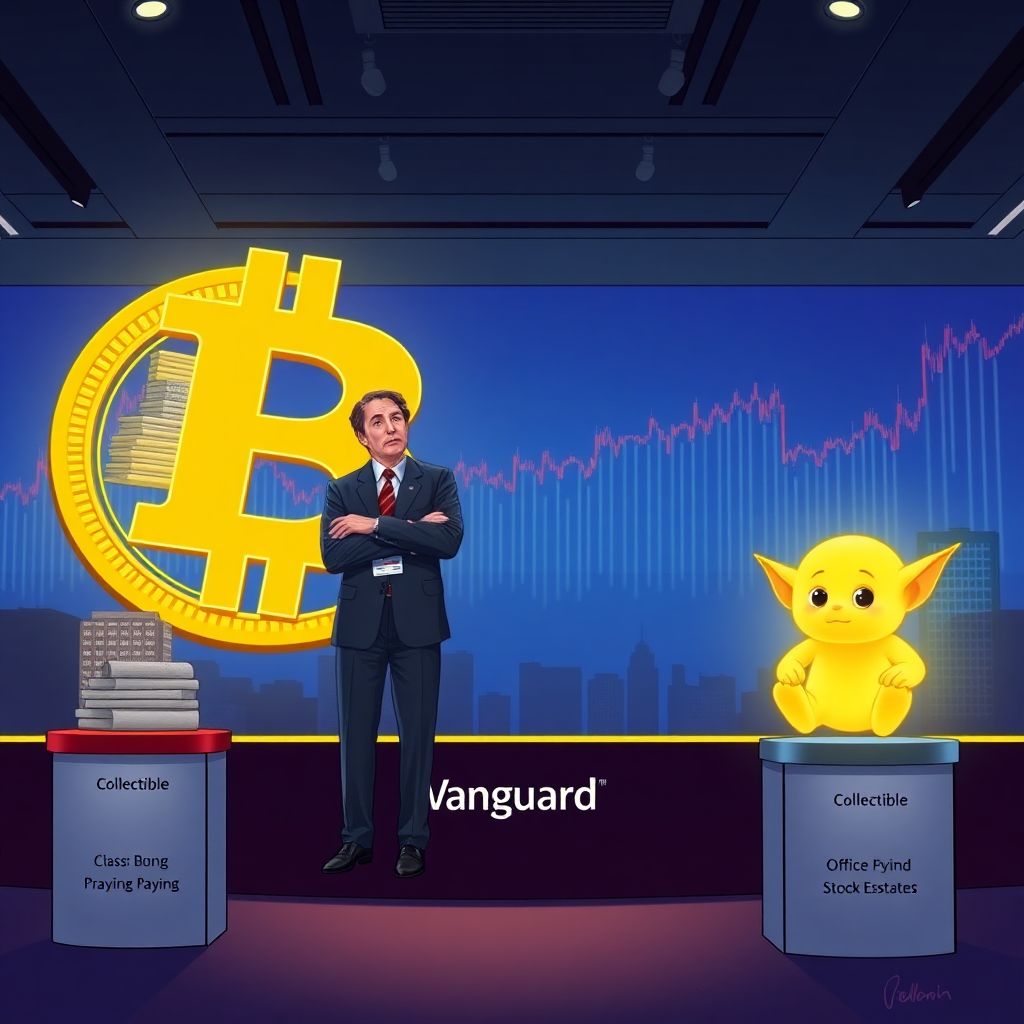
‘Digital Labubu’: Why Vanguard Still Keeps Bitcoin at Arm’s Length
Bitcoin is again facing a familiar tension: growing institutional access on one side, stubborn institutional disbelief on the other. Nowhere is this contradiction more visible than at Vanguard, which has quietly opened the door to Bitcoin exposure while still publicly questioning whether the asset deserves any place in a long‑term portfolio.
At the same time that Bitcoin has pulled back from its recent highs — trading around 92,000 dollars at the time of writing, extending a decline from its latest peak, according to market data — one of the world’s largest asset managers has chosen this moment not to celebrate the asset’s success, but to ridicule it.
Vanguard’s “digital Labubu” jab
Speaking at Bloomberg’s ETFs in Depth event in New York, John Ameriks, Vanguard’s Global Head of Quantitative Equity, was asked directly whether Bitcoin deserves to be considered an investment. His response was blunt and deliberately dismissive.
Ameriks likened Bitcoin to a “digital Labubu,” referencing the viral elf‑like plush toy that has become a collectible fad. The analogy was not a throwaway joke; it was a carefully chosen metaphor to emphasize Vanguard’s core view that Bitcoin is closer to a speculative trinket than a productive financial asset.
In Ameriks’ framework, Bitcoin offers “no income, no compounding, and no cash flow.” That means, unlike bonds that pay coupons, stocks that generate earnings and dividends, or real estate that produces rent, Bitcoin sits outside the traditional toolkit Vanguard uses to build portfolios geared toward long‑term wealth creation.
For that reason, the roughly 12‑trillion‑dollar asset manager categorizes Bitcoin as a collectible instead of a productive asset. In the same way that art, rare wine, or toys like Labubu may rise in price based on scarcity and sentiment, Bitcoin’s value, in Vanguard’s view, is more about what the next buyer is willing to pay than about any intrinsic economic output.
Ameriks went further, arguing that Vanguard has seen “no proof that the technology behind it offers lasting economic value.” This stands in sharp contrast to the narrative from crypto proponents, who present Bitcoin and its underlying blockchain as transformative innovations in money, settlement, and digital ownership.
Old criticisms in new packaging
By invoking a “digital Labubu,” Ameriks placed himself in a long line of skeptics who have compared Bitcoin to previous speculative bubbles: Dutch tulip mania in the 17th century, collectible Beanie Babies in the 1990s, or more recently meme‑driven assets that spiked and crashed on sentiment alone.
The shared theme in these comparisons is the “greater fool theory”: an asset can keep rising so long as a “greater fool” is willing to buy it at a higher price later. In this lens, scarcity alone is not enough. Without cash flows, income, or clear real‑economy utility, price appreciation rests on collective belief — and that belief, skeptics argue, can evaporate suddenly.
Supporters of Bitcoin challenge this view, insisting that the network’s security, censorship‑resistant transactions, and predictable monetary policy give it properties unmatched by traditional assets. But Vanguard’s public stance signals that, for now, those arguments have not convinced one of the most influential gatekeepers in global finance.
The paradox: Access without belief
The striking part is not just Vanguard’s skepticism. It is the fact that, despite these strong views, the company has simultaneously taken a major step toward normalizing Bitcoin access for its clients.
Under new CEO Salim Ramji — a former BlackRock executive with deep experience in ETFs and exposure to digital asset initiatives — Vanguard has reversed years of hardline resistance to crypto. The firm now permits trading of crypto‑focused exchange‑traded funds on its brokerage platform.
These ETFs hold underlying assets such as Bitcoin, Ethereum, Ripple’s XRP, and Solana, and now sit in clients’ accounts alongside traditional exposures like gold, stock funds, and bond ETFs. For more than 50 million brokerage customers, this means crypto is no longer technically “outside” the Vanguard universe.
Ameriks explained that the turning point came after the launch of spot Bitcoin ETFs in January 2024. According to him, these products helped improve market infrastructure, tighten spreads, and add liquidity, making access more operationally feasible and less disruptive during bouts of volatility.
Critically, though, he drew a clear line between access and endorsement. In his words, Vanguard simply allows clients “to hold and buy these ETFs on our platform if they wish to do so, but they do so with discretion.” The firm will not advise whether to buy or sell, or which cryptocurrencies to favor.
This approach underscores a fundamental paradox of the maturing crypto market: Bitcoin is being integrated into the plumbing of the financial system by institutions that still, at a philosophical and research level, do not actually believe in it.
A major policy U‑turn — with a catch
For years, Vanguard’s name was often synonymous with a strict “no crypto” stance. While other large managers explored Bitcoin futures, custody solutions, or tokenization experiments, Vanguard kept its distance and emphasized classic building blocks: low‑cost equity and bond funds, diversification, and long time horizons.
That posture changed dramatically on 2 December, when the firm began allowing broker clients to trade crypto ETFs and associated mutual funds. In practical terms, this cracked open the door to Bitcoin and other digital assets for millions of retail investors who primarily interact with markets through Vanguard.
The shift did not happen in a vacuum. Vanguard leadership cited growing client interest and the proven resilience of the ETF structure during periods of turbulence. Andrew Kadjeski, head of brokerage and investments at the firm, noted that ETFs holding volatile assets had generally maintained functioning markets and sufficient liquidity, even in stress.
Yet despite opening the gates, Vanguard has refused to release its own spot Bitcoin ETF or any in‑house crypto fund. That decision is as telling as Ameriks’ “digital Labubu” quip. The firm is willing to host third‑party products to avoid losing clients to competitors, but it is not willing to attach its brand to the thesis that Bitcoin is a cornerstone of long‑term wealth building.
Why Vanguard’s stance matters so much
Vanguard is not just another asset manager; it is a central architect of today’s passive investment landscape and a leading voice in how ordinary savers think about risk and return. Its model portfolios, white papers, and investment frameworks shape retirement accounts and advisory practices worldwide.
When such a heavyweight publicly categorizes Bitcoin as a collectible rather than a productive asset, it sends a powerful signal to pension funds, endowments, and financial advisors. Many of these institutions rely heavily on traditional asset allocation lenses, where each holding must justify its place through measurable contributions to income, diversification, and long‑run compounding.
Vanguard’s skepticism may therefore have a chilling effect on the speed of institutional Bitcoin adoption, especially among organizations with strict investment policies. While some hedge funds, family offices, and more flexible asset managers may embrace BTC, ultra‑conservative pools of capital might remain on the sidelines until gatekeepers like Vanguard soften their stance.
The business logic behind “skeptical access”
From a business perspective, Vanguard’s approach can also be seen as a balancing act between client demand and corporate philosophy.
On one side, refusing to offer any form of crypto exposure would risk making the platform look outdated, especially as younger investors increasingly expect to access digital assets through the same interfaces they use for stocks and ETFs. On the other side, fully embracing Bitcoin would require rewriting long‑held principles emphasizing income‑producing assets, fundamental valuation, and behavioral discipline.
Allowing trading in third‑party Bitcoin and crypto ETFs — while openly labeling them speculative and refraining from product launches — allows Vanguard to thread the needle. It keeps clients within its ecosystem, meets demand for access, but preserves the firm’s ability to say, “We warned you,” if sharp drawdowns occur.
This posture also helps protect Vanguard from reputational blowback. If a future crypto crash wipes out a large share of value, the firm can point to its documented skepticism and lack of house‑branded products as evidence that it did not push clients into the trade.
What this reveals about institutional crypto adoption
Vanguard’s position highlights a broader pattern in institutional crypto adoption: for many large firms, the path is less about ideological conversion and more about incremental, reluctant integration.
Banks, brokerages, and asset managers may build custody solutions, list futures or ETFs, or allow crypto transfers — not because they are convinced Bitcoin is “digital gold,” but because client expectations and competitive pressures demand it. Infrastructure grows even while conviction lags.
This creates a layered ecosystem where:
– Retail investors and crypto‑native funds may be enthusiastic long‑term holders.
– Some institutions treat Bitcoin as a tactical trading instrument.
– Conservative giants like Vanguard view it as a speculative collectible that must be ring‑fenced from core portfolio theory.
For Bitcoin, this is both an opportunity and a constraint. Access keeps expanding, making it easier for capital to flow in and out. But the narrative that it belongs beside stocks and bonds as a strategic allocation is still far from universally accepted.
Can Bitcoin prosper without Vanguard’s blessing?
A central question emerges: can Bitcoin continue to grow in adoption and value even if its largest gatekeepers never fully embrace it as a core investment?
History suggests it might. Bitcoin’s rise has been driven less by unanimous institutional endorsement and more by a combination of grassroots adoption, macroeconomic hedging, technological enthusiasm, and, at times, speculative fervor. Many asset classes — from gold to emerging market equities — have gone through long periods where major institutions were late or skeptical.
However, the lack of active promotion from dominant players like Vanguard could limit how deeply Bitcoin penetrates into retirement plans, target‑date funds, and ultra‑conservative portfolios. Without that integration, its investor base may remain more cyclical and sentiment‑driven, reinforcing the very boom‑and‑bust dynamics that skeptics cite as reasons to stay away.
Paradoxically, this can become a feedback loop: institutions hold back because of volatility; volatility remains high because institutions hold back.
The deeper philosophical clash
Underneath the public soundbites lies a more fundamental disagreement about what money and investment should be.
Vanguard’s philosophy has been built on:
– Broad diversification across productive assets.
– Long‑term compounding of income and growth.
– Minimizing speculation and trading.
Bitcoin, by contrast, is:
– A non‑yielding monetary asset with a fixed supply.
– Priced mostly by market sentiment and macro narratives.
– Still searching for a universally agreed‑upon role — store of value, hedge, growth asset, or something else entirely.
From Vanguard’s vantage point, something that does not generate cash flows and still exhibits extreme volatility is difficult to justify as a building block for retirement portfolios. From a Bitcoiner’s perspective, that very scarcity and independence from traditional financial systems is the point.
This philosophical gap may not close quickly, even as infrastructure converges.
What investors should take from Vanguard’s stance
For individual investors, Vanguard’s dual approach — access with skepticism — offers a useful template for thinking about Bitcoin.
It implicitly suggests that:
– Bitcoin can be accessed conveniently through regulated products.
– It should not, in Vanguard’s view, displace the core of a diversified portfolio built on productive assets.
– Any allocation is more akin to buying a collectible or speculative hedge than to purchasing income‑generating securities.
Investors who disagree with Vanguard and hold a strong conviction in Bitcoin’s long‑term role might still choose significant exposure. But understanding why a firm like Vanguard remains unconvinced can help sharpen one’s own thesis, risk management, and time horizon.
A market growing up — and arguing with itself
Bitcoin’s retreat from its highs, the expansion of spot ETF access, and Vanguard’s “digital Labubu” remark together capture a market in transition. Crypto is no longer a fringe experiment, yet it is not fully integrated into the heart of institutional portfolio theory.
Vanguard’s journey — from outright refusal to grudging enablement, without true endorsement — encapsulates the paradox of this moment. Bitcoin has forced its way into the mainstream infrastructure of finance, even as some of its biggest gatekeepers continue to doubt that it deserves to stay there.
Whether Bitcoin ultimately proves the skeptics wrong, or whether it ends up remembered as another speculative collectible, will depend less on one firm’s view and more on how the asset weathers future cycles, regulation, technological evolution, and real‑world use.
For now, the message from Vanguard is clear: you can buy Bitcoin on its platform, but you will not find it in the firm’s model portfolios — and you should not expect it to receive the same respect as stocks and bonds anytime soon.