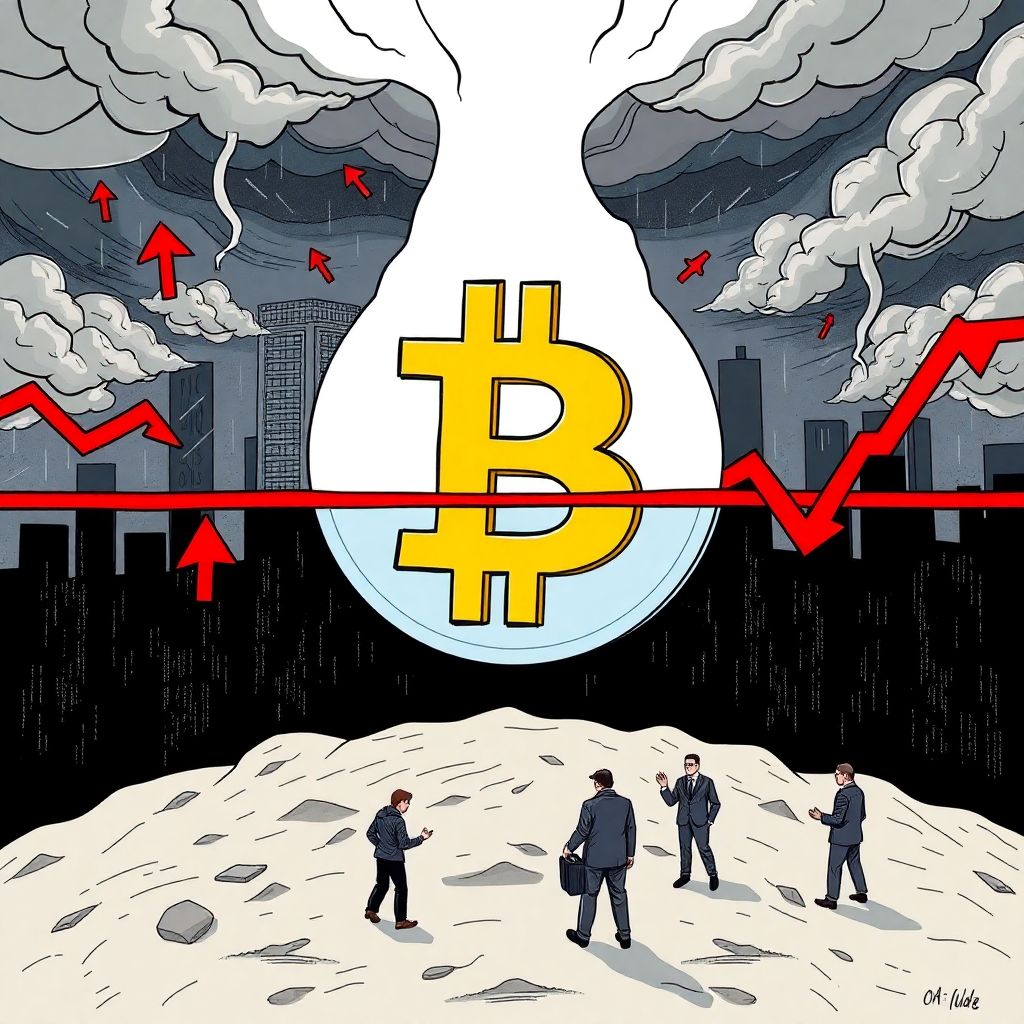
Bitcoin’s recent dip below the $95,000 mark has rattled markets, but experts urge caution before labeling the downturn a full-blown bear market. Despite the sharp decline, analysts argue that broader indicators still point to a market correction rather than a long-term reversal.
The flagship cryptocurrency slipped beneath $95K early Friday, briefly recovered, and then dropped again, reflecting increased volatility. This turbulence appears to be driven largely by short-term investors reacting emotionally to losses, rather than a fundamental shift in market sentiment.
A prominent analyst operating under the pseudonym CrazzyBlockk from on-chain analytics firm CryptoQuant noted that Bitcoin’s trajectory is often dictated by the profitability of its newest investors. These participants bring fresh liquidity into the ecosystem, and when they are sitting on gains, it tends to bolster overall market confidence. However, once these short-term holders begin to experience losses in the range of 20% to 40%, panic tends to set in.
“At that level of drawdown, we typically start to see widespread liquidation among speculative investors,” the analyst explained. “Historically, this kind of capitulation can signal the end of a correction phase, rather than the beginning of a prolonged bear market.”
Indeed, recent data shows that many traders who entered the market during Bitcoin’s rally to nearly $100,000 are now facing unrealized losses. But according to CrazzyBlockk, this pain threshold could actually reset the market and pave the way for a healthier uptrend in the near future.
Adding to the uncertainty are shifting expectations around U.S. Federal Reserve interest rate policy. Recent economic signals have complicated predictions about when the Fed might begin easing rates, leading to broader market skittishness. Cryptocurrencies, which often trade as risk assets, are particularly sensitive to such macroeconomic factors.
Despite the current price action, several on-chain metrics remain supportive. Long-term holders continue to accumulate, and miner selling has not significantly accelerated—both considered positive signs that the market is not entering a prolonged downtrend. Moreover, Bitcoin’s hash rate and network activity remain robust, indicating that the underlying infrastructure is healthy.
Market analysts also point out that drawdowns of 10% to 20% are not uncommon within larger bull runs. In fact, during previous market cycles, Bitcoin has experienced multiple such pullbacks before reaching new all-time highs. This volatility often serves to shake out weak hands and consolidate support before the next leg up.
Another factor to consider is institutional engagement. While retail sentiment appears shaken, large-scale investors have not yet shown signs of exiting their positions en masse. Inflows into Bitcoin ETFs have slowed but not reversed, suggesting that institutional conviction remains intact.
Technical indicators also offer a mixed but not entirely bearish picture. Bitcoin is currently testing key support levels, and while a drop below these could signal further downside, a strong bounce would confirm that buyers are stepping in at strategic price points.
Additionally, derivatives markets reveal that funding rates have normalized, and open interest is not excessively leveraged. This reduces the risk of cascading liquidations and suggests that much of the speculative froth has already been cleared.
Looking ahead, several upcoming catalysts could influence Bitcoin’s direction. These include potential regulatory developments, ongoing discussions about spot ETF approvals in other jurisdictions, and macroeconomic data releases related to inflation and employment. Any of these could trigger renewed momentum—upward or downward—depending on their outcomes.
In conclusion, while the recent price decline has understandably triggered anxiety among investors, the broader context suggests that Bitcoin is undergoing a healthy—if painful—market correction. Labeling it a bear market at this stage may be premature. The coming weeks will be critical in determining whether this is merely a temporary setback or the start of a more sustained downturn. Until then, seasoned investors are advised to stay focused on fundamentals, monitor key support levels, and avoid making emotionally driven decisions amidst the noise.