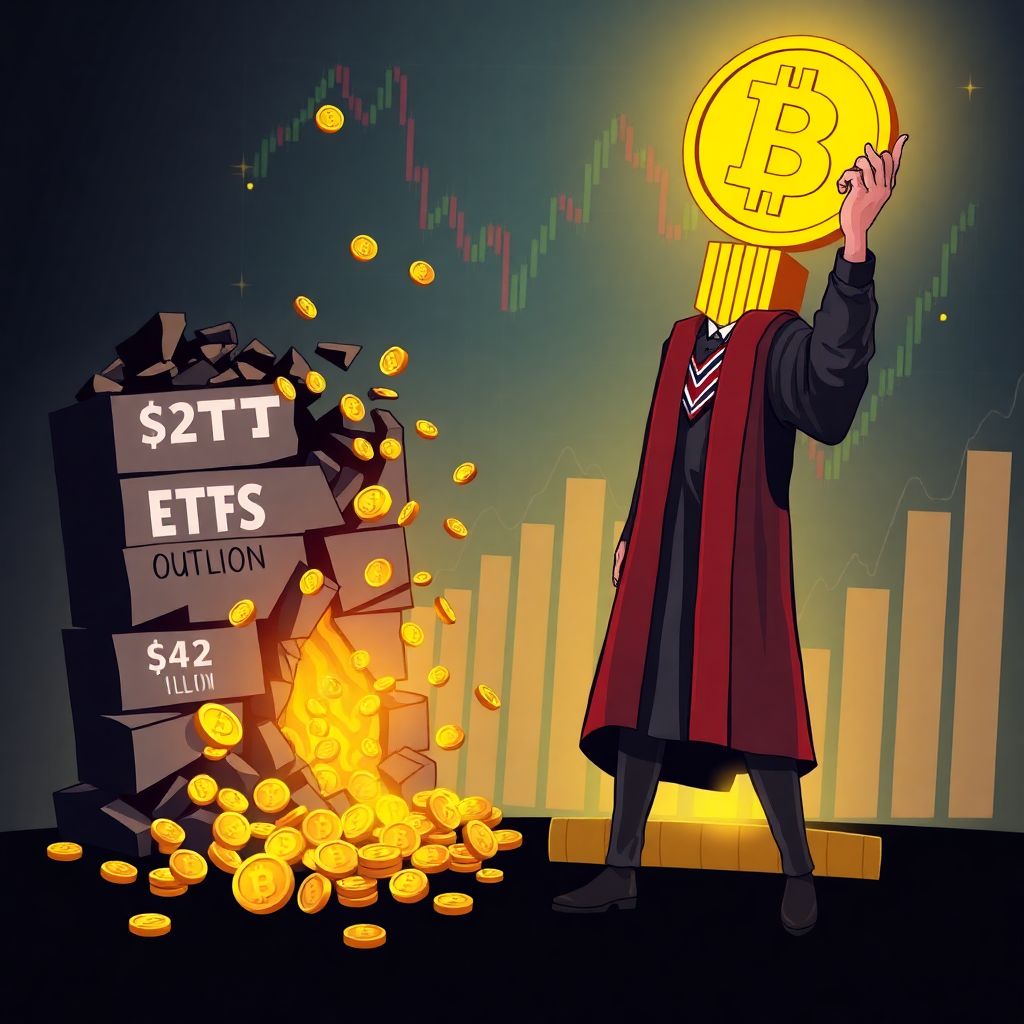
Bitcoin ETFs Face $2B in Redemptions as Harvard Makes Bold $442M Investment: Coincidence or Strategic Timing?
While Bitcoin’s price continues to fluctuate, recent developments suggest that institutional confidence in the asset remains strong. A striking contrast has emerged: as Bitcoin ETFs, particularly BlackRock’s IBIT, witness significant outflows, some heavyweight institutions like Harvard University are doubling down on the cryptocurrency. This divergence creates a compelling narrative—and potentially a prime opportunity for strategic investors.
Over the past two weeks, Bitcoin ETFs have collectively seen redemptions totaling approximately $2 billion. BlackRock’s iShares Bitcoin Trust (IBIT), once hailed for its steady inflows, has now experienced outflows on nine separate days in that short span. These redemptions have generally been driven by short-term traders and retail investors reacting to heightened market volatility and declining prices.
Yet, while some are fleeing the market, others are moving in with conviction. Harvard University has disclosed a $442 million position in Bitcoin, acquired through its investment in the IBIT ETF. This allocation now represents the largest holding in Harvard’s 13F filing, overtaking even the high-performing tech stocks often referred to as the “Magnificent Seven.” In effect, Harvard’s move may be seen as a strong stamp of approval for Bitcoin’s long-term potential—and for ETFs as a viable vehicle for institutional exposure.
This bold investment comes at a time when Bitcoin has pulled back sharply from its recent all-time high of $126,000, retreating to price levels not seen since the second quarter. While this decline has spooked short-term holders, it has presented what many see as an ideal entry point for long-term investors. The divergence between nervous retail traders and confident institutional buyers underscores a classic market setup: panic-driven selloffs often pave the way for strategic accumulation.
Further supporting this dynamic, blockchain analytics platform Lookonchain recently reported that a crypto whale purchased 251 BTC for approximately $24.18 million, bringing their total holdings to 4,169 BTC—worth over $400 million at the time of the transaction. The average cost basis of this buy was estimated at $96,345 per Bitcoin, indicating a belief in continued upward momentum despite recent dips.
This behavior aligns with the broader pattern of institutional accumulation during market downturns. While retail investors often act out of emotion, institutions typically seize volatility as an opportunity. Harvard’s significant allocation to Bitcoin, especially given its timing amid ETF outflows, could serve as a strong counter-indicator of market sentiment—what some might call “smart money” moving in while others move out.
Bitcoin’s long-term investment case remains intact. Despite recent volatility, the asset has managed to reach new all-time highs in 2024. Although its year-over-year return currently hovers around 2.62%—one of the weakest growth periods in recent memory—the broader trend suggests resilience. Institutional interest, particularly from legacy entities like Harvard, helps to validate Bitcoin’s role as a long-term store of value and a hedge against traditional financial market instability.
The current market bifurcation—between short-term fear and long-term conviction—is not new to Bitcoin. Historically, such splits have often preceded significant price movements. When high-profile institutions start accumulating an asset during periods of weakness, it often signals a potential inflection point. Harvard’s entry, paired with whale activity, indicates that this may be one of those moments.
For long-term investors, the current environment offers more than just a chance to buy at a discount. It represents an opportunity to align with institutional players who are betting on Bitcoin’s long-term narrative. The combination of ETF redemptions and strategic acquisitions sets the stage for a strong rebound, provided the broader macroeconomic environment remains favorable.
Additionally, Harvard’s move may encourage other institutional investors to follow suit. Large endowments and pension funds often look to their peers for cues on asset allocation. A high-profile stake from an Ivy League endowment could be the catalyst that pushes other funds off the sidelines, further reinforcing Bitcoin’s legitimacy in traditional finance circles.
It’s also worth noting that Bitcoin ETFs, despite recent outflows, remain a relatively new financial product. The volatility observed in funds like IBIT is not unusual in the early stages of ETF adoption, particularly for an asset as historically volatile as Bitcoin. As the market matures and more institutions enter, the capital flow into these vehicles is likely to stabilize, potentially transforming current headwinds into future tailwinds.
Moreover, the broader macroeconomic backdrop could amplify Bitcoin’s appeal. With persistent inflation concerns and geopolitical tensions, many investors are seeking non-correlated assets that can preserve value over time. Bitcoin, often dubbed “digital gold,” fits that profile for a growing number of asset allocators.
Ultimately, the contrast between ETF outflows and Harvard’s substantial investment highlights Bitcoin’s evolving market dynamics. While retail sentiment may waver, institutional conviction appears to be on the rise. Such divergence often precedes major shifts in price and perception.
As Bitcoin continues to mature, its investor base is becoming more sophisticated. The days of purely speculative retail-driven rallies are giving way to a more balanced market structure, where long-term capital plays a defining role. Harvard’s $442 million bet signals that the asset is no longer a fringe investment—it’s becoming part of the institutional mainstream.
In conclusion, whether Harvard’s move coincides with ETF redemptions by chance or design, it marks a pivotal moment for Bitcoin. The disparity between short-term pessimism and long-term confidence has created a unique window for strategic investors. As institutional players step in while others retreat, the market may be setting the stage for its next major chapter.