
Why a 10‑Year DCA Plan for Bitcoin and Ethereum Makes Sense

Thinking in decades, not days, radically changes how you approach crypto. Instead of hunting for quick wins, a 10‑year DCA (dollar‑cost averaging) plan treats bitcoin and Ethereum as long‑horizon, high‑volatility assets similar to early‑stage tech stocks. Historically, bitcoin has delivered annualized returns well above traditional markets, though with brutal drawdowns over 70–80%. Ethereum, since launch, has shown even higher upside with comparable risk. A structured bitcoin ethereum dca strategy helps smooth out this volatility by spreading entries across bull and bear cycles, turning price swings from a source of stress into a core part of your long‑term edge as an investor.
Core Principles of a Long‑Term Crypto Investment Plan
Any long term crypto investment plan for BTC and ETH rests on three pillars: time horizon, cash‑flow discipline and risk capacity. Ten years is long enough to span several halving cycles, regulatory shifts and at least one full boom‑and‑bust macro regime. Instead of asking “Will crypto go up next year?”, the better question is “What allocation can I hold through a 80% drawdown without panic‑selling?”. From there, you convert your monthly surplus cash into a fixed DCA schedule, automate purchases, and treat contributions like retirement savings: non‑negotiable, boring and systematic, irrespective of market sentiment.
How to Dollar Cost Average Crypto: Practical Setup
To understand how to dollar cost average crypto effectively, break it into simple steps. First, define a monthly amount that doesn’t compromise your emergency fund or essential expenses. Second, split that amount into a BTC/ETH ratio that matches your risk tolerance—conservative investors might lean more toward bitcoin, while growth‑oriented ones may overweight Ethereum. Third, use recurring buy features on reputable exchanges, ideally on a fixed day each week or month. Finally, export your transactions to a portfolio tracker or spreadsheet so you can monitor cost basis, realized volatility and progress toward your 10‑year target without obsessing over daily price moves.
Any Budget: Micro‑DCA vs. High‑Net‑Worth Allocations
A robust 10‑year plan scales from $20 a month to several thousand. For small budgets, “micro‑DCA” focuses on consistency over size; the psychology of sticking to the plan matters more than the absolute dollar amount in the early years. Fractional coins make this trivial: you can buy sats or gwei instead of whole units. Higher‑net‑worth investors, by contrast, must think harder about execution costs, custody solutions and jurisdictional tax rules. The mechanisms of DCA are identical, but portfolio construction, security architecture and exit liquidity planning become much more complex as capital scales into six or seven figures.
Using a Crypto DCA Calculator and Basic Forecasting
A simple crypto dca calculator is invaluable for setting expectations and stress‑testing your plan. By plugging in assumed annualized returns (for instance, 10%, 20% and 30%) and different monthly contributions, you can visualize a range of outcomes rather than anchoring on a single bullish scenario. Experts recommend running bearish cases as well—flat or even slightly negative real returns—to see whether your plan still makes sense psychologically. This probabilistic mindset helps you internalize that no outcome is guaranteed, even with bitcoin’s historically strong performance, and prepares you to stay rational through multi‑year sideways markets.
Statistical Context: Volatility, Drawdowns and Correlations
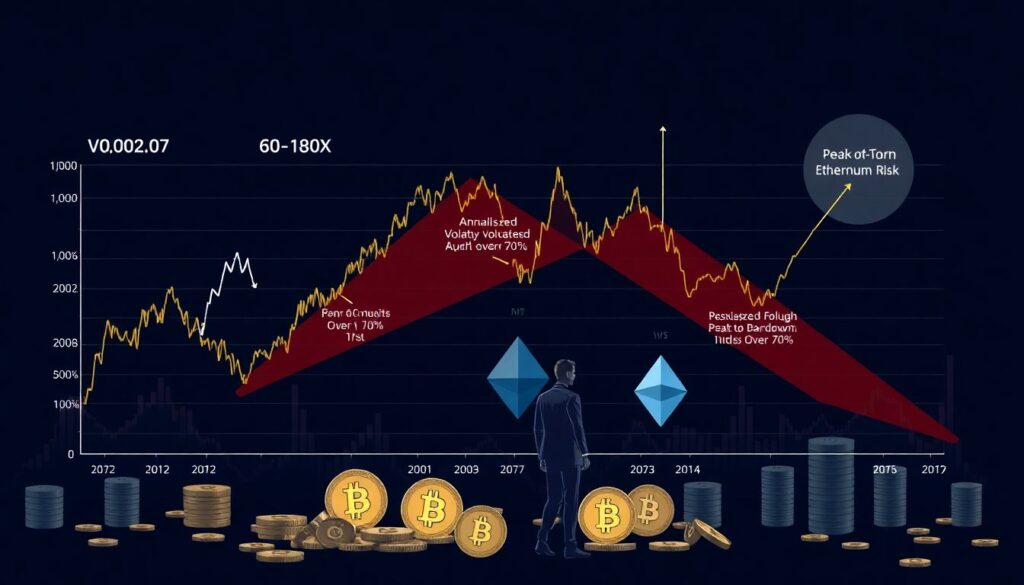
Historically, bitcoin’s annualized volatility has hovered around 60–80%, several times higher than major stock indices. Ethereum has often been even more volatile, reflecting its higher beta and platform risk. Both assets have seen repeated peak‑to‑trough drawdowns exceeding 70%, yet long‑term holders have been compensated with substantial cumulative returns over multi‑year windows. Correlation with equities has risen since 2020, especially during macro stress, but still leaves room for diversification. A decade‑long DCA strategy is explicitly built to harness this volatility: large price shocks translate into opportunistic accumulation at lower cost bases rather than catastrophic timing errors.
Building the Best Bitcoin Ethereum Investment Strategy Mix
The best bitcoin ethereum investment strategy for a 10‑year window generally treats bitcoin as the “digital monetary premium” and Ethereum as the “programmable settlement layer” with higher tech and regulatory risk. Many portfolio theorists suggest anchoring allocation to bitcoin due to its clearer monetary narrative and lower protocol complexity, then layering Ethereum for additional upside tied to smart contracts, DeFi and staking economics. A common baseline is something like 60/40 BTC/ETH for moderate risk, but there’s no universal formula; the allocation should reflect your conviction in each asset’s underlying value proposition and your tolerance for platform‑specific risk.
Economic Drivers and Supply Dynamics
From an economic perspective, bitcoin’s hard‑capped supply and quadrennial halving events create a supply‑side shock mechanism that historically has correlated with cyclical bull runs. Ethereum, following the merge to proof‑of‑stake and EIP‑1559, has introduced a dynamic fee‑burn that can reduce net issuance, making ETH potentially deflationary during high network activity. A 10‑year plan implicitly bets on sustained or growing demand for secure blockspace and censorship‑resistant value storage. Macroeconomic factors like negative real rates, sovereign debt stress and declining trust in fiat regimes can amplify this demand, but they also increase regulatory and policy uncertainty.
Industry Impact and Network Effects Over a Decade
DCA into BTC and ETH is, in effect, a long‑term vote on the future of the broader crypto infrastructure stack. As capital accrues to these base layers, it reinforces network effects: more liquidity, deeper derivatives markets, richer tooling and more institutional adoption. Ethereum’s DeFi and rollup ecosystems depend on ETH’s economic security, while bitcoin’s role as reserve collateral in on‑chain and off‑chain systems continues to expand. Over ten years, steady demand from retail and institutional DCA flows can smooth cyclical shocks and support more predictable funding for miners, validators and protocol‑level research and development.
Expert Recommendations on Risk Management
Professional portfolio managers emphasize that a 10‑year DCA plan should start with a top‑down asset‑allocation decision, not with chasing narratives. Common expert guidelines include: limit total crypto exposure to a small percentage of net worth (often cited ranges are 1–10% depending on risk profile); keep an emergency fund in fiat or low‑volatility assets; and avoid leverage entirely when building a DCA position. Security is another pillar: use hardware wallets, segregate long‑term holdings from trading accounts and document recovery procedures. Your ability to stay solvent and emotionally stable through downturns is ultimately a more powerful edge than any market timing signal.
- Define a maximum crypto allocation as a % of net worth and stick to it regardless of hype cycles.
- Prioritize self‑custody for long‑term holdings; treat exchanges as on‑ramps, not vaults.
- Reassess your risk tolerance annually or after major life events, not after big price moves.
Designing a Concrete 10‑Year DCA Schedule
Translating theory into a schedule is straightforward. Choose a contribution frequency (weekly or monthly), lock in the BTC/ETH split and automate. Many investors prefer weekly buys to reduce timing clustering around single days. Rebalancing between bitcoin and Ethereum once or twice a year can prevent one asset from dominating the portfolio after large relative moves, though some experts advocate “let your winners run” with only soft bands to reduce transaction costs. The key is to document the rules in advance so that, during volatility spikes, you’re executing a pre‑committed plan rather than improvising under emotional pressure.
- Pick a fixed contribution day and automate purchases to reduce behavioral interference.
- Use simple rebalance rules (e.g., restore target weights if one asset drifts by more than 10%).
- Log each change to your strategy with a written rationale to avoid impulsive tinkering.
Forecasts, Scenarios and When to Exit
Forecasts for BTC and ETH over a decade range from collapse scenarios to multi‑trillion‑dollar market caps, and honest analysts treat these as probability distributions, not certainties. Scenario planning helps: imagine conservative outcomes where both assets merely track or slightly outperform equities, and extreme ones where they become core components of the global financial stack. Your exit strategy might be goal‑based (e.g., sell enough to pay off a mortgage) or time‑based (start de‑risking after year eight). Embedding these rules into your long term crypto investment plan helps you avoid the trap of holding indefinitely out of pure greed or narrative attachment.
Putting It All Together

A disciplined 10‑year DCA plan into bitcoin and Ethereum doesn’t require a large income, but it does demand intellectual honesty, risk awareness and process. By combining clear allocation limits, automated recurring buys, periodic reviews and realistic scenario analysis, you create a framework that can weather both euphoric bull markets and grinding bear phases. You’re not trying to pick tops or bottoms; you’re systematically acquiring exposure to two foundational crypto assets whose long‑run trajectories will be shaped by macroeconomics, regulation and technological progress. In that context, consistency and patience become your primary sources of alpha.