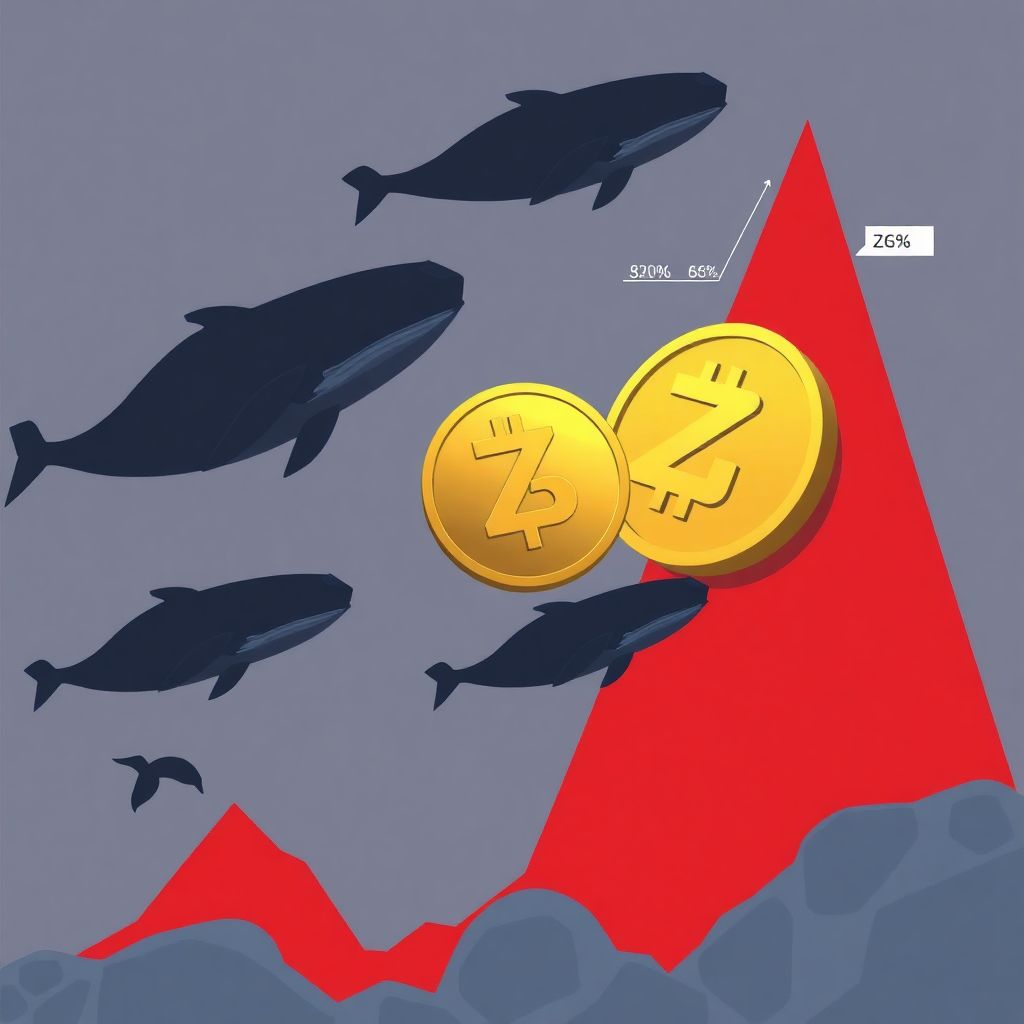
Zcash at risk of 66% slide as whales dump 38% of holdings
Zcash is flashing a cluster of bearish signals as major investors sharply cut exposure, raising the risk of a deep correction despite a modest rebound in recent days.
Over the past 24 hours, ZEC has dropped around 7%, underperforming an already weak crypto market. On a weekly timeframe, the privacy-focused coin is still up roughly 5.8%, but that short-term strength is overshadowed by a steep month‑over‑month decline of more than 40%. The price action reflects a market that is struggling to hold any upside momentum while larger structural pressures intensify.
Whales trim positions by 38% in one week
On-chain data paints a particularly troubling picture for Zcash holders. Addresses classified as large holders — the so‑called “whales” — have reduced their ZEC positions by about 38% over the last seven days. Additional selling has been recorded in the most recent 24‑hour window, suggesting that the distribution phase is still in progress rather than nearing an end.
At the same time, exchange inflows have risen, indicating that more coins are being moved from private wallets to trading platforms. This pattern generally precedes or accompanies selling, as investors typically send assets to exchanges when they intend to liquidate or rebalance portfolios.
There were net outflows from exchanges on February 12, hinting that some buyers have been stepping in on dips. Yet, the overall trend of whale distribution heavily outweighs the relatively modest signs of accumulation, reinforcing a cautious outlook.
Bearish flag pattern signals possible 66% drop
From a technical analysis perspective, Zcash appears to be developing a classic bearish “flag and pole” formation on its price charts. This pattern typically emerges after a sharp downward move (the “pole”), followed by a period of sideways or slightly upward consolidation (the “flag”).
If the price breaks down from this consolidation zone, the standard measured‑move target is often comparable to the length of the preceding decline. Applied to Zcash, this projection points to a potential additional drawdown of about 66% from current levels, assuming the pattern fully plays out.
The existence of such a setup does not guarantee that prices will fall that far, but it does highlight the scale of downside risk implied by current technical structures. For traders and longer‑term investors, it marks a clear warning that the recent bounce may be occurring within a broader downtrend rather than signaling a durable reversal.
Four-month bearish RSI divergence underscores weakening momentum
Adding to the negative technical picture is a persistent bearish divergence in the Relative Strength Index (RSI), a widely watched momentum oscillator.
Between October and February, ZEC’s price managed to register a higher high, usually a bullish sign. However, during the same period the RSI printed a lower high. This divergence often suggests that, beneath the surface, buying pressure is fading even as the price stretches higher — a classic harbinger of a potential trend reversal or correction.
Since then, the RSI has continued to slope downward, while Zcash’s price has hovered near local highs. The widening gap between price action and momentum confirms that the latest rallies have been supported by less and less strength. In practical terms, it means that each upward move has required more effort from buyers and may be increasingly vulnerable to sharp pullbacks.
Concentrated ownership heightens vulnerability
On-chain distribution data adds another layer of fragility. The top 100 Zcash addresses are estimated to control around 70% of the total circulating supply. Such high concentration can lead to sudden, outsized impacts on the market when a small number of holders decide to sell or reduce risk.
Recent on-chain “smart money” indicators — metrics that track whether sophisticated or historically profitable addresses are accumulating — have remained largely flat. There is no clear evidence of aggressive, value‑oriented buying stepping in to absorb the supply being offloaded by larger holders. This absence of meaningful accumulation increases the likelihood that any further wave of selling could push prices lower with relatively little resistance.
Key levels: what could invalidate the bearish case?
Technically oriented analysts note that Zcash recently bounced off lows reached in early February, suggesting that short‑term buyers are still willing to defend certain support levels. However, they also emphasize that this rebound does not, by itself, overturn the broader bearish setup.
To invalidate the flag pattern and alleviate the risk of a 66% decline, ZEC would need to reclaim and hold above key resistance levels that cap the current consolidation. A decisive breakout, ideally accompanied by rising volume and an upturn in RSI momentum, would show that demand is strong enough to overpower immediate selling pressure.
Conversely, a clear breakdown below the lower boundary of the consolidation zone — particularly if it coincides with further whale distribution and rising exchange inflows — would likely confirm the bearish continuation scenario and could accelerate losses.
Outperformance with a fragile foundation
One of the more striking elements of the current Zcash narrative is its relative performance against major cryptocurrencies. While the broader market has been under pressure, with Bitcoin and Ethereum logging significant declines over the same monthly period, ZEC has at times appeared more resilient on shorter timeframes.
Market observers caution, however, that this relative outperformance may be deceptive. The fact that large holders have been distributing into strength means that recent price stability may have been built on an unstable base. When whales use periods of relative outperformance to exit positions, it often leaves a vacuum of support once their selling is complete and short‑term buyers are left holding the bag.
This dynamic can produce sharp, cascading declines if sentiment turns and there are not enough fresh participants willing to absorb the overhead supply.
What this means for traders and investors
For short‑term traders, the current Zcash environment is highly tactical. Volatility and well-defined technical structures can create trading opportunities on both the long and short side, but the risk profile is elevated:
– Bullish traders may look for a confirmed breakout above resistance, coupled with improving RSI and a slowdown in exchange inflows, as a sign that the downtrend is weakening.
– Bearish traders may focus on the lower edge of the flag pattern and recent local lows as trigger zones for potential continuation of the downtrend.
Longer‑term investors, by contrast, may treat the ongoing distribution by large holders and the potential for a 66% decline as signals to exercise patience. Waiting for signs of structural accumulation — such as a narrowing of ownership concentration, sustained on-chain buying by long‑term addresses, and a shift in momentum indicators from bearish to neutral or bullish — could help reduce downside risk.
The privacy coin angle: additional headwinds
Zcash’s status as a privacy‑focused cryptocurrency also shapes its risk-reward profile. Privacy coins face a more complex regulatory landscape compared with more transparent assets. Periodic crackdowns, exchange delistings, or tightened compliance standards can dampen liquidity and investor appetite, amplifying the impact of selling pressure.
In markets where sentiment is already fragile, any hint of renewed regulatory scrutiny toward privacy coins could further undermine confidence, especially when whales are actively reducing exposure. This backdrop makes technical and on-chain warning signs even more important to monitor.
Could fundamentals counteract the bearish setup?
Despite the current technical and on-chain pressures, Zcash still retains fundamental features that attract a certain segment of the crypto community: strong privacy guarantees, an established brand, and a long‑standing presence in the market compared with newer anonymity projects.
If developers deliver meaningful upgrades, enhance scalability, or improve user experience and integrations, these developments could eventually spark renewed interest. In such a scenario, the current downtrend might be seen in hindsight as part of a longer accumulation phase. However, there is little in the current data to suggest that this inflection point has already arrived; for now, technicals and whale behavior dominate the narrative.
Risk management in an asymmetric setup
With a measurable downside target of roughly 66% from current levels implied by the flag pattern, the near‑term risk appears skewed to the downside. That does not preclude rallies, short squeezes, or abrupt reversals, but it does argue for cautious position sizing and tight risk controls.
Participants who choose to remain exposed to ZEC in this environment may consider:
– Defining clear invalidation levels where they will exit if the bearish scenario accelerates.
– Avoiding over‑concentration of capital in a single asset, especially one with high ownership concentration and active whale distribution.
– Monitoring exchange inflows, large holder behavior, and RSI trends as early warning indicators of either deterioration or stabilization.
Outlook: volatility ahead
Zcash is caught at the intersection of heavy whale selling, weakening momentum, tightly concentrated ownership, and a textbook bearish chart pattern. Unless bulls can quickly reclaim key technical levels and demonstrate fresh, sustained demand, the risk of a deep extension of the current downtrend remains elevated.
In the coming weeks, the battle between short‑term bargain hunters and large holders reducing exposure is likely to define ZEC’s trajectory. For now, the balance of evidence leans toward caution, with technicals and on-chain data both pointing to the possibility of a significant further decline before a durable bottom can form.