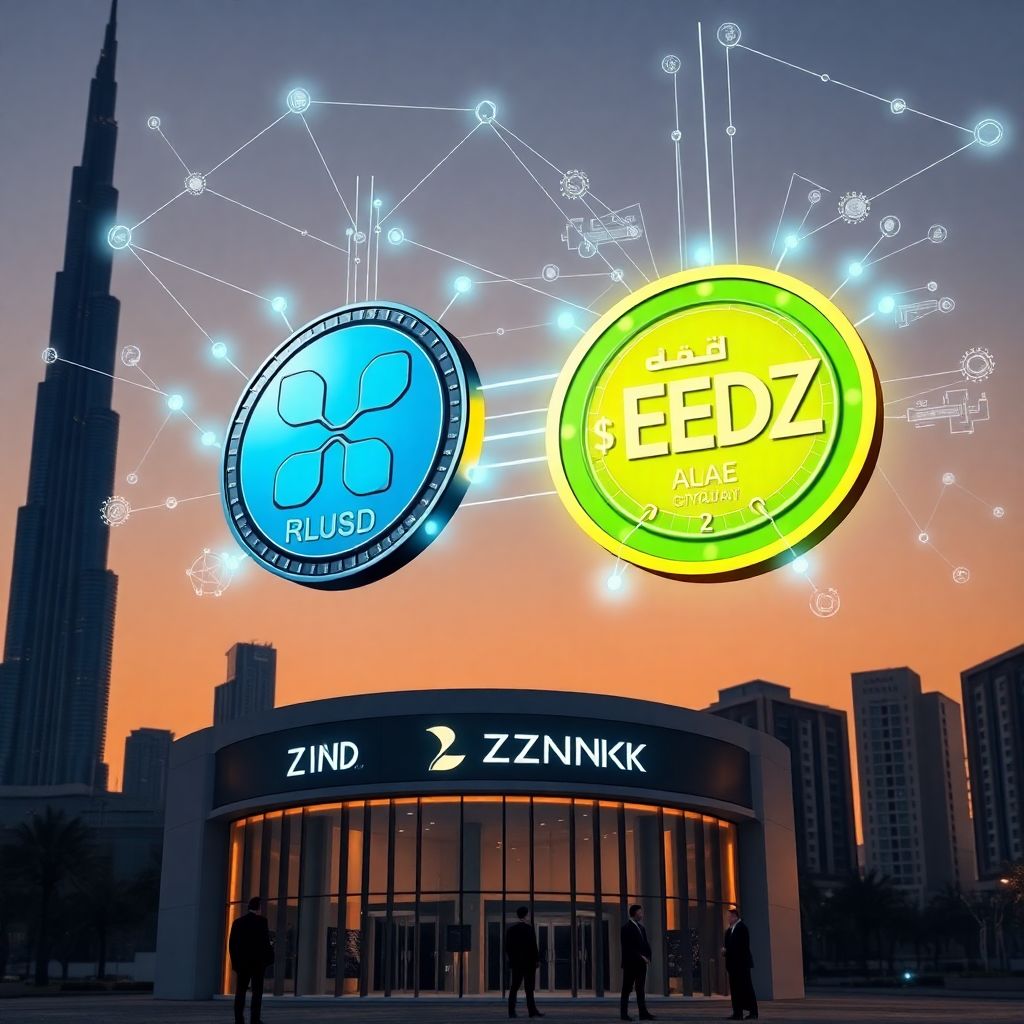
XRP news: Ripple pushes RLUSD stablecoin deeper into UAE market through Zand Bank
Ripple is strengthening its foothold in the United Arab Emirates with a new phase of collaboration with digital-first lender Zand Bank, targeting the fast-growing market for on‑chain financial services. The partnership expands the use of Ripple’s U.S. dollar‑pegged stablecoin RLUSD in parallel with Zand’s dirham‑backed token AEDZ, signaling a more ambitious push into regulated, blockchain‑based finance in the region.
Under the agreement, Ripple and Zand will roll out joint solutions that combine RLUSD and AEDZ to support seamless, multi‑currency transactions on-chain. The initiative is designed to help traditional financial services migrate to blockchain infrastructure, using stablecoins and tokenization as core building blocks for payments, settlements, and liquidity management.
Zand describes the move as a major step forward in bringing real-world use cases for digital assets into a regulated banking framework. By integrating a U.S. dollar stablecoin with a UAE dirham token inside an institutional environment, the two companies aim to offer banks, corporates, and fintechs a more efficient alternative to legacy cross‑border rails, while remaining compliant with local and international standards.
The partnership does not directly alter the technical parameters of XRP, but it does deepen Ripple’s institutional presence in a strategically important market. Historically, XRP has often been treated by traders as a barometer of confidence in Ripple’s broader business and ecosystem. When Ripple signs new banking deals or expands its network in key regions, sentiment around XRP tends to react, even when the announcements focus on infrastructure or stablecoins rather than the token itself.
At the time of writing, XRP was trading around 1.41 dollars, gaining approximately 1.3% over the previous 24 hours. Near‑term price movements remain highly correlated with overall crypto market conditions, macro risk appetite, and liquidity cycles. However, sustained progress in stablecoin adoption, enterprise partnerships, and regulatory integration can gradually strengthen the long‑term narrative around Ripple’s technology and, indirectly, XRP’s potential role within that ecosystem.
Why the UAE matters for Ripple’s strategy
The UAE has positioned itself as one of the most proactive jurisdictions for digital asset innovation, combining supportive regulation with a strong focus on compliance. For Ripple, expanding in such an environment offers several strategic advantages:
– Access to a regional financial hub that connects the Middle East, Africa, and South Asia
– A regulatory framework that explicitly contemplates blockchain, tokens, and digital asset custody
– A client base of banks and corporates already exploring tokenized payments and treasury solutions
By working with a fully licensed digital bank like Zand, Ripple can showcase how its stablecoin and infrastructure stack operate in a tightly regulated setting, which is increasingly important for institutional adoption.
The role of RLUSD and AEDZ in on‑chain finance
RLUSD, Ripple’s dollar‑backed stablecoin, is intended to provide a predictable, low‑volatility asset for payments, settlements, and liquidity flows. Zand’s AEDZ plays a similar role for the UAE dirham. Together, they can underpin a variety of use cases:
– Cross‑border payments: Corporates moving funds between the UAE and dollar‑centric markets can use RLUSD and AEDZ instead of relying on slow and expensive correspondent banking channels.
– On‑chain FX: Stablecoin pairs like RLUSD/AEDZ enable near‑instant foreign exchange on blockchain rails, with transparent rates and programmable settlement.
– Treasury and liquidity management: Institutions can park short‑term liquidity in tokenized dirham and dollar instruments, move capital between them, and integrate smart‑contract‑based workflows for cash management.
This approach illustrates a broader industry trend: regulated stablecoins and tokenized fiat are emerging as the primary bridge between traditional finance and public or semi‑public blockchains, while more volatile assets such as XRP or other cryptocurrencies are increasingly used for specific liquidity or bridging functions rather than day‑to‑day pricing and settlement.
What this means for XRP’s positioning
Even though XRP is not the headline instrument in this announcement, the deal reinforces a central point in Ripple’s long‑term story: the company is not just a crypto issuer but a provider of infrastructure for on‑chain value transfer. In practice, this can benefit XRP in several ways:
– Network effect spillover: As more institutions integrate Ripple’s rails and stablecoins, adding support for XRP as a liquidity or bridging asset becomes easier from a technical standpoint.
– Regulatory signaling: Partnerships with licensed banks in tightly supervised markets help normalize Ripple’s technology stack, indirectly improving perceptions of XRP’s legitimacy among conservative investors.
– Ecosystem resilience: A business model that includes stablecoins, tokenization, and enterprise solutions reduces reliance on speculative XRP demand alone, which can be positive for long‑term ecosystem stability.
Traders should be careful not to conflate every Ripple partnership with immediate on‑chain demand for XRP. However, the cumulative effect of these deals is to embed Ripple’s technology more deeply into global payment flows—creating optionality for XRP usage in the future.
Stablecoins vs. volatile crypto in regulated markets
The partnership with Zand highlights a reality that has been emerging over the past few years: for banks and large corporates, stablecoins are often more attractive than volatile crypto assets as a first step into blockchain. Key reasons include:
– Price stability aligned to a fiat currency
– Easier accounting and risk management
– Regulatory comfort when tokens are fully backed and issued under clear frameworks
In this context, XRP and similar assets may play a more specialized role, for example as high‑speed bridges between stablecoins on different networks or as instruments integrated into liquidity pools and automated market makers. This layered model—stablecoins for end‑user value, bridge assets for infrastructure—may define how regulated on‑chain finance evolves.
Potential use cases in the UAE and beyond
As Ripple and Zand roll out their joint initiatives, several concrete applications could emerge:
1. Corporate remittances and trade finance: UAE‑based exporters and importers could settle invoices in RLUSD or AEDZ, with programmable payment terms and automated release of funds tied to shipping or documentation milestones.
2. Retail remittances: The UAE hosts a large expat population that sends money home regularly. Stablecoin‑based corridors may offer faster, cheaper transfers compared with traditional remittance services.
3. Tokenized bank accounts: Zand could offer tokenized representations of customer balances, enabling real‑time transfers and composable financial products within a compliant perimeter.
4. Institutional DeFi‑style services: Over time, regulated yield products or repo‑like instruments backed by tokenized fiat and high‑quality collateral could be built on top of RLUSD and AEDZ, blurring the line between traditional money markets and DeFi.
Each of these use cases strengthens the argument for keeping value “on‑chain” rather than moving in and out of legacy payment channels, thereby increasing the relevance of infrastructure providers like Ripple.
Investor outlook: how to interpret this development
For XRP holders and broader crypto investors, the partnership offers several signals:
– It confirms Ripple’s commitment to stablecoin infrastructure as a central pillar of its strategy, not just a side product.
– It underscores the importance of the Middle East as a testing ground for regulated digital asset innovation.
– It supports the narrative that institutional adoption is shifting from pilots and proofs of concept to real, revenue‑generating applications.
However, it does not guarantee immediate upside for XRP. Price dynamics will continue to be influenced by macro conditions, regulatory developments in major jurisdictions, and sector‑wide liquidity cycles. The more meaningful impact of such partnerships is structural, gradually improving the quality of Ripple’s network, customer base, and technology stack.
The bigger picture: convergence of stablecoins, CBDCs, and bank tokens
The collaboration between Ripple and a licensed digital bank also hints at a broader convergence on the horizon. As governments explore central bank digital currencies and commercial banks experiment with tokenized deposits, the boundaries between public stablecoins, bank‑issued tokens, and sovereign digital money may become increasingly blurred.
In that environment, platforms capable of interoperating across different forms of digital cash—whether RLUSD, AEDZ, a future digital dirham, or other tokenized currencies—will be in high demand. Ripple’s ability to position its infrastructure as a neutral rail for these instruments could prove more important than the success of any single token.
Conclusion
Ripple’s expanded partnership with Zand Bank in the UAE is more than just another regional deal. It illustrates how the company is aligning its dollar stablecoin RLUSD with a locally anchored asset, AEDZ, to build a compliant, multi‑currency on‑chain finance stack tailored for institutions. While XRP is not at the center of this specific announcement, the strengthening of Ripple’s institutional and regulatory footprint feeds into the longer‑term narrative that underpins XRP’s role within a maturing, more stable, and more regulated digital asset ecosystem.