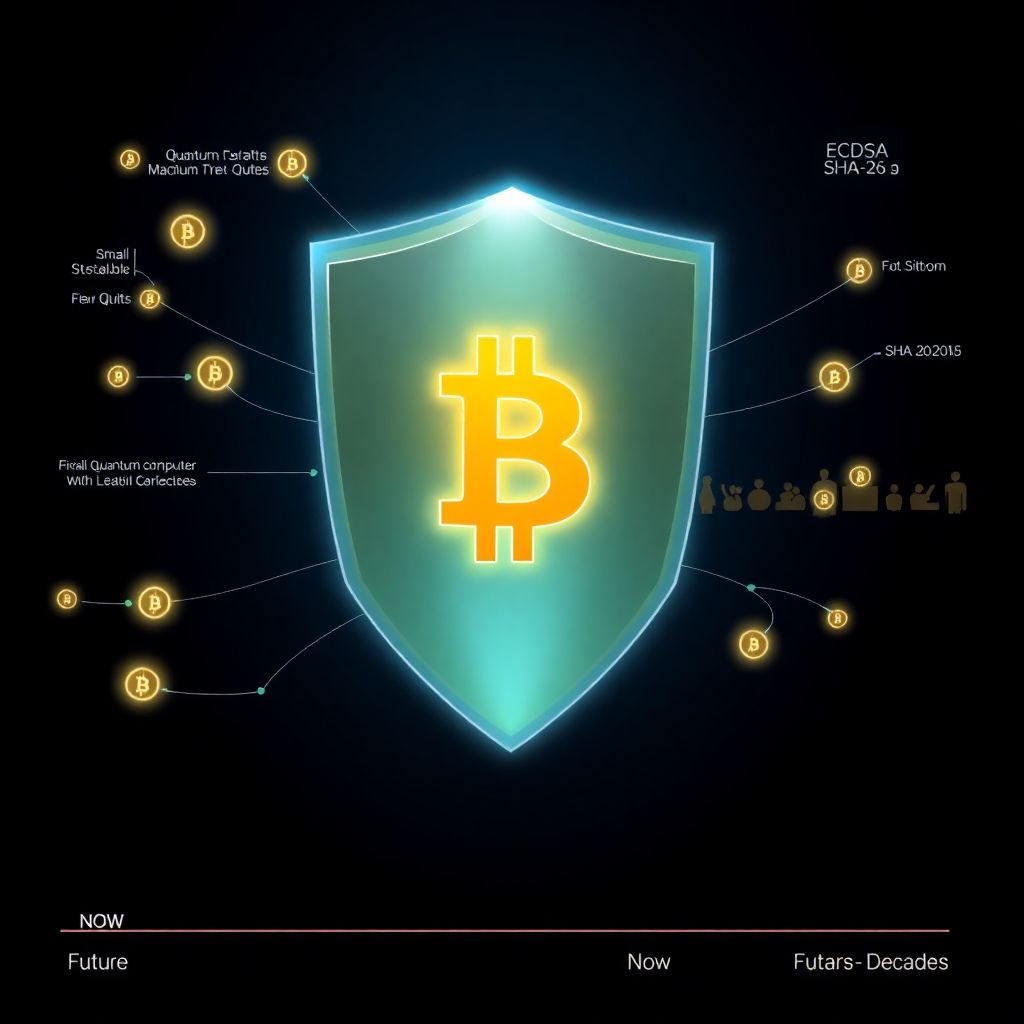
Why Quantum Computing Isn’t a Serious Threat to Bitcoin—At Least for Now
Quantum computing has long been portrayed as a looming existential risk to Bitcoin: one day, so the story goes, ultra-powerful machines will be able to crack its cryptography, steal funds, and undermine the integrity of the network.
A recent research note from digital asset investment firm CoinShares takes a far more measured view. According to their analysis, Bitcoin is *theoretically* vulnerable to sufficiently advanced quantum computers, but the machines that exist today are nowhere near capable of carrying out such attacks in practice. The real risk, they argue, lies many years in the future—and the Bitcoin ecosystem has significant time to prepare.
“Bitcoin’s quantum vulnerability is not an immediate crisis but a foreseeable engineering consideration, with ample time for adaptation,” the researchers wrote. In other words, this is a technical challenge to plan for, not an emergency demanding panic.
How a Quantum Attack on Bitcoin Would Work
At the core of Bitcoin’s security model are cryptographic algorithms that make it easy to verify transactions but practically impossible to reverse‑engineer the corresponding private keys. Today’s classical computers cannot feasibly derive a private key from a public key or from a Bitcoin address within the lifetime of the universe.
Quantum computers, however, work in a fundamentally different way. Using quantum bits (qubits) and algorithms like Shor’s algorithm, a sufficiently large and stable quantum computer could, in theory, solve the mathematical problems underlying Bitcoin’s cryptography much faster than any classical machine.
A successful quantum attack on Bitcoin would generally involve:
1. Targeting public keys that are visible on the blockchain.
2. Using a quantum algorithm to compute the corresponding private keys.
3. Spending the funds from those addresses before the legitimate owner or the network can react.
In principle, this could allow an attacker to steal coins, disrupt transactions, and damage confidence in Bitcoin’s security. But the crucial point is not whether such an attack is theoretically possible—it’s whether current quantum computers can realistically pull it off. According to CoinShares, the answer right now is clearly no.
Why Today’s Quantum Computers Are Too Weak
The research highlights that the gap between “theoretically breakable” and “practically breakable” is enormous. Modern Bitcoin cryptography—especially the elliptic curve algorithm used for digital signatures—would require a quantum computer with a very large number of logical, error‑corrected qubits and the ability to run complex algorithms with extremely low error rates.
Today’s quantum hardware:
– Has relatively few qubits, often in the hundreds or low thousands, not the millions of *reliable* qubits likely needed.
– Suffers from high error rates. Quantum states are fragile and decohere quickly, demanding sophisticated error correction that massively increases resource requirements.
– Can only run short, highly controlled experiments, not long, resource-intensive cryptographic attacks on a global network under real-time pressure.
CoinShares concludes that, given the state of the field, quantum computers are far too limited to pose a real-world risk to Bitcoin’s cryptography—both in terms of raw power and long-term stability. Even optimistic projections of quantum progress suggest that true “Bitcoin-breaking” capability is not around the corner.
The Timeline: Years, Not Months
One of the main questions investors and users have is *when* quantum computing could become a real concern. CoinShares stops short of giving a precise date—because any such prediction depends on scientific and engineering breakthroughs that are inherently uncertain. But the tone of the report is clear:
– There is no immediate danger.
– The problem is best viewed on a multi‑year to multi‑decade horizon, not as something that could happen overnight.
– Quantum advantage in narrow, specific tasks does *not* automatically translate into the ability to break widely used cryptosystems like those securing Bitcoin.
This timeframe is crucial. It suggests that developers, researchers, and the wider Bitcoin community have substantial breathing room to design, test, and deploy quantum‑resistant upgrades long before an actual threat materializes.
Where Bitcoin Is Actually Exposed
Not all aspects of Bitcoin are equally vulnerable to quantum attacks. CoinShares and other cryptography experts generally distinguish between two primary components:
1. Digital signatures (ECDSA / Schnorr)
– These secure ownership of coins and authorize transactions.
– They are considered the most direct target for quantum computers using Shor’s algorithm.
– Addresses that have already revealed their public keys (for example, by sending coins in the past) are more vulnerable in a post-quantum world than addresses that have never been spent from.
2. Hash functions (SHA‑256)
– These secure mining (proof‑of‑work) and some aspects of address generation.
– Quantum computers using Grover’s algorithm could, in theory, speed up brute‑force attacks.
– However, Grover’s algorithm only provides a *quadratic*, not an exponential, speedup—meaning doubling the hash size or making modest design changes can significantly mitigate this risk.
Overall, the signature scheme is the most concerning layer when considering long‑term quantum threats. But again, the vulnerability is theoretical given current technology, not operational.
Bitcoin’s Built-In Advantage: Upgradability
An often overlooked strength of Bitcoin is that its cryptographic primitives are not etched in stone. While changes to the protocol are conservative and carefully debated, they *can* be made.
The network has already demonstrated its ability to adopt major upgrades, such as SegWit and Taproot, through a combination of:
– Bitcoin Improvement Proposals (BIPs)
– Extensive testing and peer review
– Gradual, opt‑in upgrades that avoid sudden disruption
In a future where quantum attacks are credibly on the horizon, Bitcoin can follow a similar path to adopt post‑quantum cryptography (PQC)—new cryptographic schemes designed to resist both classical and quantum adversaries. These PQC systems are already being studied and standardized by leading cryptographic bodies, and they can be integrated into Bitcoin’s transactional and address layers over time.
What Post‑Quantum Bitcoin Could Look Like
If a shift to quantum‑resistant cryptography became necessary, several strategies are conceptually available:
– Post‑Quantum Signature Schemes: Replacing or supplementing ECDSA/Schnorr with quantum‑secure alternatives like lattice‑based signatures or hash‑based signatures.
– Hybrid Schemes: For a transition period, transactions could require both a classical and a post‑quantum signature, ensuring security even if only one of the systems proves robust.
– New Address Types: Introducing address formats that embed post‑quantum keys, allowing users to gradually migrate funds from older, quantum‑vulnerable addresses.
– Incentivized Migration: Encouraging users to move coins from vulnerable outputs (e.g., ones with exposed public keys) to quantum‑hardened outputs well before any realistic attack surface emerges.
Each approach comes with trade‑offs in terms of transaction size, fees, complexity, and privacy. But none is fundamentally incompatible with Bitcoin’s design. With sufficient lead time, the ecosystem can experiment and coordinate a safe transition.
The Realistic Risk Today: Long‑Term Stored Coins
While there is no immediate operational risk, the long time horizon raises a more subtle question: what about coins that are held for many years or decades, such as long‑term savings, institutional reserves, or dormant wallets?
For very long‑term holders, the relevant concern isn’t whether quantum computers exist *today*, but whether an attacker in the future could retroactively target coins that were left unprotected. That’s why:
– It is generally safer for long‑term storage to use addresses that have not yet revealed public keys (i.e., UTXOs that have never been spent from).
– Users may eventually be advised to rotate funds into post‑quantum addresses when robust solutions are standardized and widely supported.
CoinShares’ message here is implicit: Bitcoin users don’t need immediate action, but they should stay informed. Over the coming years, best practices for “quantum‑aware” storage will likely evolve, especially for very large or strategic holdings.
How Quantum Progress Will Be Monitored
Another important factor tempering the risk is that quantum breakthroughs are unlikely to appear entirely out of nowhere. Progress in quantum computing happens through:
– Published research in physics, engineering, and computer science
– Hardware milestones announced by major technology firms and research labs
– Benchmarks such as qubit counts, coherence times, error rates, and demonstrations of specific algorithms
As these metrics improve, cryptographers and Bitcoin developers will be able to roughly estimate how close quantum machines are to crossing various security thresholds. That provides a kind of “early warning system” for the need to accelerate post‑quantum upgrades.
The scenario where a fully capable, secret quantum computer suddenly appears and silently breaks Bitcoin overnight is considered extremely unlikely—not only because of the monumental engineering challenge, but also because such a capability would have far broader implications for global communications, finance, and national security long before it reaches Bitcoin.
Why Panic Is Counterproductive
Alarmist narratives about quantum computing and Bitcoin often ignore both the scale of the technical challenge and the adaptability of cryptographic systems. Overstating the immediacy of the threat can have negative side effects:
– Unnecessary fear among users and investors
– Misallocation of research resources toward speculative scenarios instead of real, present‑day vulnerabilities
– Reduced trust in otherwise sound cryptographic foundations
CoinShares’ research instead advocates a calm, engineering‑driven approach: acknowledge the theoretical vulnerability, track quantum progress, and plan for gradual mitigation. That stance aligns with the broader consensus among many cryptographers who view quantum risk as serious in the long term but non‑urgent in the short term.
The Bottom Line for Bitcoin Users
Based on the current state of quantum technology and the analysis presented:
– Bitcoin is not currently at serious risk from quantum attacks.
– Existing quantum computers are orders of magnitude too weak to break its cryptography.
– The potential threat is real but distant, best framed as a future design and upgrade challenge.
– The network has years of lead time to monitor developments and adopt post‑quantum defenses if and when they are needed.
For now, the most practical steps for users are the same as they’ve always been: follow good security practices, use reputable wallets, keep private keys safe, and stay informed about protocol developments. Quantum computing remains an important topic to watch—but not a reason to abandon or distrust Bitcoin today.