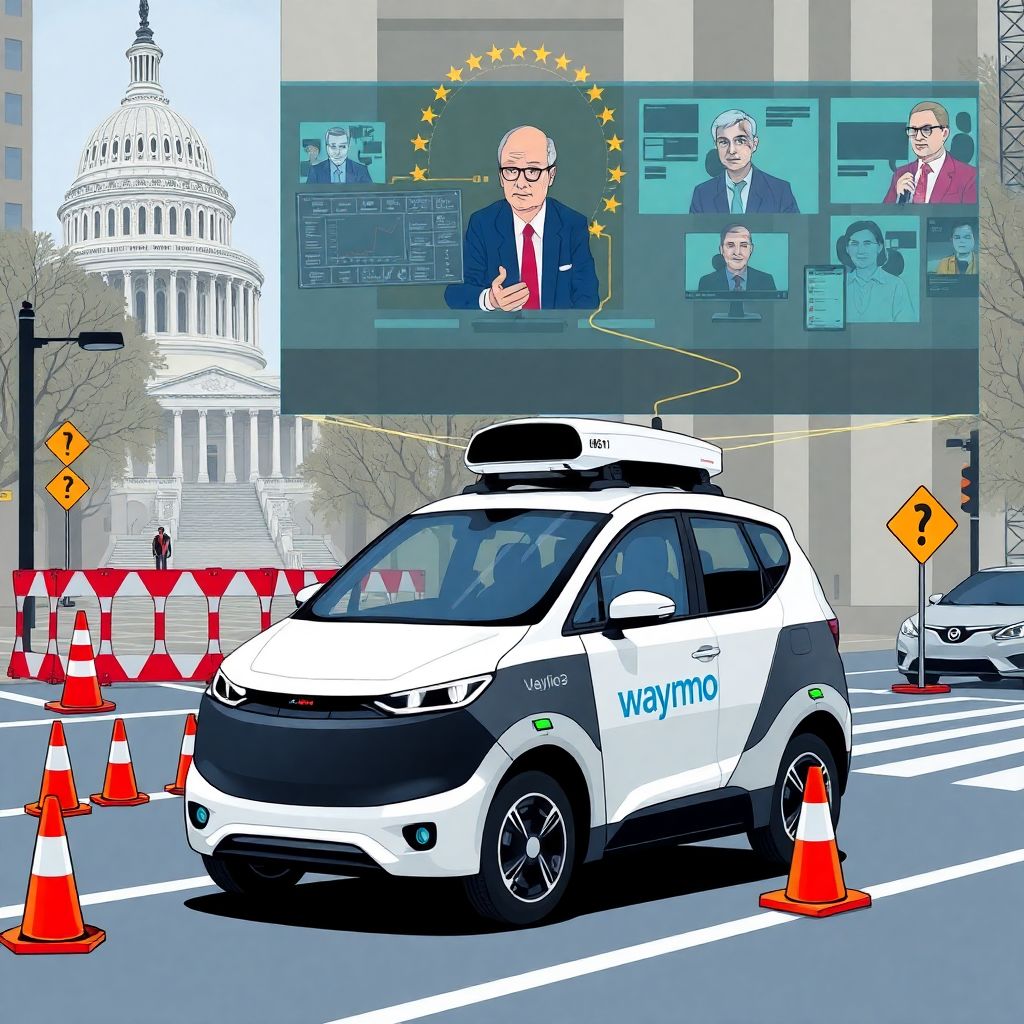
Waymo’s ‘Driverless’ Pitch Faces Skepticism in Washington
Waymo’s portrayal of its robotaxis as fully “self-driving” is under renewed fire in Washington after a senior company executive admitted that human workers, based overseas, help guide the cars when they get stuck on American roads. The revelation has intensified an already heated debate over how far today’s autonomous technology has actually progressed—and whether the language used to market it is misleading lawmakers and the public.
Speaking before the U.S. Senate Committee on Commerce, Science, and Transportation, Waymo Chief Safety Officer Mauricio Peña acknowledged that the company’s vehicles sometimes depend on remote human support to navigate complex, confusing, or unusual situations. Those operators, based in the Philippines, can be consulted when the software encounters a scenario it cannot confidently handle on its own.
Peña stressed that these remote workers are not “driving” the vehicles in the conventional sense.
“They provide guidance, they do not remotely drive the vehicles,” he told senators. “Waymo asks for guidance in certain situations and gets an input, but the Waymo vehicle is always in charge of the dynamic driving task.”
In other words, the company argues that its cars remain in control of steering, braking, acceleration, and lane position, even when human staff weigh in. But the very existence of this human backstop has prompted fresh questions: if a robotaxi can’t fully operate without human help in real-world conditions, does “self-driving” still accurately describe what’s happening?
What Lawmakers Want to Know
Senators pressed Waymo on several fronts:
– How often do the vehicles need human intervention?
While Peña acknowledged the use of remote assistance, he did not provide granular statistics on intervention frequency in open testimony. Lawmakers are increasingly pushing for hard numbers to evaluate how autonomous these systems truly are in daily operation, not just in controlled testing.
– Where are the human operators and how are they trained?
The fact that support staff are located in the Philippines raised issues around training standards, oversight, and accountability. Senators questioned whether U.S. regulators have any visibility into how these workers are selected, instructed, and evaluated, given their role in helping vehicles navigate American streets.
– Is the term “self-driving” misleading?
Several members of the committee suggested that average consumers might reasonably assume “self-driving” means no human involvement at all. The existence of a remote safety net, they argued, could be at odds with public perceptions shaped by company branding and marketing.
The Battle Over What “Self-Driving” Means
At the core of the dispute is the definition of autonomy itself. The industry often relies on a scale known as the SAE levels of driving automation, ranging from Level 0 (no automation) to Level 5 (full autonomy under all conditions). Waymo’s service aims at Level 4 automation—vehicles can handle all driving tasks within a defined operational domain, but there may still be limitations and rare edge cases.
Waymo’s position is that remote staff offering high-level advice does not downgrade that level of autonomy, because the car’s software still makes the final call on maneuvering. In the company’s framing, asking an operator whether a blocked lane is safe to pass, or whether a police barricade requires rerouting, is different from a human taking the wheel.
Critics, however, argue that for practical purposes, any system that regularly depends on human input—whether through a steering wheel, joystick, or remote chat window—cannot be called fully “self-driving” without qualification. They warn that blurring these distinctions may encourage overtrust in technology that is not ready for universal deployment.
Safety, Transparency, and Public Trust
Safety advocates say the hearing highlighted a broader problem: the lack of standardized, public-facing reporting about how autonomous vehicles perform in the wild. While many companies, including Waymo, release some safety metrics, they are often selective, difficult to compare, and framed in ways that favor the company’s narrative.
Lawmakers are increasingly demanding:
– Clear data on disengagements—moments when the system cannot proceed without human help, whether local or remote.
– Incident reports that explain what went wrong when vehicles encounter hazards, confusion, or emergency scenarios.
– Detailed descriptions of the operational design domain—the specific conditions (weather, geography, time of day, road types) under which the system is intended to operate safely.
For communities already uneasy about driverless cars, news that people thousands of miles away may be stepping in—even indirectly—risks further eroding trust. Residents in pilot cities have complained about stalled vehicles, unexpected stops in traffic lanes, and awkward behavior around construction zones and emergency responders. The idea that these moments may trigger a chain of communication ending in a remote office overseas raises new questions about response times, cultural context, and local knowledge.
Why Remote Assistance Exists in the First Place
From a technical perspective, remote assistance is not unique to Waymo; it is a widely discussed tool in the autonomous vehicle industry. No matter how advanced, algorithms struggle with rare, ambiguous, or never-before-seen situations—often called “edge cases.” Examples include:
– Unexpected road closures with improvised signage
– Unusual police or firefighter hand signals
– Objects in the road that sensors detect but cannot classify
– Conflicting cues from lane markings, cones, and traffic lights
In such moments, having a human review camera feeds and maps and then provide high-level guidance can be a safety-enhancing measure. Support staff might, for instance, confirm that a temporary detour sign applies to the lane the vehicle is in, or advise the car to wait for law enforcement direction.
Waymo and similar companies argue that this model is not a crutch but a pragmatic safety layer—akin to air traffic controllers working with largely automated aircraft systems, rather than pilots being replaced entirely by computers. The company insists that over time, as the fleet encounters more scenarios and the underlying models improve, reliance on human guidance will diminish.
The Labor and Ethics Dimension
The revelation that remote operators are based in the Philippines also opened an uncomfortable conversation about labor conditions and ethical outsourcing. When human workers are tasked with helping safeguard passengers and other road users in another country, several issues arise:
– Wages and working conditions: Are these workers paid and protected at a level commensurate with the responsibility they bear?
– Training quality: Do they receive robust instruction in traffic law, local driving norms, and emergency procedures specific to U.S. cities?
– Mental load and liability: What happens when operators must make high-stakes judgments under time pressure with limited situational awareness?
Critics warn that as more companies quietly rely on low-cost overseas labor for safety-critical support, a hidden human layer will emerge beneath the promise of “driverless” technology—raising both ethical and regulatory concerns.
The Regulatory Vacuum
The hearing also underscored a broader policy gap. While individual states have crafted their own rules for testing and operating autonomous vehicles, there is still no comprehensive national framework that clearly defines:
– What marketing terms like “self-driving,” “autonomous,” and “driverless” are allowed to mean
– Minimum safety and reporting requirements for commercial robotaxi services
– Standard protocols for remote assistance, including training, location, and oversight of operators
Without uniform federal standards, companies can tailor their public messaging to highlight innovation while glossing over technical and operational caveats. Lawmakers signaled growing impatience with this patchwork approach and hinted at future legislation that would impose clearer definitions and stricter disclosure obligations.
The Risk of Overhyping the Technology
The language used to describe these systems isn’t a mere branding issue; it can shape real-world behavior. If riders, pedestrians, and other drivers believe a vehicle is truly “self-driving,” they may assume:
– The car will flawlessly handle any situation that arises
– No human is overseeing the system
– They bear little responsibility for monitoring or intervening
History offers a cautionary tale. Earlier semi-automated systems branded with names suggesting full autonomy led some drivers to misuse the technology, resulting in preventable crashes. Safety advocates fear that invoking “self-driving” for services that quietly rely on human backup risks repeating similar mistakes at a citywide scale.
Balancing Innovation and Accountability
Waymo, for its part, frames remote guidance as evidence of a responsible, layered safety strategy rather than a weakness. From the company’s perspective, ignoring the value of human judgment in rare edge cases would be reckless. Its executives argue that pairing advanced software with human-in-the-loop support can accelerate deployment while maintaining high safety margins.
But for regulators, the central issue is not whether human backup is inherently good or bad. It is whether the public is given a clear, accurate picture of how the system actually works—and how often it needs help. That question goes beyond Waymo to the entire autonomous vehicle sector.
To strike a sustainable balance, policymakers and experts are increasingly calling for:
– Standardized technical definitions of autonomy levels, enforceable in marketing and user documentation
– Mandatory reporting on intervention rates, including remote assistance events
– Independent safety audits of both software performance and remote-operator programs
– Clear communication to riders explaining what the vehicle can and cannot do, and what human roles are still involved
What Comes Next for Waymo and the Industry
The Capitol Hill grilling marks a turning point in how Washington scrutinizes self-driving claims. As robotaxi pilots expand and more cities confront the daily realities of sharing the road with autonomous fleets, the veneer of futuristic inevitability is giving way to practical questions of governance, labor, and safety.
For Waymo, the challenge will be to maintain its reputation as a technical leader while adapting to a more demanding regulatory and political environment. That likely means greater transparency about remote assistance, more detailed safety metrics, and less reliance on broad-brush labels that invite misinterpretation.
For the broader industry, the hearing is a warning shot: the era of loosely defined “self-driving” rhetoric is nearing its end. Companies that want to operate at scale on public roads in the United States will need not only cutting-edge software but also clear language, rigorous oversight, and a willingness to admit where humans are still very much part of the system.