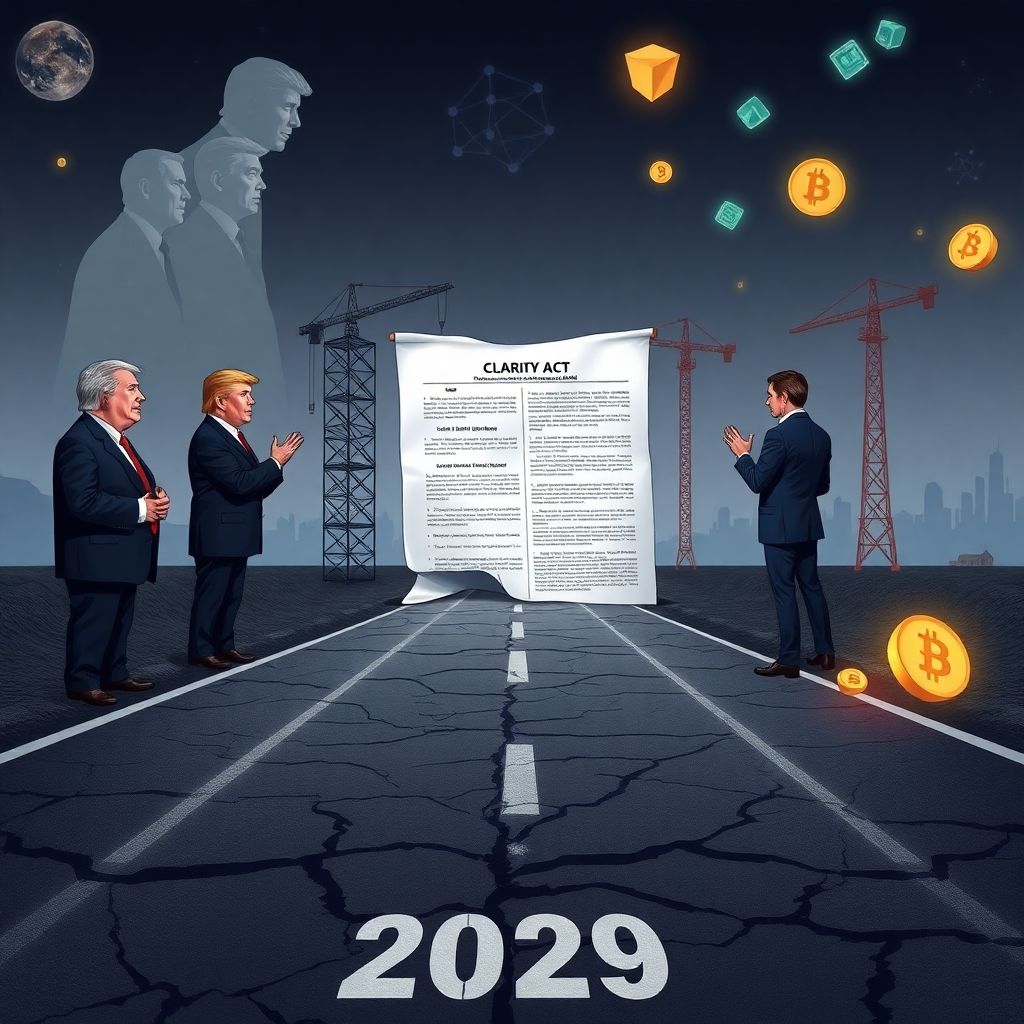
Crypto regulation in the United States is drifting further into the future, with political infighting around Trump-era conflict-of-interest rules threatening to push comprehensive legislation out to the end of the decade.
According to a new analysis from TD Cowen, large-scale reform of U.S. crypto market structure is now unlikely before 2027, with the full set of rules potentially not in place until 2029. The firm’s outlook centers on the fate of the CLARITY Act and related market structure proposals, which have quietly become the main vehicle for crypto policymaking in Washington.
Conflict-of-interest fight stalls the bill
The primary roadblock, TD Cowen argues, is not technical disagreement over how to regulate digital assets, but a fierce clash over ethics provisions. Democratic lawmakers are pressing for strict conflict-of-interest rules that would prohibit senior government officials from owning, operating, or profiting from cryptocurrency businesses.
These proposed safeguards are not abstract. The language is explicitly shaped by concerns about President Trump and his family’s potential financial ties to digital asset ventures. Democrats see these restrictions as essential to prevent self-dealing, ensure public trust, and avoid any perception that policy is being written to benefit those in power.
Republicans, however, view these provisions as a direct shot at the current administration. They oppose measures that would immediately constrain Trump-era officials, arguing that singling out the sitting president and his family politicizes what should be a broader regulatory framework. As a result, the ethics language has turned into a red line for both sides, creating a legislative stalemate.
A delayed ethics compromise
To break the deadlock, TD Cowen sketches out a potential compromise that is already circulating in policy discussions: delay implementation of the conflict-of-interest rules by roughly three years.
Under this scenario, Congress could move ahead with the core crypto market structure reforms while postponing the most contentious ethics provisions until a future administration. The bill would still contain the ethics rules, but they would not take effect immediately. Instead, they would activate after the current Trump administration has left office, sidestepping accusations that the legislation is specifically targeted at the sitting president.
Such a phased approach would give lawmakers a path to advance badly needed regulatory clarity for exchanges, stablecoin issuers, and other market participants, while deferring the most politically explosive elements. TD Cowen’s analysis suggests that this kind of split-timeline deal could become the only viable route for any bipartisan progress.
No breakthrough expected in 2025
Even with a compromise framework on the table, TD Cowen does not expect the Clarity Act–style crypto market structure bill to pass in 2025. The firm concludes that “meaningful progress” is now more likely to slip into 2027, pushing major implementation work even further out.
If that timing holds, key rulemakings by agencies such as the Securities and Exchange Commission and the Commodity Futures Trading Commission would only fully crystallize toward the end of the decade. TD Cowen estimates that final, comprehensive regulatory rules might not be fully in force until 2029.
For the industry, that implies several more years of operating under a patchwork of enforcement actions, guidance letters, and court decisions, rather than a clear legislative framework.
Electoral calculations shape the timeline
The delay is not just about ethics language; it is also deeply tied to electoral strategy. TD Cowen notes that many Democrats see little reason to rush a compromise in 2026 if they believe they have a realistic opportunity to retake the House of Representatives in that year’s midterm elections.
From that perspective, waiting could be advantageous. A shift in congressional control would allow Democrats to bring the bill back under more favorable political conditions, potentially restoring stronger conflict-of-interest protections or renegotiating other regulatory details. In other words, the calendar itself becomes a negotiating tool: by slowing the process now, Democrats keep their options open for a future Congress that might be more aligned with their priorities.
Republicans, for their part, may feel some urgency to lock in a lighter-touch framework while they hold power, but the ethics provisions remain a substantial barrier to cutting a deal.
CLARITY Act remains the fallback option
Despite the gridlock, TD Cowen stresses that Washington is not abandoning crypto regulation altogether. Instead, the focus is shifting toward incremental work on the CLARITY Act, which has effectively become the fallback framework for U.S. digital asset policy.
The report expects continued legislative activity around the CLARITY Act in early 2026. Lawmakers and staff are likely to keep refining definitions of digital assets, clarifying the distinction between securities and commodities, and working out how centralized and decentralized platforms fit into existing regulatory regimes.
This ongoing technical work means that when the political window for broader reform finally opens—likely around 2027—much of the underlying policy architecture could already be drafted, debated, and ready to move.
What this means for the crypto industry
For market participants, the extended timeline is a mixed picture.
On the one hand, the prospect of clear, unified federal rules for token issuance, trading, custody, and disclosures remains distant. Companies will continue to navigate uncertainty around whether specific tokens are treated as securities, commodities, or something else entirely. This uncertainty can chill innovation, complicate fundraising, and deter some institutional players from deeper involvement.
On the other hand, a slower legislative pace gives the industry extra time to adapt, strengthen compliance, and shape the eventual rules. Firms with robust legal and regulatory strategies may find they can operate and even expand under the current framework, while preparing for more stringent requirements later in the decade.
Internationally, the delay risks pushing some activity offshore to jurisdictions with clearer rules, but it also gives U.S. policymakers more time to observe how foreign regimes—such as comprehensive digital asset laws in Europe or Asia—perform in practice.
Short-term focus: enforcement and guidance
With no sweeping statute likely in the near term, U.S. crypto oversight will remain driven by regulators and courts.
Agencies are expected to continue asserting jurisdiction through enforcement actions, settlement agreements, and interpretive statements. That means the industry’s rules of the road will keep developing case by case, as high-profile lawsuits and administrative actions define what is permissible.
For businesses, this environment places a premium on:
– Proactive compliance programs tailored to existing securities, commodities, and banking laws
– Careful token design to avoid the most obvious securities-law triggers
– Transparent disclosures to users and investors
– Engagement with regulators to anticipate shifting expectations
Even without a new statute, the regulatory burden is likely to rise as oversight becomes more sophisticated and coordinated.
Long-term stakes: market structure and competitiveness
The stakes behind the delayed bill are substantial. A comprehensive U.S. crypto market structure law would likely address:
– How centralized exchanges and brokerages are licensed and supervised
– The status of stablecoins and their reserve requirements
– Clearer criteria for when a token transitions from a security to a non-security
– Custody standards for institutional and retail assets
– Rules for market integrity, including surveillance, reporting, and transparency
Delaying those decisions until 2027–2029 means the U.S. will continue to operate without a unified digital asset framework while other major economies race ahead. That could influence where new projects launch, where liquidity concentrates, and how global capital flows into tokenized assets.
At the same time, a longer runway might enable the U.S. to learn from early adopters and avoid regulatory missteps, potentially resulting in a more balanced and durable framework once it finally arrives.
The politics of ethics in financial regulation
The current standoff underscores how questions of ethics and conflicts of interest can reshape financial legislation. Many Democrats argue that without strict prohibitions on self-enrichment, any crypto bill risks being viewed as captured by insiders or tailored to benefit politically connected firms and individuals.
Republicans counter that overly aggressive conflict rules could discourage qualified experts from entering government and that targeting a sitting president in statutory language erodes the norm of neutral, forward-looking lawmaking.
The proposed three-year delay on ethics enforcement reflects a broader pattern in U.S. policymaking: when immediate application is politically impossible, lawmakers sometimes embrace phased or deferred implementation to defuse controversy while still anchoring future guardrails in statute.
Outlook: momentum without resolution
TD Cowen’s analysis concludes that momentum for crypto regulation is real but constrained. Staff-level work, technical drafting, and negotiations are ongoing, particularly around the CLARITY Act, and few in Washington now argue that digital assets can be left entirely to unregulated markets.
Yet the most consequential shifts to U.S. crypto market structure—those that would finally replace uncertainty with a coherent legislative framework—appear to be several years away. Between now and the late 2020s, the crypto sector will likely continue to evolve in a gray zone: too significant to ignore, too politically charged to fully regulate.
For investors, builders, and institutions, that means planning for a decade defined by gradual, fragmented change rather than a single, watershed law—at least until Congress can find a way to resolve the Trump-era conflict rules that currently hold the entire project in place.