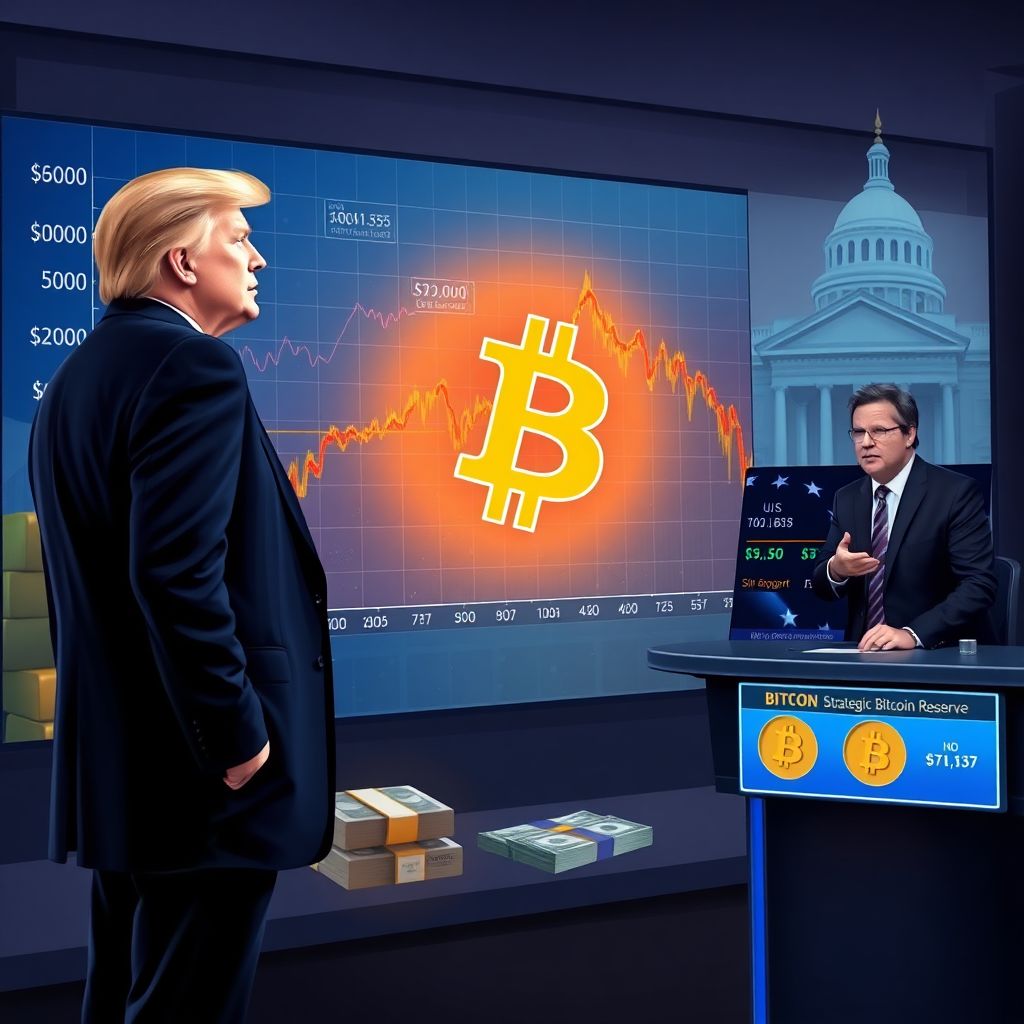
Trump’s $60k Bitcoin play? Cramer teases “Strategic Reserve” trigger
Market analyst Jim Cramer has ignited fresh speculation about U.S. crypto policy, suggesting that the Trump administration is eyeing a specific Bitcoin price level as a buying opportunity for a proposed national stockpile of BTC.
Speaking on CNBC’s “Squawk on the Street” on Friday, Cramer claimed that the White House has a target in mind:
> “I heard at $60,000 the President is gonna fill the Bitcoin Reserve,” he said.
His comments landed in the middle of a turbulent week for the crypto market. Earlier in the week, Bitcoin suffered a sharp sell-off, briefly sliding toward the 60,000-dollar area before staging a strong rebound back above 70,000. By the time of reporting, BTC was trading at 71,133.74 dollars, up around 3% in the last 24 hours — a move that underscored just how fast market sentiment is shifting.
If Cramer’s claim is accurate, it would imply that the administration is prepared to act only if Bitcoin retreats by more than 15% from current levels, effectively turning the 60,000 mark into a politically significant support zone as well as a technical one. Until or unless that threshold is reached, any large-scale government accumulation would remain hypothetical.
What the numbers say about U.S. government Bitcoin holdings
On-chain analytics from Arkham indicate that the U.S. government already controls a sizable stash of Bitcoin. Current estimates put the holdings at 328,372 BTC, with a notional value north of 23 billion dollars at prevailing prices. Importantly, those holdings have shown no meaningful changes in recent weeks, suggesting that—despite the noise—no new large-scale on-chain accumulation has yet begun.
These coins are largely the product of law enforcement actions: seized from criminal enterprises, darknet markets, and other illicit activities over the years. Rather than being bought on the open market, they were acquired through legal forfeiture processes, then typically held for some time before being auctioned or otherwise disposed of.
A March 2025 executive order reshaped this framework for a portion of those assets. Under that directive, Bitcoin designated for a U.S. Strategic Bitcoin Reserve must originate from criminal and civil asset forfeitures. Crucially, once BTC is deposited into this reserve structure, it cannot be sold. That transforms a subset of previously disposable seized assets into a long-term, non-liquid strategic holding.
Legal limits: no bailout, no forced buying
Despite growing political and market chatter, the legal boundaries around government involvement in Bitcoin are clearly defined, and they are restrictive.
Treasury Secretary Scott Bessent has reiterated that the federal government does not have the legal authority to bail out Bitcoin, support its price, or require commercial banks to buy it. In other words, Washington cannot quietly arrange a backdoor support program for BTC similar to the interventions sometimes seen in traditional finance.
This position serves two purposes. First, it signals to markets that Bitcoin remains a risk asset, not a protected or implicitly guaranteed instrument. Second, it draws a line between “strategic reserve” rhetoric and the actual use of taxpayer funds: under current law, public money cannot be deployed to buy Bitcoin on behalf of the state.
Any Bitcoin that ends up in a Strategic Reserve, therefore, must come from forfeitures, not appropriations. That distinction is central to understanding how far the U.S. can actually go, even if the political will to embrace Bitcoin increases.
Strategic Reserve: still hypothetical, but increasingly plausible
While the notion of a U.S. Strategic Bitcoin Reserve remains largely conceptual, the probability that it becomes a formal, codified policy appears to be climbing.
Prediction market data suggest that participants are assigning a 31% chance that such a reserve will be officially established before 2027—up from 23% at the start of January. That eight-point jump in a short period hints at a meaningful shift in perceived policy direction, influenced by both political developments and Bitcoin’s performance.
A formally recognized reserve would differ from current ad hoc holdings in several ways:
– The mandate and governance rules would be explicitly defined.
– Assets might be ring-fenced from standard auction processes.
– Long-term strategic, geopolitical, and monetary considerations would guide decisions, rather than purely legal or procedural ones.
For now, though, this remains a matter of probability and speculation rather than settled law.
Why a $60k trigger matters for markets
Cramer’s reference to 60,000 dollars as a “fill the reserve” level carries psychological and technical weight, regardless of whether it becomes policy.
For traders, the idea that a major sovereign actor might step in aggressively around a specific price can shape expectations about support levels and downside risk. If enough market participants believe a government bid is waiting near 60,000, they may front-run that level, buying dips sooner and softening potential sell-offs.
At the same time, any such expectation is inherently fragile. If Bitcoin were to break decisively below that level without visible government action, it could flip from perceived support into a catalyst for deeper fear, as traders reassess assumptions about official demand.
This dynamic underscores the risk of politicizing price levels: they become not just technical markers, but potential tests of credibility for both policymakers and prominent commentators.
The geopolitical angle: Bitcoin as a strategic asset
Behind the noise of day-to-day price action lies a larger question: why would any administration consider Bitcoin a candidate for a strategic reserve in the first place?
Supporters point to several arguments:
– Digital scarcity: Bitcoin’s fixed supply contrasts with the ability of central banks to expand fiat money, making it attractive as a long-term store of value.
– Geopolitical diversification: Holding BTC could reduce reliance on other nations’ currencies and financial systems, particularly in a world where sanctions and financial fragmentation are more common.
– Technological hedge: As financial infrastructure moves on-chain, having direct exposure to the foundational asset of that ecosystem could be seen as a hedge against being left behind.
Critics counter that Bitcoin’s volatility, uncertain regulatory trajectory, and concentration of liquidity in a few large venues make it ill-suited for strategic reserves that traditionally prioritize stability, predictability, and deep, dependable markets.
Domestic politics: symbolism and signaling
Domestically, talk of a Bitcoin reserve is as much about political signaling as it is about balance sheets.
Associating national policy with Bitcoin appeals to a growing voter base that sees crypto as a symbol of financial freedom, innovation, and resistance to perceived overreach by traditional institutions. For a populist movement, tying an “America First” narrative to digital assets can be an effective way to signal alignment with those constituencies.
At the same time, it risks alienating skeptics who fear speculative excess, systemic risk, or environmental concerns around Bitcoin mining. Any administration that pushes aggressively into Bitcoin will have to navigate a polarized audience: evangelists expecting bold moves and skeptics watching for missteps.
Market volatility and the “government put” myth
Bitcoin’s recent rebound above 70,000 underscores that volatility remains a core feature of the asset. Daily moves of several percentage points are still routine, even as the market has matured.
In this environment, speculation about a “government put” — the belief that authorities will step in to support Bitcoin at certain levels — can distort risk assessment. Traders who assume state intervention will cap downside may take on more leverage or reduce hedges, leaving them vulnerable if policy remains neutral or proves slower and more limited than they hoped.
The explicit statements from the Treasury about the lack of bailout authority are therefore not mere legal clarifications; they serve as a warning that Bitcoin’s risk is still borne by private investors, not the public purse.
What a real Strategic Bitcoin Reserve would have to solve
If the U.S. were to formally establish a Strategic Bitcoin Reserve, policymakers would confront a series of practical questions beyond simply “how much” and “at what price”:
– Custody and security: Would coins be held by existing federal entities, specialized new institutions, or a hybrid model involving private custodians under strict oversight?
– Transparency vs. secrecy: How often would holdings be disclosed? Total secrecy might offer tactical advantages but could undermine public trust; full transparency could invite front-running or speculative attacks.
– Accounting and valuation: How would mark-to-market volatility be reflected in government accounts, and what risk limits would apply?
– Interoperability with existing reserves: Would Bitcoin complement or compete with gold and foreign currency reserves, or be treated as a separate, experimental category?
None of these issues are insurmountable, but each introduces complexity that extends far beyond the simple narrative of “the government is buying Bitcoin.”
What investors should realistically take from Cramer’s hint
Cramer’s suggestion that the administration might “fill the Bitcoin Reserve” at 60,000 dollars is, for now, a provocative soundbite rather than a confirmed policy blueprint. The hard facts are more limited:
– The U.S. already holds a large Bitcoin stash via seizures.
– An executive order specifies that certain seized BTC can be funneled into a non-saleable strategic structure.
– Treasury has drawn a firm line against using public funds for direct BTC purchases or bailouts.
– Prediction markets see rising odds of a formal reserve being created within the next few years.
– Bitcoin remains volatile, and short-term moves are still driven primarily by market forces, not government actions.
For market participants, the most prudent approach is to treat policy speculation as one factor among many—alongside macro conditions, liquidity, regulation, and on-chain data—rather than as a guarantee of support.
The idea of a U.S. Strategic Bitcoin Reserve reflects a world in which digital assets are no longer niche curiosities but part of broader monetary and geopolitical debates. Whether that idea turns into a durable institution—or remains a talking point amplified by television soundbites—will depend on legislative choices, legal constraints, and, ultimately, voter appetite for tying national strategy to the world’s most famous cryptocurrency.