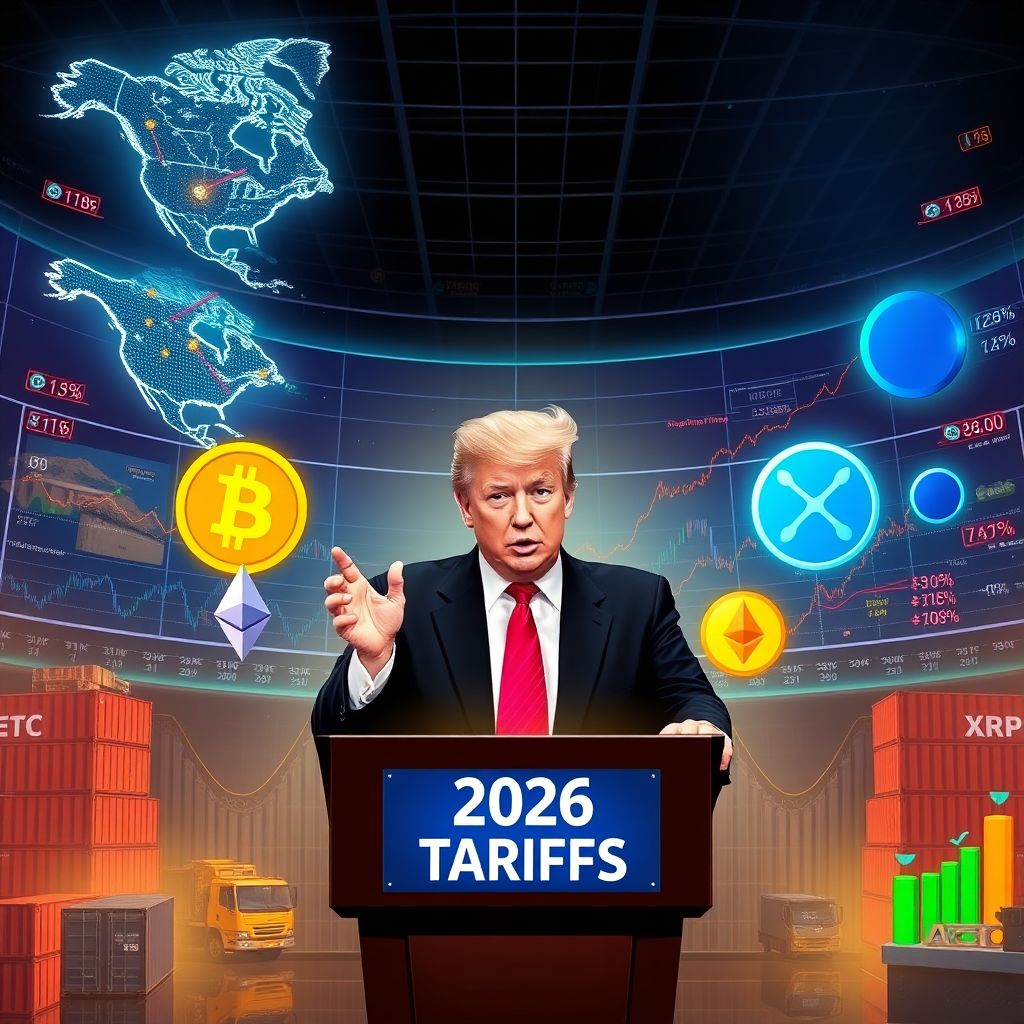
How Trump’s 2026 tariffs could shake Bitcoin, Ethereum, and XRP
As 2026 opens, digital assets are more intertwined with global macroeconomics than ever before. Bitcoin (BTC), Ethereum (ETH), and XRP no longer trade purely on crypto-native narratives; they increasingly move in response to interest rates, inflation expectations, and geopolitical developments. Against this backdrop, President Donald Trump’s renewed tariff policy for 2026 has become a key variable for markets—and crypto is not immune.
Tariffs might look like a niche issue limited to trade and manufacturing, but they ripple through inflation, monetary policy, investor sentiment, and currency markets. All of these are now critical drivers for major cryptocurrencies. Understanding how tariffs intersect with these factors is essential for anyone trying to anticipate where BTC, ETH, and XRP could be headed in the months ahead.
—
What the Trump tariffs mean in practice
By 2025, the Trump administration had rolled out a wide-ranging set of tariffs on imported goods: industrial metals, autos and auto parts, selected electronics, and other strategically important products. These policies reshaped U.S. trade relationships, raised costs along global supply chains, and injected uncertainty into corporate planning.
The new and expanded tariffs expected for 2026 continue in that direction. Key characteristics include:
– Higher import duties on targeted sectors
– Elevated costs for manufacturers reliant on foreign components
– The risk of retaliatory tariffs from major trading partners
– A more fragile environment for cross-border trade and investment
The direct impact is felt in the real economy—higher prices for certain goods and more complex logistics—but the indirect impact shows up in financial markets. Equities, bonds, currencies, and now cryptocurrencies can all respond to shifts in inflation, growth prospects, and risk appetite that stem from trade policy.
—
From tariffs to inflation, and then to markets
Tariffs function like a tax on imported goods. When those costs are passed on to businesses and consumers, they can push prices higher, at least in affected sectors. If the tariffs are broad or persistent enough, they can nudge overall inflation upward.
In that scenario, central banks—especially the Federal Reserve—face a tougher balancing act. If inflation remains sticky or reaccelerates because of higher import costs, policymakers may:
– Keep interest rates higher for longer
– Slow or pause planned rate cuts
– Maintain tighter overall financial conditions
Tighter conditions generally mean less liquidity sloshing around global markets. Risk assets, including growth stocks, high-yield credit, and cryptocurrencies, tend to feel the pressure first. For crypto, the knock-on effects from tariffs are therefore not about trade mechanics directly, but about how they reshape the broader macro environment.
—
Why crypto is more sensitive in 2026
Crypto markets in early cycles were dominated by retail traders and speculative narratives. By 2026, the landscape looks very different:
– Institutional exposure to BTC and ETH has grown substantially
– Crypto derivatives and structured products are more widespread
– Crypto is increasingly treated as part of a diversified macro portfolio
When institutions rebalance in response to changing interest rate expectations or global risk sentiment, crypto often moves alongside other high-risk assets. That means tariff headlines can now influence digital assets via the same channels that drive equities and commodities.
In short, trade policy has become part of the macro puzzle that professional investors use to allocate capital—including to BTC, ETH, and XRP.
—
Short-term impact: volatility and “risk-off” swings
In the near term, Trump’s 2026 tariffs are likely to amplify volatility across risk assets. Crypto, already known for sharp price swings, can react even more violently when macro uncertainty spikes.
Possible short-term dynamics include:
– Knee-jerk selloffs in BTC, ETH, and XRP on negative trade or tariff news
– Correlation spikes between crypto and stock indices as traders de-risk broadly
– Rapid shifts in derivatives funding rates and leverage as traders reposition
Whenever markets interpret tariffs as a sign that inflation could remain elevated or that growth might slow, traders tend to move into “risk-off” mode—scaling back from volatile assets until there is greater clarity. Crypto commonly gets caught in that de-leveraging wave.
—
Longer-term angle: inflation hedge and alternative system
Beyond the initial turbulence, tariffs can have a very different effect. If they contribute to persistent inflation or raise concerns about currency debasement, interest in alternative or non-sovereign stores of value tends to grow.
For cryptocurrencies, this can create a paradox:
– In the short run, macro shocks trigger selloffs
– Over the longer run, the same forces can strengthen the case for holding BTC and other assets not tied to any single government
If higher tariffs are perceived as part of a broader regime of fiscal deficits, financial repression, and politicized trade policy, some investors may see Bitcoin in particular as a hedge against systemic risk—much like digital gold. Ethereum and XRP can benefit indirectly as capital flows into the broader crypto ecosystem, though their narratives are more tied to utility and infrastructure than pure store-of-value status.
—
Bitcoin (BTC): between risk asset and digital gold
Bitcoin sits at the crossroads of two identities: it trades like a high-beta macro asset during market panics, yet is increasingly marketed and held as “digital gold.”
In a tariff-driven environment, several simultaneous forces may shape BTC:
1. Correlation with equities:
When markets react to tariff news by selling stocks, BTC often gets dragged down as part of the broader risk complex. Systematic funds and institutional traders may reduce BTC exposure alongside other volatile assets during risk-off episodes.
2. Inflation and currency concerns:
If tariffs contribute to higher consumer prices or fuel worries about the long-term strength of the U.S. dollar and other fiat currencies, Bitcoin’s capped supply and non-sovereign design become more attractive. Over a multi-year horizon, that narrative can support accumulation on dips.
3. Institutional positioning:
Large asset managers now see BTC as part of their macro toolkit. As they respond to changing rate expectations and inflation forecasts, BTC can be used both as a hedge and as a tactical trading instrument, magnifying intraday and weekly volatility around tariff-related headlines.
The net result is a choppy path: Bitcoin could experience sharp drawdowns when tariffs are viewed as negative for global growth, followed by renewed inflows once investors refocus on its long-term scarcity and independence from monetary policy.
—
Ethereum (ETH): liquidity-sensitive and tied to on-chain activity
Ethereum’s price dynamics are typically more sensitive than Bitcoin’s to shifts in liquidity and risk appetite. That is partly because ETH is at the center of a broad on-chain economy—DeFi, NFTs, derivatives, tokenization—and partly because many of those sectors are still considered speculative.
Tariff-driven macro conditions can affect ETH in several ways:
1. Higher rates, lower speculative flows:
If tariffs keep inflation elevated and central banks hold rates higher, risk-adjusted returns from traditional fixed-income products become more appealing. Marginal capital that might have flowed into DeFi yield strategies or crypto-native ventures can instead move into safer, more predictable assets.
2. Pressure on DeFi and Web3 funding:
When global financial conditions tighten, venture capital funding slows and token valuations compress. This can weigh on activity and innovation across Ethereum-based ecosystems, lowering transaction volumes and fee revenue, which in turn can drag on ETH demand.
3. Support from staking and network usage:
On the other hand, Ethereum’s transition to proof-of-stake and the maturation of staking markets provide a yield component that can partially offset macro headwinds. As long as the network continues to process significant value and host real economic activity, that underlying utility can help stabilize ETH in the medium term.
In a world of unpredictable tariffs and shifting policies, ETH may behave as both a tech-bet on the future of finance and a productivity asset that benefits from real on-chain demand, even as it remains vulnerable to liquidity squeezes.
—
XRP: trade frictions and cross-border payments
XRP occupies a distinct niche. Its primary use case revolves around facilitating rapid, low-cost cross-border payments and liquidity management. That positioning could become more relevant if trade frictions increase and financial institutions seek more efficient ways to move value.
Potential XRP dynamics in a tariff-heavy 2026 include:
1. Gradual adoption tailwinds:
If trade relationships become more complex and traditional correspondent banking costs rise, demand for faster, cheaper settlement options might grow. Over time, this can support more institutional experimentation with XRP as a bridge asset in certain corridors.
2. Limited immediate reaction to tariff headlines:
Unlike BTC and ETH, which react strongly to macro swings and speculative flows, XRP’s price may be less directly tied to short-term tariff news. Any benefits from altered trade patterns are likely to materialize slowly as real-world integrations expand.
3. Regulatory overhang and jurisdictional risk:
Tariff regimes often go hand in hand with more assertive regulatory and geopolitical stances. For an asset like XRP, which depends heavily on regulatory clarity in multiple countries, any tightening or fragmentation of financial rules could be a double-edged sword—opening new markets in some regions while complicating operations in others.
Overall, XRP’s relationship with tariffs is more about long-term shifts in global payments infrastructure than about immediate macro volatility.
—
How markets may evolve through 2026
As the year advances, traders and long-term investors alike will gradually adapt to the new trade landscape. Several medium-term scenarios are plausible:
– Tariffs remain elevated, inflation stays sticky:
Central banks hold rates higher for longer. Risk assets struggle periodically, but BTC’s hedge narrative strengthens over time. ETH and XRP experience cyclical ups and downs, with selective pockets of growth where real utility is proven.
– Tariffs soften or are partially rolled back:
If trade tensions ease or exemptions are expanded, growth and inflation pressures may moderate. In this case, improved risk sentiment could boost all three assets, especially if it coincides with clearer regulatory frameworks and continued institutional adoption.
– Escalation and retaliatory measures:
Should major economies respond with counter-tariffs or currency interventions, volatility would spike. Flight to safety could initially hurt crypto, but longer-term trust in fiat systems might erode, lending further support to Bitcoin and, to a lesser extent, other established digital assets.
In every scenario, narrative and positioning matter just as much as the policy details. Market participants will constantly reassess whether tariffs are a temporary negotiating tool or part of a lasting shift in the global economic order.
—
Risk management and strategy for crypto investors
For traders and investors navigating this tariff-driven environment, a few principles become particularly relevant:
– Expect higher volatility around policy announcements and trade negotiations
Key speeches, tariff updates, or new trade measures can trigger rapid repricing across BTC, ETH, and XRP.
– Watch interest rate expectations as closely as tariff headlines
It is not tariffs alone that move crypto, but how they shape expectations for inflation and central bank policy.
– Differentiate between short-term panic and long-term theses
Sharp drawdowns may reflect temporary de-risking rather than a structural change in the value proposition of Bitcoin, Ethereum, or XRP.
– Recognize asset-specific roles
BTC is increasingly treated as macro collateral and a store-of-value play; ETH is the backbone of programmable finance; XRP is tied to cross-border payment infrastructure. They will not always react identically to the same macro shock.
Adopting a framework that connects trade policy, inflation, rates, and crypto positioning can help investors avoid reacting purely emotionally to tariff-related news.
—
Final thoughts: turbulence now, structural questions later
Trump’s 2026 tariffs are likely to introduce an additional layer of uncertainty into an already complex macro environment. For crypto, that means:
– Short-term: heightened volatility, correlation with broader risk assets, and potential price pressure as investors seek safety.
– Long-term: renewed debate over inflation, fiat currency stability, and the appeal of alternative financial systems—areas where Bitcoin, Ethereum, and XRP each offer different value propositions.
The role of crypto as a parallel financial architecture does not vanish because of tariffs; if anything, it may become more visible as governments wield trade and monetary tools more aggressively. Over the course of 2026, as policies crystallize and markets digest the new trade reality, clearer trends in BTC, ETH, and XRP are likely to emerge—shaped not only by code and communities, but also by the shifting geopolitics of the global economy.