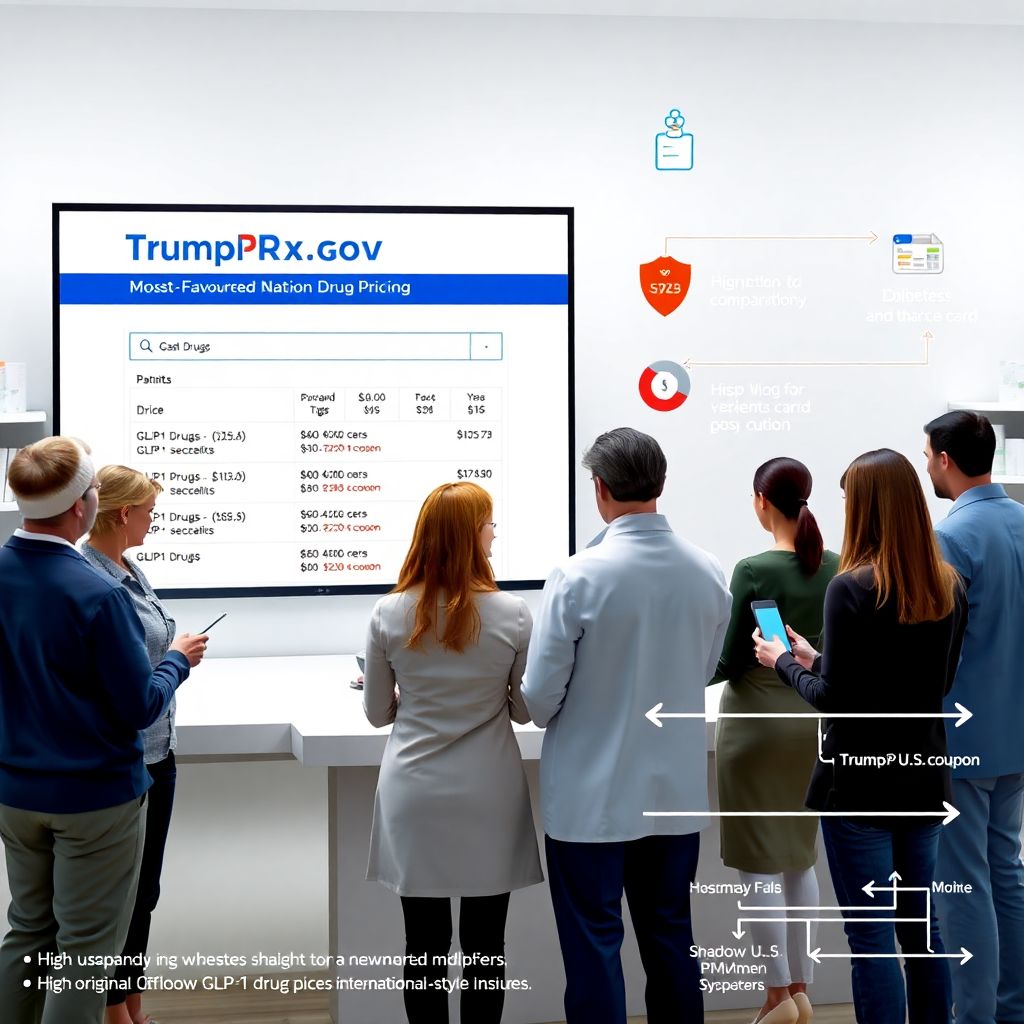
President Trump’s administration has unveiled TrumpRx, a federal platform that promises to dramatically cut what Americans pay at the pharmacy counter—especially for high-demand GLP‑1 drugs used for diabetes and weight loss. Branded as a “most-favored-nation” pricing tool, TrumpRx.gov is pitched as a way to import the kind of prices other rich countries pay, while sidestepping the web of middlemen that keeps U.S. costs among the highest in the world. But does it actually work as advertised, and how legitimate is it?
At its core, TrumpRx is a cash-pay marketplace. Instead of running your prescription through your insurance, you search for your medication on the site and see pre‑negotiated prices that are often substantially below typical U.S. retail levels. The platform shows you discounted cash prices, then lets you generate a printable or digital coupon. You take that coupon to a participating pharmacy or connect directly with cooperating manufacturers to complete the purchase. There is no requirement to create an account, and you don’t need health insurance to use it.
The “most-favored-nation” label is key to how TrumpRx is being marketed. In theory, the program aims to peg what Americans pay closer to the lowest prices charged for the same drugs in other advanced economies. For years, pharmaceutical companies have been able to charge U.S. consumers far more than patients in Europe, Canada, or Japan, in part because those countries often have centralized price negotiation and hard caps. TrumpRx is designed to inject that kind of global reference pricing into the U.S. retail experience, at least for drugs included in the platform.
The White House is framing TrumpRx as a transparency project aimed squarely at the hardest-to-see part of the drug supply chain: pharmacy benefit managers (PBMs), insurers, and the rebate and spread-pricing arrangements that operate behind closed doors. In the current system, the list price of a medication is only the starting point. PBMs and insurers negotiate secret rebates with manufacturers, pharmacies adjust their own pricing strategies, and the final amount a patient pays can be wildly disconnected from the actual net price of the drug. TrumpRx, by contrast, tries to surface a clear, upfront cash price that doesn’t depend on your insurance plan, deductible, or formulary tier.
The timing and design of the platform highlight one particular category: GLP‑1 drugs. These medications—originally developed for type 2 diabetes and now widely prescribed for weight loss—have exploded in popularity. They are also notoriously expensive, with monthly list prices that can exceed what many people pay for rent. Because coverage rules are patchy and many health plans restrict or deny access, a growing number of patients are already paying out of pocket or hunting for discount programs. TrumpRx zeroes in on this demand, attempting to aggregate lower cash prices and use volume to pressure manufacturers.
From a user’s standpoint, the process is intentionally streamlined. You visit the site, type in the name of your prescription, select the dose and quantity, and see a list of participating pharmacies or manufacturers with their offered cash prices. Once you choose an option, you generate a coupon—either to print or store on your phone. At the pharmacy, you present the coupon along with your prescription, and the pharmacy processes the transaction using the TrumpRx pricing, not your insurance. That separation from insurance is critical: it means your purchase might not count toward your deductible or out‑of‑pocket maximum, but it also frees you from formulary restrictions or prior authorizations that can delay treatment.
That leads to the central question: is TrumpRx legit, or just another political branding exercise? On a basic legitimacy level, the platform is government-backed and operates through TrumpRx.gov, which places it in a different category from private coupon apps or discount cards that earn money through spread pricing or affiliate fees. The prices displayed are the result of negotiated arrangements between the government, manufacturers, and pharmacy partners, rather than a third party clipping a hidden margin off each transaction. You are not required to hand over sensitive personal data or banking information to search prices, which reduces some of the privacy and security concerns associated with commercial discount platforms.
However, legitimacy does not automatically equal universal benefit. TrumpRx has important limitations that consumers should understand. First, it is a cash-pay program. If you currently have comprehensive drug coverage with low copays, TrumpRx prices may not beat what you already pay with your insurance card. In some cases, using TrumpRx instead of insurance might save money on a single fill but cost more over the year, because the purchase will not be logged toward your insurer’s deductible or out-of-pocket cap. Second, not every drug and not every pharmacy may be included, particularly in the early stages. Coverage may skew toward high-profile, high-cost medicines like GLP‑1s and other “blockbuster” therapies, while cheaper generics may see less dramatic differences.
Another important nuance is the impact on the broader drug-pricing ecosystem. The administration is betting that by steering patients toward transparent cash prices, it can weaken the leverage of PBMs and force manufacturers to recalibrate their pricing strategies. But the large incumbents in the drug supply chain are unlikely to stand still. Insurers and PBMs may respond by tightening coverage rules, adjusting formularies, or changing how they structure premiums and rebates. Manufacturers, meanwhile, could choose to offer attractive cash prices on some drugs while quietly raising others, preserving their overall revenue while appearing to cooperate with the program.
For patients, this means TrumpRx should be treated as another tool in the toolbox, not a magic bullet. The most practical approach is to comparison-shop: check what your insurance copay or coinsurance would be for a given prescription, then look up the TrumpRx cash price for the same drug, dose, and quantity. Factor in whether you’re likely to hit your deductible anyway, whether the drug is a one-time or long-term therapy, and whether your doctor expects to adjust the dose. In some scenarios—especially for people with high deductibles, no insurance, or poor coverage for specific drugs—TrumpRx could deliver substantial savings. In others, your existing insurance might still win.
GLP‑1 users are a prime example. Many health plans either do not cover weight-loss indications at all or impose strict prior authorization hurdles. Patients who don’t meet those criteria but still seek treatment often turn to telehealth services, compounding pharmacies, or offshore pharmacies—options that can range from legitimate to outright dangerous. A government-backed cash-pay program with transparent pricing at domestic pharmacies represents a safer, more regulated alternative, provided your specific medication and dose are available and competitively priced within TrumpRx.
There is also a political dimension that can’t be ignored. Drug prices are a volatile electoral issue, and any administration wants to show visible action. Branding the site TrumpRx and emphasizing “most-favored-nation” pricing language is clearly designed to signal toughness toward Big Pharma and solidarity with consumers. That doesn’t negate the program’s potential value, but it does mean expectations should be realistic. Structural problems in U.S. drug pricing—like fragmented negotiation power, patent gaming, and complex rebate chains—cannot be dismantled overnight by a single platform, even one backed by the federal government.
Critically, patients should watch for how quickly and how often TrumpRx prices update, and whether the platform expands beyond a narrow set of headline drugs. If the site remains focused mainly on a handful of high-profile medications, its broad impact will be limited, even if it delivers real savings for those specific products. If, on the other hand, the roster of drugs and participating pharmacies steadily grows, and prices stay consistently competitive, TrumpRx could evolve into a serious counterweight to existing discount and insurance-based models.
From a safety perspective, the program’s design has some advantages. Because purchases run through licensed U.S. pharmacies and recognized manufacturers, the risk of counterfeit or substandard medication is significantly lower than with unregulated online sources. The fact that no insurance information is required also reduces opportunities for fraud tied to health plan data. Still, users should remain cautious about look‑alike websites, scam ads, or phishing attempts that misuse the TrumpRx name or logo to harvest personal data.
Looking ahead, TrumpRx could also have ripple effects on innovation and access debates. Critics argue that squeezing prices too hard could dampen incentives for pharmaceutical research and development, especially for high-risk, high-cost therapeutic areas. Supporters counter that the current system overshoots what’s necessary to sustain innovation and that aligning U.S. prices more closely with other wealthy nations is both fair and sustainable. How TrumpRx shapes real‑world prices and manufacturer behavior will be a test case in that ongoing argument.
For now, the smartest way for individuals to approach TrumpRx is pragmatic rather than ideological. If you or a family member takes an expensive branded drug, particularly a GLP‑1 or another specialty medication, it is worth checking the platform’s quoted cash price and comparing it to every other option available to you—your insurance benefit, manufacturer assistance programs, and independent discount cards. Document the numbers, ask your pharmacist to walk through the scenarios, and choose the route that delivers the best combination of affordability, continuity of care, and safety.
In that sense, TrumpRx is both legitimate and incomplete. It is a real, government-backed attempt to introduce more transparent, globally benchmarked pricing into a notoriously opaque system. It will almost certainly help some patients meaningfully lower their costs, especially those currently shut out of insurance coverage for certain drugs. But it is not a universal cure for high drug prices, and it does not replace the need for broader reforms around negotiation authority, patent rules, and insurer-PBM practices.
If you treat TrumpRx as a hard promise that every prescription will suddenly become cheap, you are likely to be disappointed. If you treat it as a new, credible channel to check alongside your existing options, you maximize its potential benefit. The platform’s long-term success will depend less on the political branding around it and more on whether it can consistently deliver lower, transparent prices across a wide range of drugs—and whether patients, doctors, pharmacies, and manufacturers are willing to change their habits to take advantage of it.