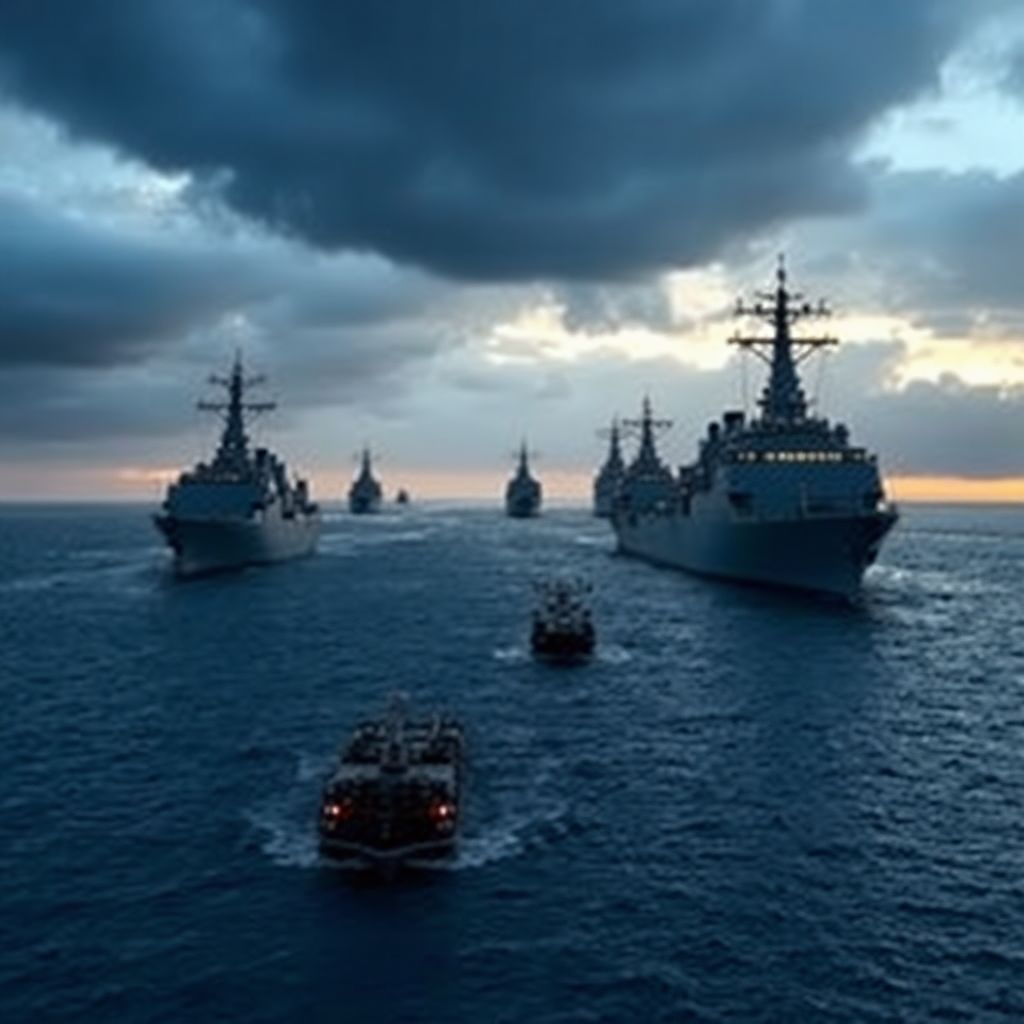
President Trump has warned that the United States is preparing to use its Navy to enforce a blockade in and around the Strait of Hormuz, signaling a sharp escalation in tensions with Iran over maritime security and nuclear concerns. In a message posted Sunday on Truth Social, he said US naval forces would begin interdicting ships attempting to enter or exit the narrow waterway, framing the move as a direct response to what he described as global economic blackmail.
According to Trump, the decision follows negotiations in which Iran’s nuclear ambitions remained the central unresolved issue. He asserted that Tehran is seeking not only financial concessions but, “more importantly, Nuclear,” reiterating his long‑standing claim that Iran’s atomic program lies at the heart of the current confrontation.
Trump wrote that the US Navy has been instructed to identify and stop vessels in international waters that have paid what he called an “illegal toll” to Iran for passage through the strait. Any ship that agrees to such payments, he said, would no longer be guaranteed safe passage on the high seas under US protection. The measure, he argued, is intended to cut off what he portrayed as a revenue stream Iran is using to exert pressure on the global economy.
He further claimed that American forces would begin locating and neutralizing naval mines that Iran has allegedly deployed in or near the Strait of Hormuz. Presenting these steps as an immediate countermeasure, Trump said the objective is to end what he termed “WORLD EXTORTION,” accusing Tehran of using the strategic chokepoint to manipulate energy markets and intimidate other countries.
In the post, Trump described a longer‑term vision in which the strait would eventually operate on an “ALL BEING ALLOWED TO GO IN, ALL BEING ALLOWED TO GO OUT” basis, suggesting a fully open and secure corridor for commercial traffic. He argued that Iran had obstructed that arrangement by raising alarms about potential mines and security threats in the waterway, thereby justifying its own interference with shipping.
The former president’s language toward Iranian forces was notably confrontational. He warned that any Iranian military unit that fires upon US vessels or commercial ships under American protection would face direct and immediate retaliation. While he did not specify what form that retaliation might take, the statement implied that even limited attacks or harassment at sea could trigger a broader military exchange.
Trump also indicated that other countries are expected to join or support the proposed blockade, though he did not name any prospective partners. He provided no firm timeline, operational details, or legal framework for how the blockade would be enforced, leaving unanswered questions about rules of engagement, intelligence coordination, and how neutral or allied vessels would be treated.
At the same time, he claimed that Iran’s naval and air capabilities have already been “degraded,” suggesting that Tehran is in a weaker position to challenge US operations in the area. The message repeated the view that Iran’s leadership is driven by a combination of financial need and the pursuit of nuclear capabilities, with the nuclear file portrayed as the decisive issue shaping US actions.
The Strait of Hormuz, a narrow channel between the Persian Gulf and the Gulf of Oman, remains one of the most critical maritime arteries on the planet. A significant share of the world’s seaborne oil and a substantial volume of liquefied natural gas pass through this corridor every day. Any announcement of military action affecting this route is closely watched by energy traders, shipping companies, insurers, and governments from Asia to Europe and beyond.
Because of this strategic importance, even the suggestion of a blockade can have far‑reaching implications. Energy markets tend to react swiftly to perceived risks in the strait, often pushing up oil prices in anticipation of supply disruptions or rising insurance and transport costs. Shipping operators may adjust routes, delay departures, or seek additional security arrangements if they believe vessels could be delayed, searched, or targeted in the region.
A naval blockade, particularly if enforced beyond the immediate limits of the strait, also raises complex legal questions under international law. States imposing a blockade typically must justify it under the right of self‑defense or with explicit authorization from international bodies. Without clear legal grounding and transparent rules of engagement, there is a heightened risk of miscalculation, confrontation with third‑party vessels, and diplomatic fallout with countries whose ships are stopped or inspected.
For Iran, the threat to close or destabilize the Strait of Hormuz has long been a strategic lever. By hinting that it could disrupt a vital energy corridor, Tehran can signal its ability to impose costs on the global economy if it faces sanctions, military strikes, or diplomatic isolation. Trump’s statement aims to neutralize that tool by asserting that the United States will not allow Iran to regulate, tax, or endanger shipping through the waterway.
If fully implemented, the policy Trump outlined would represent a substantial expansion of US naval responsibilities in the region. American forces would need to monitor large stretches of international waters, identify ships suspected of paying Iranian tolls, gather evidence of such payments, and decide in real time how to respond. This would demand significant intelligence, surveillance, and coordination with allied navies, as well as clear communication to commercial operators about what to expect.
For shipping companies and insurers, the key questions would include: which waters are considered subject to interception, what constitutes evidence of an “illegal toll,” and how US authorities distinguish between vessels coerced into paying and those cooperating willingly. Uncertainty on these points could itself become a source of risk, even before any shots are fired or mines are found.
Regional states that border the Persian Gulf and rely heavily on energy exports may find themselves navigating a delicate balance. On one hand, they depend on free and secure passage through the Strait of Hormuz and may quietly welcome efforts to limit Iran’s leverage. On the other, they are wary of being drawn into open conflict or seeing their ports and terminals targeted in retaliation. Much will depend on whether they are asked to participate formally in the blockade or merely to support it politically and logistically.
The threat of retaliatory action also raises concerns about escalation beyond the maritime domain. Iran could respond not only at sea but through proxy groups, cyber operations, or attacks on infrastructure elsewhere in the region. A confrontation that begins with interdictions or mine‑clearing in the strait could spill over into a broader crisis involving energy facilities, military bases, or commercial shipping in other key waterways.
Domestically, Trump’s posture underscores his emphasis on projecting strength in foreign policy and on taking a hard line toward Iran, especially over its nuclear program. By tying the proposed blockade to nuclear concerns and accusations of extortion, he is presenting the measure as both a security necessity and a defense of global economic stability. Critics, however, are likely to question whether such a move risks drawing the United States into another prolonged confrontation in the Middle East.
The absence of specific operational details in Trump’s statement leaves considerable ambiguity about how imminent or extensive any naval action might be. Nonetheless, the message sets out a clear political baseline: the United States, under his leadership, would be prepared to use direct military measures to prevent Iran from profiting from or threatening traffic in the Strait of Hormuz, even at the risk of heightened tensions and potential military clashes in one of the world’s most sensitive maritime chokepoints.