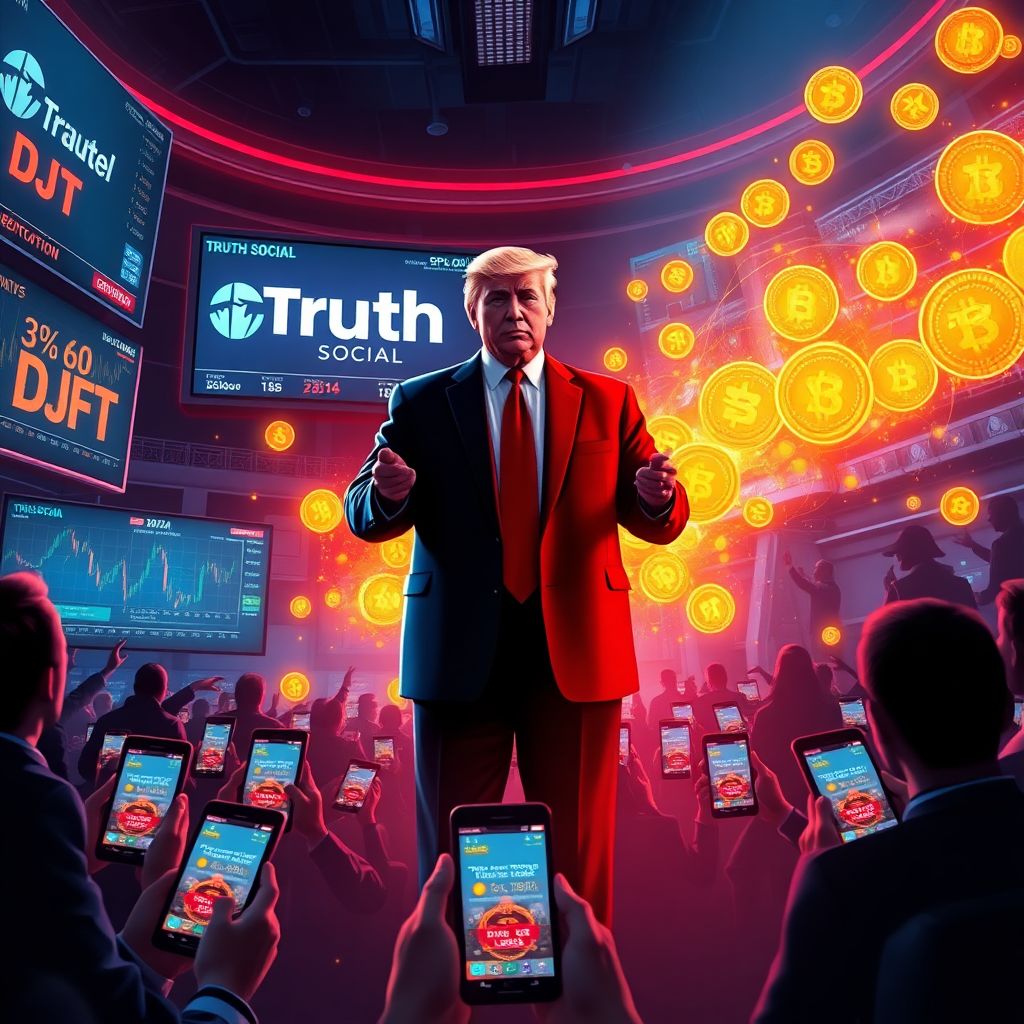
Trump’s token initiative kicks off: innovation or just pay‑to‑play 2.0?
The Trump family’s love affair with crypto is no longer a sideshow—it’s the business model. In just the first six months of 2025, they reportedly pulled in about $802 million from crypto‑related ventures, with digital assets accounting for more than 90% of their declared income. Now, the operation is entering a new phase: an in‑house token tied to the president’s own media empire.
From memes to tokens: Trump Media pivots deeper into blockchain
Trump Media & Technology Group (TMTG), the company behind the MAGA‑centric social platform Truth Social, has unveiled what it calls a “Digital Token Initiative.” The move signals a shift from simply riding meme waves and NFT hype toward building a more structured crypto ecosystem around Trump’s brand and media properties.
Under the plan, existing shareholders of TMTG will be eligible to receive a new digital token associated with Truth Social. The initiative effectively tries to fuse equity ownership with blockchain‑based perks, adding a new speculative layer to an already volatile stock.
What shareholders are actually getting
According to the announcement, anyone holding at least one full share of DJT stock—TMTG’s publicly traded ticker—will qualify for an allocation of these new tokens. Along with the tokens come “associated rewards,” which are expected to include benefits and special access related to Trump‑connected products such as Truth Social and its premium tier, Truth+.
At this early stage, however, the token is more of a loyalty chip than a liquid asset. The company has stated that these tokens:
– Cannot be freely transferred between users
– Cannot be redeemed for cash
– Are not tradable on markets like Polymarket—at least not yet
The absence of transferability or cash conversion makes this look less like a typical cryptocurrency and more like a controlled, in‑platform rewards unit. But that limitation could change if TMTG decides to open the door to secondary markets or introduce new utility that requires real‑world liquidity.
The missing details: minting, allocation, and distribution
Key questions remain unanswered. TMTG has offered little clarity on:
– How many tokens will be minted in total
– How they will be allocated among shareholders and possibly insiders
– What mechanisms will govern issuance, vesting, or burning
– Whether the token will live on a public blockchain or be part of a more closed system
This opacity matters. In crypto, tokenomics—supply structure, distribution, and utility—determine whether a project is sustainable or just a short‑term wealth extraction tool. Without those details, it’s difficult to know if this is a serious technological play or an elaborate marketing scheme bolted onto a politically charged media brand.
Meanwhile, traders are already betting on a full Trump coin
Even though this initial token is tightly controlled and non‑tradeable, speculators are looking further down the road. On prediction markets, traders are assigning roughly a 27% probability that Donald Trump will launch a fully‑fledged, tradable cryptocurrency by year’s end.
In other words, markets are treating this “Digital Token Initiative” as a trial balloon: a low‑risk way for TMTG to test infrastructure, sentiment, and legal gray areas before potentially rolling out a coin that can be bought, sold, and speculated on globally.
Crypto: the new Trump cash machine
The financial context is impossible to ignore. Traditional Trump revenue pillars—golf resorts, licensing deals, and real estate branding—are increasingly overshadowed by the money flowing from digital assets. NFTs, meme tokens, and other blockchain‑based products have become the family’s new cash engines.
For supporters, this is framed as Trump adapting to a new financial era, embracing innovation and bypassing what he frequently describes as a hostile establishment. For critics, it looks like the same old monetization strategy: turn political celebrity into a high‑velocity financial product, now turbocharged by crypto.
Pay for play, or just capitalism on-chain?
The central ethical question is whether this tokenization drive crosses the line into pay‑for‑play territory. When a sitting U.S. president or major political figure uses their media business to issue tokens, several concerns emerge:
– Influence for sale: If access, status, or perceived closeness to power can be gamified through token distribution, it blurs the distinction between political support and financial speculation.
– Regulatory gray zones: Tokens that reward shareholders and tie into a public company may resemble securities, loyalty points, or something in between—raising questions for regulators who are already struggling to define the boundaries of crypto.
– Information asymmetry: Insiders may know far more about future token utility or policy decisions that could affect its value, creating opportunities for political insider trading in everything but name.
Supporters counter that this is just free‑market innovation: a politician‑businessman empowering his audience with new digital tools and rewards. Detractors see it as another way to monetize political fandom while shifting risk to the public.
From social media battles to blockchain wars
TMTG originally framed itself as a direct challenge to Elon Musk’s X, positioning Truth Social as the home base for Trump’s political movement and disenfranchised conservatives. That narrative is evolving. Rather than competing only in the attention economy, TMTG is now stepping into the value transfer layer of the internet—blockchain.
This evolution mirrors a broader trend: social platforms are experimenting with tokens, tipping, and on‑chain identity systems to lock in users and convert engagement into financial flows. For TMTG, a proprietary token could:
– Reward heavy content creators and influencers aligned with the MAGA message
– Incentivize users to spend more time on the platform
– Create a self‑contained economy less dependent on traditional advertisers or hostile financial intermediaries
Whether this becomes an empowering ecosystem or a closed economic loop funnelling value upwards depends on how the token is governed and who controls the levers.
The politics of profit: conflicts and consequences
When a political brand is so deeply intertwined with speculative finance, the risk of conflicts of interest escalates. With over 90% of the Trump family’s reported income in early 2025 coming from digital assets, every policy stance on crypto, financial regulation, or taxation potentially intersects with personal gain.
Key implications include:
– Policy bias: Any move to favor or protect the crypto industry could be perceived as self‑serving, especially if it directly benefits Trump‑related tokens, NFTs, or exchanges.
– Voter trust: For some supporters, Trump’s alignment with crypto reinforces his outsider persona and willingness to challenge traditional finance. For skeptics, it confirms fears that his political project is tightly bound to personal enrichment.
– Market volatility: Trump’s public statements have already influenced the prices of various meme coins and NFTs tied to his name. A formal token initiative could amplify those swings, with retail investors caught in the middle.
Legal and regulatory storm clouds
Regulators are already struggling to classify and oversee crypto assets. A politically connected token raises the stakes. Several issues are likely to attract scrutiny:
– Securities law: If the token’s value depends on TMTG’s performance or Trump’s political clout, it could be considered an unregistered security, triggering enforcement actions.
– Campaign finance rules: Even if the initiative is framed as a corporate loyalty program, lines blur when a sitting president’s or leading candidate’s media operation is distributing value to supporters.
– Disclosure obligations: Public companies face strict requirements on how they communicate about new financial products. Any misleading statements about token utility or future profits could invite lawsuits.
So far, TMTG has avoided detailed commentary, which may be strategic: the less they promise, the harder it is for regulators to claim investors were misled. But that same vagueness also keeps ordinary shareholders in the dark.
The fan economy meets the token economy
For Trump’s most devoted followers, the token is likely to be more than a digital coupon. It can serve as:
– A status symbol of loyalty within the MAGA ecosystem
– A potential future lottery ticket if the token eventually becomes tradable
– A new way to feel financially and emotionally invested in the Trump brand
This taps into the broader “fan token” phenomenon, where celebrities, sports teams, and influencers issue on‑chain assets that blur the line between merch, membership, and speculative investment. The emotional connection becomes part of the financial calculus—often to the detriment of rational risk assessment.
Could this be a real crypto innovation?
To be more than a flashy rewards program, Trump’s Digital Token Initiative would need to evolve along several serious lines:
– Clear utility: Tokens should do something beyond signaling allegiance—such as enabling governance votes within the platform, unlocking meaningful services, or facilitating creator payments.
– Transparent tokenomics: The supply schedule, insider allocations, and distribution rules must be disclosed and verifiable.
– Interoperability: A token that works only within a walled garden is easier to control but less compelling. Connecting to broader blockchain ecosystems could make it more useful, but also more regulated.
If TMTG treats this initiative as a truly long‑term infrastructure project rather than a quick monetization play, it could become a test case for politically branded digital economies.
Or is it just the next monetization chapter?
Skeptics argue that the pattern is familiar: identify a passionate base, bundle identity and loyalty into a financial product, and harvest the resulting speculative frenzy. NFTs and meme coins connected to Trump have already produced huge paydays; a media‑linked token could be the next iteration of that same strategy.
The timing reinforces this view. With hundreds of millions already flowing from digital assets into the Trump family’s accounts in early 2025, adding another token looks less like experimentation and more like scaling a proven revenue engine.
What happens next?
For now, the token remains a promise: a controlled, non‑tradable asset linked to stock ownership and platform loyalty. The real inflection point will come if and when TMTG:
– Enables transferability and secondary trading
– Expands the token’s role inside Truth Social and Truth+
– Or launches a separate, fully tradable cryptocurrency with Trump’s name or brand explicitly attached
At that stage, all the unresolved questions—about pay‑for‑play, regulation, insider enrichment, and market manipulation—will become far harder to ignore.
Until then, Trump’s blockchain pivot sits on a knife edge between genuine technological experiment and a highly sophisticated method of squeezing more value out of political fandom. Whether it turns into a meaningful crypto revolution or just another way to cash in on “The People” will depend not on the slogans, but on the code, the disclosures, and who ultimately benefits from this new tokenized reality.