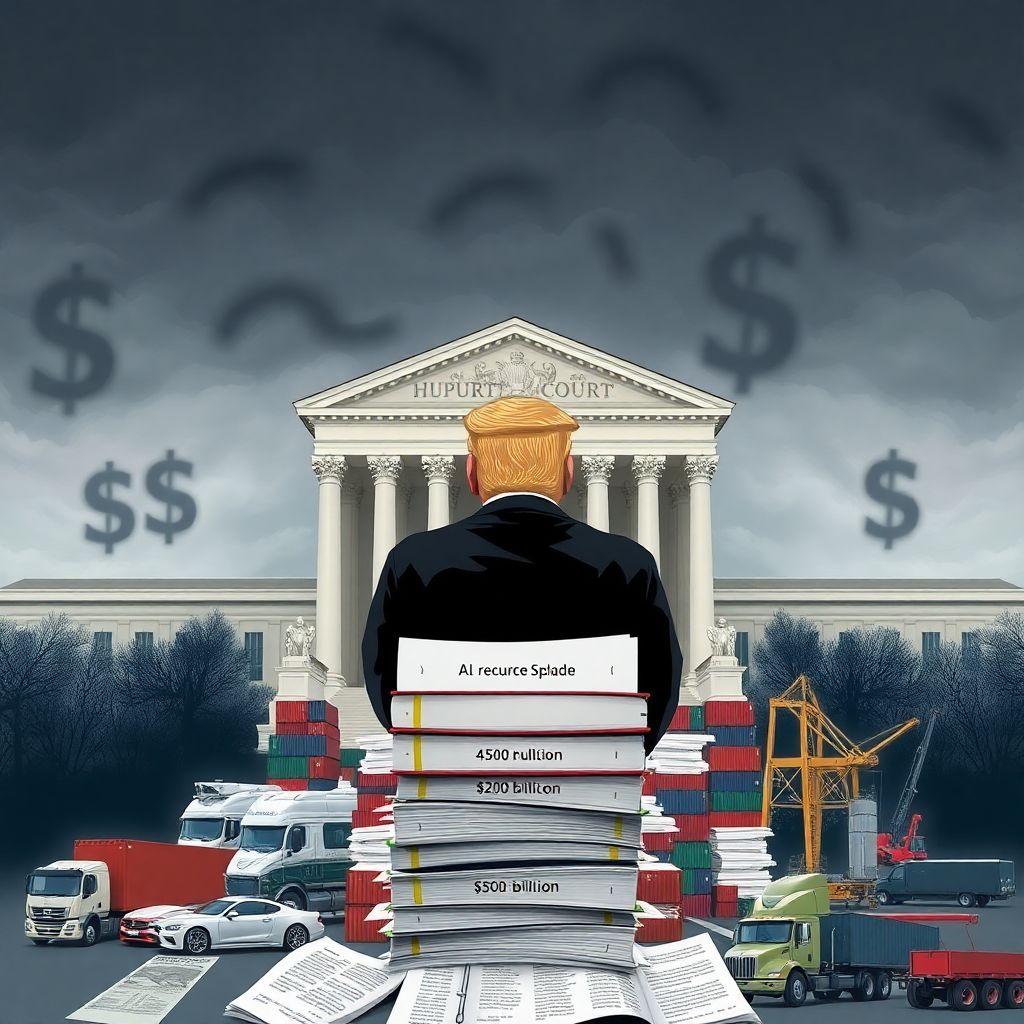
Trump tariff showdown: $200 billion in duties and a 4,500‑page rulebook face a Supreme Court test
A landmark Supreme Court decision expected as soon as Friday could redraw the boundaries of U.S. trade policy, putting roughly $200 billion in customs duties and a sprawling 4,500‑page tariff schedule under legal scrutiny.
At the center of the case, Learning Resources, Inc. v. Trump, is a basic question with enormous implications: how far can a president go in using emergency powers to rewrite trade rules and impose tariffs without direct approval from Congress? The answer could determine the fate of more than half the tariff revenue collected since early 2025 and force a major rewrite of the technical code that governs almost every imported product.
A tariff code that has exploded in size
Under Donald Trump’s second term, the U.S. tariff regime has grown not only in financial weight but in sheer complexity. The latest version of the Harmonized Tariff Schedule now runs in excess of 4,500 pages, according to federal documentation. That is more than 100 pages longer than the 2025 edition and roughly 800 pages thicker than the 2017 baseline, when Trump first came into office.
Much of this growth stems from ad‑hoc tariff actions and narrow, product‑specific rules issued in rapid succession. Each new measure tends to generate new subcategories, exceptions, and statistical reporting lines, adding legal and administrative layers that importers must navigate just to know what they owe at the border.
Trade economist Scott Lincicome, vice president for trade policy studies at the Cato Institute, notes that the number of distinct tariff actions covering major import categories has ballooned from three in 2017 to at least 17 today. In an analysis published late last year, he described the modern U.S. tariff code as “mind‑numbingly difficult” for businesses and lawyers alike, with an overall economic cost that he believes is “likely staggering.”
Chapter 99: the epicenter of emergency trade policy
The densest concentration of this new complexity sits in Chapter 99 of the tariff schedule, which begins around page 3,320. This section is essentially the catch‑all repository for temporary measures and country‑ or product‑specific tweaks issued under various trade authorities, including emergency powers.
Throughout 2025, the administration used Chapter 99 to roll out dozens of new provisions, attaching unique statistical codes to items ranging from auto ignition coils and high‑end industrial machinery to construction equipment like backhoes. Each code can trigger a different duty rate, exemption, or sunset date, turning a once‑narrow policy tool into a dense thicket of special rules.
For companies importing finished goods or components, even small changes in these entries can alter profit margins or upend supply chains. A single product can now straddle multiple tariff classifications depending on use, origin, or minor design differences, creating compliance challenges that favor large firms with extensive legal resources over smaller competitors.
A rising burden on consumers and businesses
Behind the legal and bureaucratic complexity is a straightforward economic result: higher prices. Researchers at the Yale Budget Lab estimate that the effective burden of tariffs on consumers now averages about 16.8 percent. While the government formally taxes importers, much of that cost is passed down the chain in the form of more expensive consumer goods, costlier intermediate inputs, and squeezed margins for small businesses.
Since early 2025, the U.S. has collected more than $200 billion in duties, according to government figures. The Tax Foundation estimates that roughly 55 percent of this haul comes from emergency tariffs—the very measures now under review by the Supreme Court. If the justices conclude that the White House exceeded its legal authority, the decision could invalidate a significant chunk of this revenue.
What the Supreme Court is really deciding
Learning Resources, Inc. v. Trump centers on the president’s use of the International Emergency Economic Powers Act (IEEPA), a statute originally crafted to let presidents respond quickly to national security emergencies and extraordinary foreign threats. Over time, IEEPA has evolved into a powerful and flexible tool for sanctions, trade restrictions, and, increasingly, tariffs.
The core issue is whether the administration stretched that authority beyond its intended scope when it imposed broad, long‑lasting tariffs framed as emergency responses. The Court’s ruling will effectively answer three key questions:
1. How broadly can a president define an “emergency” for trade purposes?
2. Can tariffs justified as emergency measures remain in place for years without new congressional approval?
3. What remedies are available if the Court concludes those duties were unlawfully collected?
Analysts suggest that around $100 billion in tariff revenue is directly at stake in the ruling. But the precedent could matter even more than the dollars: a restrictive interpretation of IEEPA would limit the trade policy tools available to future presidents of either party.
Potential fallout: mass refunds and a new tariff map
If the Court rules that certain emergency tariffs were unlawful, the government could be forced to return billions of dollars to importers. Major retailers and large industrial buyers are already positioning themselves to claim potential refunds. Costco, for example, has joined a growing roster of companies suing the administration to preserve their right to reimbursement should the duties be struck down.
Such a decision would almost certainly trigger a rapid rewrite of the tariff schedule. Hundreds of entries—particularly in Chapter 99—might need to be revised, excised, or recast under alternative legal authorities. In 2025 alone, more than 30 revisions were made to the schedule; a sweeping Supreme Court ruling could multiply that figure many times over in a short period.
The administration has signaled that, if some tariffs are overturned, it intends to replace them with alternatives it characterizes as “legally durable.” That likely means leaning more heavily on longstanding trade laws such as Section 232 (national security) or Section 301 (unfair trade practices) rather than on emergency powers. However, those tools come with their own procedural requirements, geopolitical risks, and litigation exposure.
Markets brace for impact
Financial markets have already started to price in the uncertainty. Equity indices have traded with noticeable restraint in recent weeks, and commodities traders have cut back on risk exposure ahead of the ruling. For sectors tightly linked to global supply chains—manufacturing, autos, retail, technology hardware—tariff rules can significantly alter earnings expectations, capital spending plans, and inventory strategies.
Tariffs function as a tax on cross‑border flows of goods. When they shift abruptly, companies may need to revisit everything from pricing and sourcing choices to plant locations and logistics contracts. For investors, that means a higher risk of earnings surprises and valuation swings in industries most exposed to international trade.
Bond markets are watching as well. A decision that forces large‑scale refunds or cuts off a major source of tariff revenue might have modest implications for the fiscal outlook. While tariffs represent a small slice of total federal income compared with income and payroll taxes, any precedent that curtails executive flexibility in raising trade revenue can influence long‑run budget projections and macroeconomic modeling.
Crypto: from early 2026 boom to cautious sideways trading
Digital asset markets, which surged at the start of 2026 on the back of institutional inflows, high‑profile exchange‑traded fund launches, and wider stablecoin adoption, have cooled markedly. Bitcoin and Ethereum have moved largely sideways since mid‑December, while volumes in many alternative tokens have fallen off, based on recent market data.
Tariffs might seem distant from crypto, but there are several channels linking the two. First, broad shifts in risk appetite driven by macroeconomic policy uncertainty often spill over into the digital asset space. When investors face unclear trade rules, corporate earnings risk, and possible macro headwinds, they tend to trim exposure to more volatile assets, including cryptocurrencies.
Second, companies building hardware for the sector—such as mining rigs, specialized chips, and data center infrastructure—can be directly affected by tariff schedules on electronics, semiconductors, and computing equipment. Changes in import costs can reshape mining economics, influence where data centers are built, and alter the global geography of hash power and blockchain infrastructure.
Finally, the broader regulatory tone matters. A Supreme Court decision that reins in aggressive use of emergency economic powers may signal to crypto firms and investors that there are firmer limits on unilateral executive action in economic policy. While trade and digital assets sit in different legal silos, a ruling that emphasizes process, statutory limits, and congressional authority could be read as a broader win for regulatory predictability.
How businesses are positioning themselves
Across the economy, companies are adopting defensive stances while they wait for clarity. Import‑heavy businesses—retailers, industrial distributors, consumer electronics makers—are:
– Delaying major sourcing changes until the ruling clarifies which tariffs will remain in place.
– Running “dual‑track” financial models that assume both a status‑quo tariff environment and scenarios where key duties are removed or refunded.
– Consulting customs and trade counsel to document overpayments and ensure they are eligible for potential reimbursement claims.
Technology manufacturers are likewise on edge. Many rely on intricate, transnational supply chains that cross borders multiple times before a finished product is ready for sale. Even a modest shift in the tariff treatment of intermediate components can tilt the logic of where assembly plants should be located or which suppliers are cost‑competitive.
Crypto‑focused firms, for their part, are watching indirectly linked signals: risk sentiment, regulatory tone, and hardware costs. Mining companies and data‑center operators in particular are running sensitivity analyses on potential changes to tariffs on chips, power equipment, cooling systems, and networking gear.
What the ruling could mean for future trade policy
Beyond its immediate impact on revenue and refunds, Learning Resources v. Trump is widely seen as a test case for how far courts are willing to let presidents go when reshaping the global trade landscape without new legislation.
If the Court upholds most of the contested tariffs, it would effectively affirm a broad interpretation of IEEPA and related statutes. Future presidents could read that as a green light to continue using emergency declarations as a flexible tool for economic statecraft—imposing or lifting tariffs, sanctions, and restrictions at speed, with relatively limited congressional oversight.
If, instead, the justices draw a sharp line around what counts as an emergency and how long such measures can remain in place, it could force a rebalancing of power between the White House and Congress in trade policy. Lawmakers might need to play a more active role in authorizing and reviewing tariff actions, and major shifts in trade policy could become slower but more stable and predictable.
Either way, the decision will shape how companies interpret political risk in the United States. A system that relies heavily on unilateral emergency powers may be faster but more volatile; one that leans on statute‑driven processes and legislative compromise may appear slower but less prone to abrupt, sweeping changes.
Scenarios to watch after the decision
Analysts are sketching out several broad scenarios:
1. Status quo largely upheld
Most emergency tariffs are affirmed; only narrow adjustments are required. Markets may initially rally on relief, but expectations of continued aggressive tariff policy could weigh on trade‑exposed sectors.
2. Partial rollback with complex remedies
Some duties are struck down, others preserved. The result is a messy transition with selective refunds and a wave of technical amendments to the tariff schedule. Legal and compliance costs spike as companies sort through case‑by‑case impacts.
3. Broad curtailment of emergency tariff powers
A strong rebuke from the Court forces the administration to dismantle or replace a large share of emergency tariffs. Short‑term volatility is likely as markets digest new rules, but longer‑term clarity on legal boundaries could eventually support investment and trade.
In every scenario, businesses will need to reassess supply chains, hedge strategies, and capital plans in light of the new legal landscape.
How companies and investors can prepare now
While the outcome remains uncertain, there are practical steps firms and market participants can take:
– Map exposure: Identify which products, inputs, and hardware fall under emergency‑linked tariff codes, especially in Chapter 99.
– Model multiple futures: Run financial projections under different tariff and refund outcomes, including best‑case and worst‑case rulings.
– Document payments: Maintain detailed records of past duties paid to support claims if certain tariffs are declared unlawful.
– Review contracts: Examine supplier and customer agreements for clauses addressing changes in duty rates, cost sharing, and force majeure events.
– Watch regulatory signals: Monitor how the administration frames any replacement measures; the chosen legal basis will hint at how aggressive future trade actions might be.
For investors—whether focused on equities, commodities, or digital assets—the ruling will be a key signal about the direction of U.S. economic governance, not just trade. A clearer boundary between statutory policy and emergency action can reshape risk assessments across asset classes.
A narrow case with outsized consequences
On its face, Learning Resources v. Trump is a dispute about the legality of specific tariff measures and the interpretation of a decades‑old emergency statute. In practice, it has become a referendum on who controls the trade levers of the world’s largest economy, how predictable U.S. economic policy really is, and where the line lies between executive flexibility and legal overreach.
With more than $200 billion in duties collected, a tariff code that has swelled to over 4,500 pages, and roughly $100 billion in revenue directly at risk, the stakes are substantial. From importers and manufacturers to crypto firms and global investors, virtually every corner of the market has a reason to pay close attention to what the justices decide in the coming days.