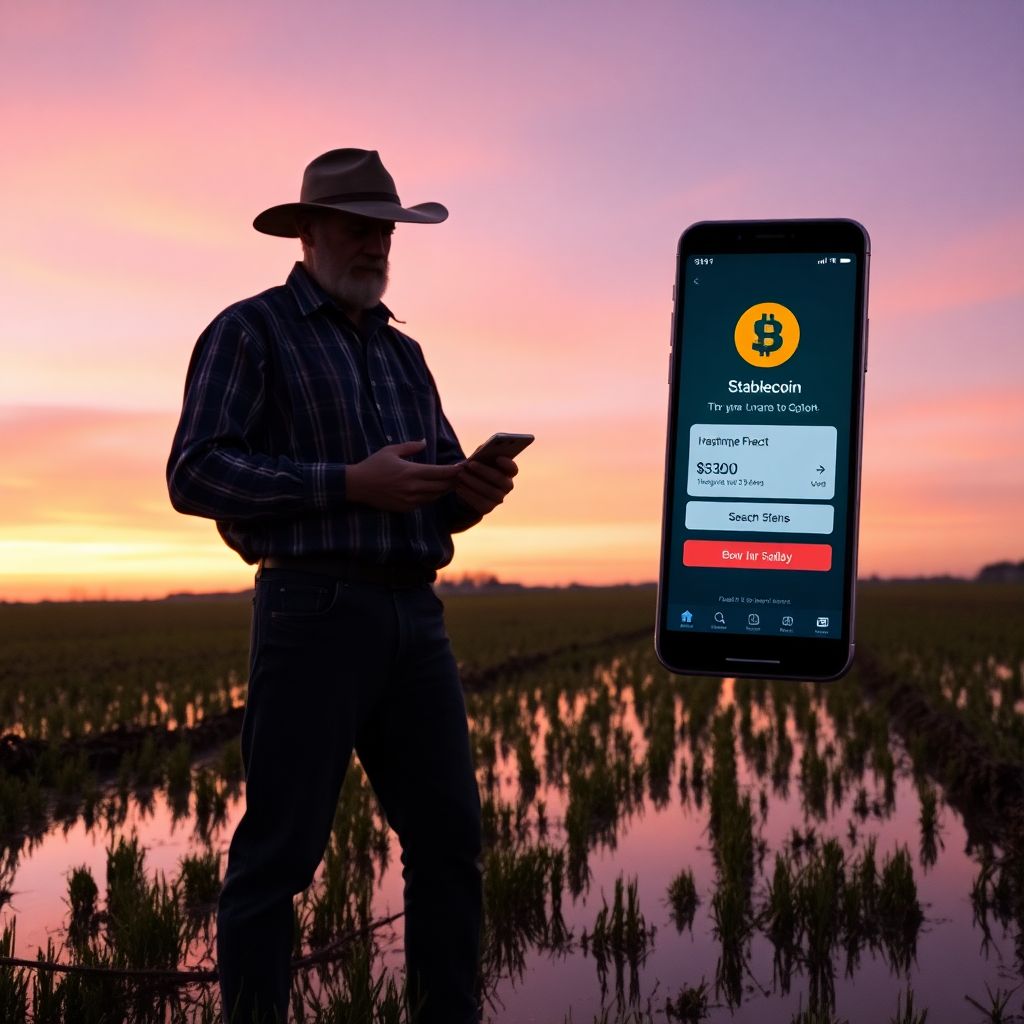
What if a farmer whose fields were just destroyed by a storm could receive insurance money before the floodwater even receded?
That isn’t science fiction anymore. It’s the logical next step if we combine stablecoins, smart contracts, and real-time climate data into a new kind of insurance system that pays out in seconds instead of seasons.
Climate change has turned extreme weather from a rare shock into a permanent feature of agricultural life. In 2024 alone, farmers in the United States lost more than $20 billion to wildfires, hurricanes, floods, hail, frost, and tornadoes. Canadian agriculture is under similar pressure: in 2022 and 2023, over half of all farming operations struggled with drought, while more than a quarter battled flooding. In British Columbia, weather-related agricultural losses in a single year approached $460 million.
Those numbers are enormous, but they don’t capture the full picture. Farmers in wealthier countries at least have some access to credit, subsidies, or insurance. Producers in lower-income regions such as rural Kenya or parts of Brazil often have none of that. Their livelihoods are more exposed, their tools are less advanced, and their financial buffers are thinner. A drought that a U.S. farmer can barely survive might push a smallholder in the Global South permanently out of agriculture.
When a farm is hit by a climate disaster, the real crisis unfolds not only in the broken infrastructure and ruined crops, but in the cash flow that stops overnight. A farm is a living system with rhythms that cannot be paused. Once income disappears, bills do not. Seeds still need to be bought, equipment repaired, wages paid, loans serviced. Every week without financial support may mean missed planting windows, abandoned fields, and spiraling debt that can take years to overcome-if the farm survives at all.
Traditional insurance is poorly suited to this new era of volatility. It is slow, heavily intermediated, and dependent on manual verification. After the catastrophic floods in Pakistan in 2022, many small farmers had to wait months for relief money to pass through layered bureaucracies and local financial institutions. By the time payments finally arrived, critical planting seasons were over. Some farmers were left unable to fund operations for the following year, turning a single weather event into a multi-year economic disaster.
If climate shocks can devastate a farm in minutes, financial relief can no longer take months. The time lag is not just an inconvenience; it is the difference between recovery and collapse. To adapt to a hotter, more unstable planet, farmers need liquidity that is as fast and predictable as the weather is chaotic.
This is where an unlikely technology steps in: stablecoins.
Stablecoins are digital tokens engineered to maintain a stable value relative to traditional currencies such as the U.S. dollar. Unlike volatile cryptocurrencies, they are designed as reliable units of account and mediums of exchange. Their real promise lies in utility, not speculation: they move value instantly, across borders, 24/7, at low cost, and with built-in transparency.
Most conventional insurance payouts flow through banks and legacy payment rails that were never designed for speed, inclusivity, or global reach. Adjusters must travel to affected areas, fill out paperwork, submit claims, wait for approvals, and then rely on banking infrastructure that often barely exists in rural settings. Even in sophisticated financial systems, this can take months. In places with weaker institutions, the process can stretch beyond a year.
By contrast, stablecoin transfers can be settled in seconds. They do not close on weekends or holidays, do not require local branches, and are not constrained by national payment systems. A farmer with nothing more than a basic smartphone and internet access can receive a payout directly into a digital wallet, whether they live in a remote Canadian valley or a small village in Central America.
Financial exclusion makes this especially important. In countries like El Salvador, hundreds of thousands of people work in agriculture, yet a significant share of the population lives without access to formal banking. Only a small fraction of farmers can obtain agricultural credit. For the majority, there is no checking account to receive a wire transfer, no credit card, no local bank manager. Stablecoins transform a phone into a de facto bank account-one that can hold value, send and receive funds, and interact with insurance programs from anywhere.
This is not a theoretical exercise. Humanitarian organizations have already demonstrated that stablecoin-based payments can operate in some of the most challenging environments on earth. Emergency funds have been delivered in stablecoins to displaced families in active conflict zones, avoiding the usual bottlenecks of correspondent banking, capital controls, and local cash shortages. If digital dollars can navigate war zones, there is no technical reason they cannot reach farms scattered across vast rural territories.
Yet speed alone does not solve the problem. The other breakthrough comes from programmable money and smart contracts.
Smart contracts are pieces of software that run on blockchains and execute automatically when certain conditions are met. In insurance, this unlocks parametric coverage: instead of paying out based on human assessment of damage, policies are tied to objective external indicators-like rainfall levels, wind speeds, or temperature thresholds.
Imagine a drought insurance policy written as code. If cumulative rainfall in a defined region drops below a preset level for a given period, the smart contract triggers automatically. It pulls verified climate data from trusted weather sources-satellite feeds, sensor networks, or certified meteorological stations-and, the moment the threshold is breached, sends out stablecoin payments directly to insured farmers’ digital wallets.
No one has to file a claim. No adjuster needs to visit the field. There are no discretionary decisions by an insurance officer deciding who qualifies and who does not. The rules are coded in advance, known to all parties, and enforced automatically.
This architecture radically reduces paperwork, delays, and opportunities for corruption or favoritism. It also makes insurance more predictable for farmers: they know in advance what parameters will trigger compensation and roughly how much they will receive. Platforms are already experimenting with this model, using blockchain-based systems to deliver automatic stablecoin payouts to growers when extreme weather hits. Processes that once required weeks of manual handling can now be compressed into minutes.
Just as important as speed is trust. Climate finance has long been plagued by opacity. Billions in aid, relief, and insurance flows disappear into layers of middlemen, administrative overhead, and poorly tracked intermediaries. Recipients on the ground often do not know why money is late, reduced, or missing entirely. Donors and insurers struggle to verify how funds are used and where they end up.
Blockchain infrastructure offers a different approach. Each stablecoin transfer is recorded on a public, tamper-resistant ledger. While individual farmers’ identities can still be protected, the flow of funds from the origin to the final recipients can be tracked and audited. This dramatically enhances accountability.
Some initiatives are already demonstrating that climate insurance payouts can be both automated and fully traceable, directing stablecoin-based compensation to smallholder farmers in regions like sub-Saharan Africa. In such models, every unit of value can be followed from the original contributor to the farmer’s wallet. That degree of transparency, coupled with rapid settlement, begins to rebuild confidence among all parties involved: farmers, insurers, donors, and governments.
When these elements-instant settlement, programmable rules, and transparent recording-work together, they can transform the very nature of agricultural risk management.
Consider how this might look in practice for a mid-sized farmer in a drought-prone region. At the start of the season, they enroll in a parametric insurance program via a simple mobile interface. They select coverage levels based on rainfall thresholds and historical yield data, pay their premium in local currency (which is converted into stablecoins behind the scenes), and receive a digital policy stored in their wallet.
Throughout the season, the program continuously monitors rainfall data for that geographic area using multiple independent data feeds to prevent manipulation. If rainfall stays within normal ranges, nothing happens-the farmer simply continues operations. If the region slips into drought conditions below the agreed index, the contract self-executes. Within seconds, the farmer receives a payout directly in stablecoins, which they can either hold, convert to local currency through participating agents, or use to pay suppliers that also accept digital payments.
The impact of even a modest, rapid payout is significant. Instead of selling equipment at fire-sale prices or taking on predatory loans to survive the season, the farmer can purchase drought-resistant seeds, pay workers, or invest in water-saving technology. The shock is absorbed, not amplified.
There are broader macroeconomic implications as well. Faster, more reliable payouts serve as an automatic stabilizer for rural economies. When large numbers of farmers receive timely compensation after a regional disaster, local businesses-from input suppliers to transport operators-can keep functioning. This sustains employment and demand in areas that are otherwise highly vulnerable to climate shocks.
Of course, this vision is not without challenges. Digital literacy, smartphone access, and reliable internet connectivity remain obstacles in many agricultural regions. Regulatory frameworks for both insurance and digital assets are evolving unevenly across countries. Consumer protection, data privacy, and currency stability must be carefully managed. And the design of parametric products must be robust enough to avoid “basis risk,” where the index signals a payout even though a farmer is fine-or, worse, fails to trigger when a farmer is in real distress.
Yet these hurdles are largely solvable with thoughtful policy, phased deployment, and strong collaboration between governments, insurers, technology providers, and farmer organizations. Pilot programs can start small, refine index designs, and build trust before scaling. User interfaces can be designed for low literacy environments, with voice support and visual cues. Offline-capable wallets and local agents can bridge gaps where connectivity is weak or intermittent.
Another critical dimension is integration with local economies. Receiving money in stablecoins is only empowering if farmers can easily convert it to goods and services. That means embedding digital payments into local supply chains: enabling agro-dealers, cooperatives, transporters, and even local markets to accept digital payments or to act as cash-out points. In many cases, these same infrastructures can also be used for savings, remittances, and access to small loans, multiplying the developmental impact beyond insurance alone.
Governments, too, stand to benefit. Climate disasters strain public budgets, forcing emergency reallocations and politically sensitive bailouts. A robust, parametric, stablecoin-enabled insurance network can offload part of that burden to risk pools and capital markets, while giving authorities better data in real time about where losses are occurring and how support is being distributed. Over time, this can inform smarter investments in climate adaptation: irrigation, resilient infrastructure, and crop diversification.
For the global financial system, this approach tests a deeper proposition: can money become not just faster and cheaper, but smarter and fairer? Stablecoins and smart contracts offer a toolkit for building financial rails that respond dynamically to real-world conditions instead of waiting for human approval at every step. In sectors like agriculture, where timing is everything and climate uncertainty is rising, that responsiveness is not a luxury-it is a necessity.
If we continue to rely solely on legacy insurance and aid mechanisms, climate volatility will keep outpacing our capacity to respond. Farmers will be asked to shoulder risks they cannot manage, in a system that too often fails them when they need it most. The result will be more abandoned farms, greater rural poverty, food price instability, and increased migration from devastated agricultural regions.
Alternatively, we can re-architect the way money moves in response to climate events. We already have the building blocks: stable, programmable digital currencies; verifiable weather and satellite data; and maturing regulatory thinking on digital assets and innovative insurance. The question is less about technology and more about political will, institutional courage, and design.
Payouts that arrive in seconds will not stop droughts, hurricanes, or floods. But they can break the vicious cycle where a single bad season destroys years of work. They can give farmers the confidence to invest again after a loss, to adopt new climate-resilient practices, and to stay in business on land their families may have worked for generations.
In a world where climate disasters can form overnight, there is no reason financial relief should still travel at the speed of paper forms and manual approvals. If we choose to deploy them wisely, stablecoins and smart contracts can turn climate insurance from a slow, uncertain promise into a tool of immediate, tangible resilience-measured not in months, but in seconds.