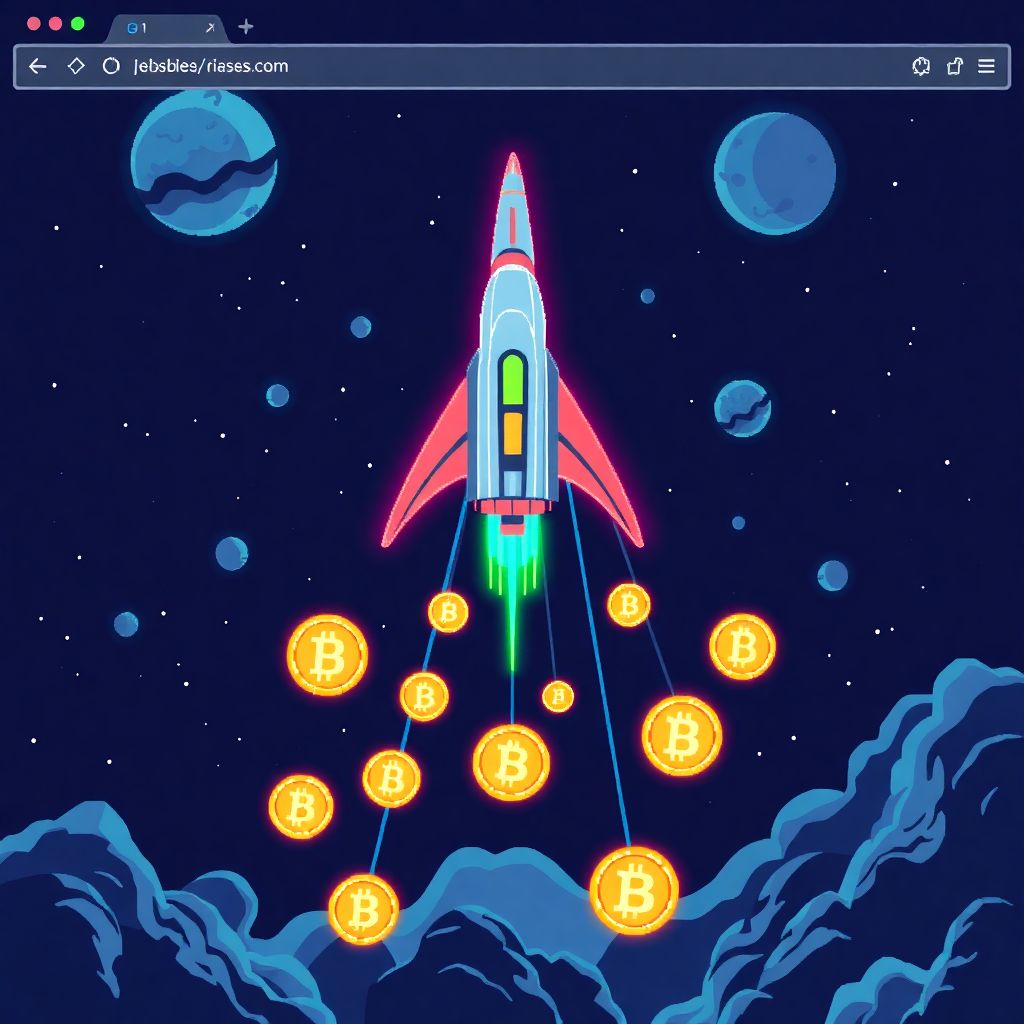
‘Space Invaders’ Style Web Game Lets You Earn Real Bitcoin-If You’re Good Enough
A new browser game inspired by classic arcade shooters is putting a modern, crypto-native twist on the high-score chase: instead of tickets or bragging rights, the prize is real Bitcoin. But claiming that reward won’t be straightforward. You’ll need a mix of old-school gaming skill, favorable blockchain conditions, or a serious pile of BTC to throw around.
The game, called Mempool Space Invaders, is free-to-play and runs directly in your web browser. It borrows its structure from the legendary “Space Invaders,” but swaps out pixelated aliens for Bitcoin “whales” dropping from the sky. These whales aren’t just thematic enemies-they’re tied directly to real transactions happening on the Bitcoin blockchain.
Every whale drifting down the screen represents an actual live Bitcoin transaction. When you successfully blast one, the game pulls in the size of that transaction and adds the amount of BTC it carries to your score. Land a hit on a massive whale and your score can spike dramatically; clip only small, low-value transactions and your total will rise more slowly.
If you fail to shoot a whale before it reaches your defenses, your shields begin to erode. Each missed transaction slowly chips away at your protection. Let enough of them slip past and your shields collapse entirely, ending your run. From there, you have two choices: start a new game at no cost, or pay 1,000 sats to resume where you left off.
That small payment-1,000 satoshis, or about $0.73 at recent prices-illustrates how the game folds Bitcoin mechanics into the arcade loop. A satoshi (or “sat”) is the tiniest unit of Bitcoin, equal to 1/100,000,000 of a BTC. By pricing continues in sats, the game keeps the experience natively Bitcoin-focused, down to the smallest denomination.
The promise of a Bitcoin bounty is what makes Mempool Space Invaders stand out from typical browser games. A player will ultimately walk away with a BTC prize, but the odds of that being you depend on three main factors: your ability to survive and rack up points, the overall activity level on the Bitcoin network while you’re playing, and how much Bitcoin you’re willing-or able-to push through the blockchain yourself.
Skill matters because survival is not guaranteed. Like the original arcade classics, the difficulty ramps up as you progress. Managing enemy speed, shot timing, and positioning becomes critical. A careless moment can cost you a run that took dozens of high-risk dodges and perfectly timed hits to build. The higher the transaction values falling down the screen, the more punishing any mistake feels.
Luck plays a bigger role than in most retro shooters, because your scoring potential is tethered to real-world blockchain data. If you happen to be playing during a lull, with only small transactions flowing through the mempool, you’ll have fewer big whales to harvest for a massive score. Jump into the game during a surge in Bitcoin usage, when large transfers are being broadcast, and you might see enormous whales whose successful destruction can rocket your score upward.
Then there’s the “rich” factor. In theory, someone moving huge amounts of BTC could influence what appears in the game. Large self-directed transactions might show up as whales, giving that player a chance to shoot down their own transfers and stack an outsized score-assuming the game’s design and timing line up with what is happening on-chain. That dynamic makes Mempool Space Invaders not just a test of reflexes, but also a kind of live visualization of economic activity on Bitcoin.
By visualizing the mempool-the pool of unconfirmed Bitcoin transactions-as hostile invaders, the game offers a quirky, intuitive way to understand how the network processes pending transfers. Each falling whale is a reminder that behind every flickering sprite is someone, somewhere, moving value across the Bitcoin network.
The “play for free, pay in sats to continue” model sits at the crossroads of arcade nostalgia and today’s crypto culture. Classic cabinet games demanded coins for another go; here, the coin is digital and globally accessible. Hardcore competitors might decide that the cost of a few thousand sats is worth preserving a deep run, especially if they’re chasing a leaderboard-topping score that could help unlock the BTC bounty.
What makes the concept especially intriguing is how it blends three worlds that rarely intersect this directly: retro arcade design, real-time blockchain data, and financial incentives. Instead of abstract points, your score has a direct relationship to visible, measurable economic activity. Instead of purely fictional enemies, you’re shooting at data pulled from a live monetary network.
For players, that combination creates a new category of experience. It’s not quite play-to-earn in the conventional sense, where you grind for small token rewards, and it’s not a pure educational tool. It’s a high-score contest powered by real Bitcoin, with a risk-reward profile shaped by how intensely you’re willing to compete.
The psychological impact is also different from normal arcade games. Knowing that your score is literally denominated in BTC can make every missed whale sting harder. Watching a massive transaction drift by untouched doesn’t just mean lost points-it feels like a missed financial opportunity. That tension can push players to take more risks, pay for continues, or keep coming back at different times of day, hoping to catch a luckier slice of mempool activity.
From a broader perspective, Mempool Space Invaders hints at how blockchain-based “data-as-gameplay” might evolve. Instead of static levels designed once and replayed endlessly, every session is shaped by external factors: global trading trends, fee spikes, or broader market volatility. When the Bitcoin network is quiet, the game slows down. When the mempool is congested and high-value transfers explode, the game effectively surges into a higher gear.
The use of sats as the currency for continues is also a subtle educational tool. Many newcomers hear about Bitcoin only in full-coin terms, which can feel prohibitively expensive. By normalizing tiny amounts like 1,000 sats as an everyday spend for entertainment, the game reinforces the idea that Bitcoin is divisible and can function at very small scales-much like the coins and tokens that once clinked into arcade machines.
For long-time Bitcoiners, the game doubles as a kind of live dashboard with a twist. Instead of staring at charts and mempool graphs, you’re interacting with them-chasing high-value whales, reacting to bursts of activity, and intuitively sensing how busy the network is. When the screen fills with large, fast-moving whales, you know something significant is happening on-chain.
At the same time, the promise of a BTC bounty ensures that the experience isn’t just cosmetic. There is real money at stake, even if the odds of winning depend heavily on timing and competition. That combination of tangible reward, data-driven gameplay, and arcade mechanics could attract not only crypto enthusiasts, but also retro-gaming fans curious about how digital money can be woven into familiar formats.
In the end, Mempool Space Invaders is less about perfectly recreating an old game and more about reframing Bitcoin itself as something you can see, feel, and chase in real time. Whether you approach it as a high-stakes score attack, a playful window into the blockchain, or a speculative shot at a Bitcoin prize, the premise remains the same: if you’re skilled, fortunate, or flush with BTC, this retro-style shooter offers a surprisingly direct path to earning real Bitcoin-with every falling whale representing both a threat and an opportunity.