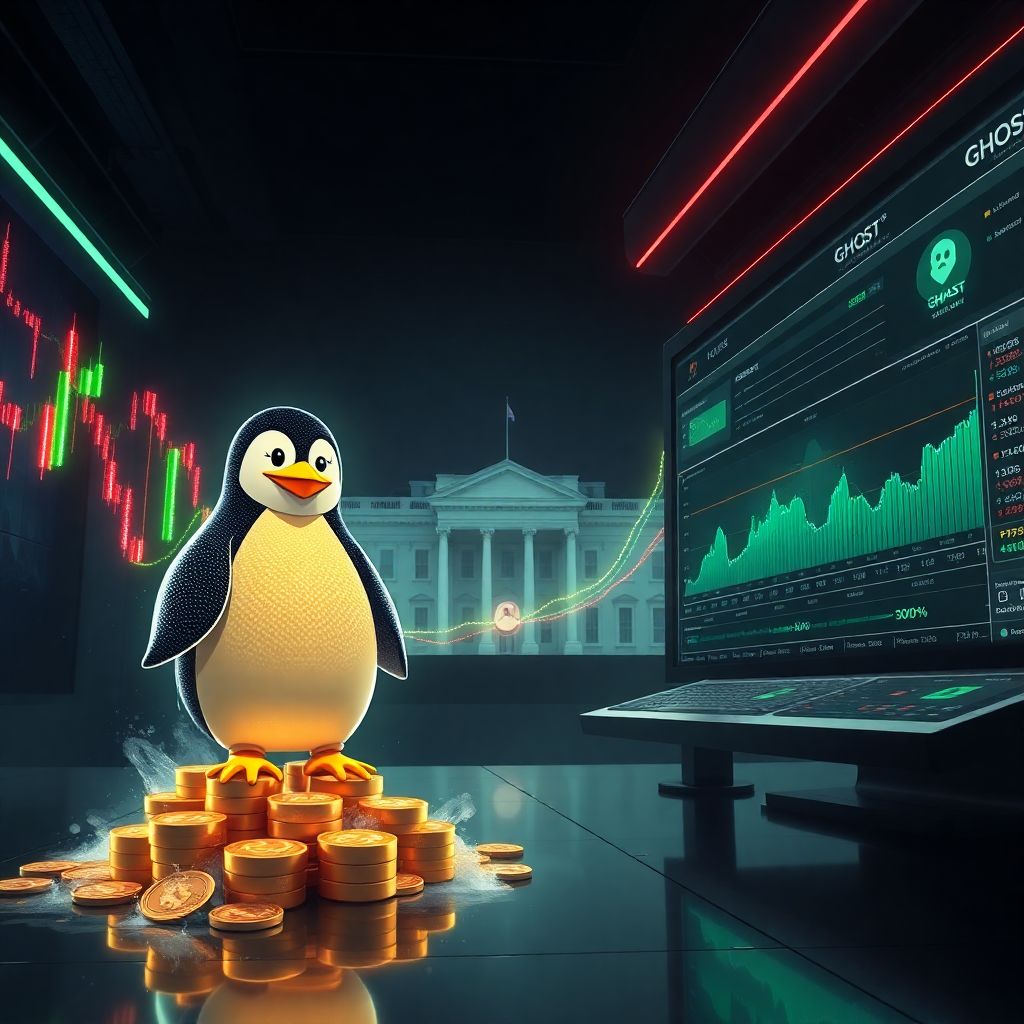
Is the privacy token story about to matter again? Activity on Solana suggests it might. As the speculative frenzy around Nietzschean Penguin (PENGUIN) cools, a visible share of profits is sliding into GhostWareOS and its token GHOST, reviving interest in Solana’s privacy infrastructure.
From meme season to “what’s next?”
Anyone who has spent time trading Solana tokens has seen the cycle:
1. A meme coin catches fire.
2. Liquidity pours in, price goes vertical.
3. Early buyers take profits.
4. The market hunts for “the next thing” that feels less like a punchline and more like a thesis.
In late January 2026, that rotation pattern became obvious again. As PENGUIN’s momentum faded and intraday swings turned brutal, GHOST quietly exploded from its local lows — a move of roughly 300% — right as traders began talking about a renewed “Solana privacy” narrative.
On-chain wallets that were exiting PENGUIN started showing up as buyers of GHOST. Prices told the same story: PENGUIN retraced, GHOST ripped.
Why privacy keeps coming back as a theme
Unlike most narratives that appear and vanish with each cycle, privacy has a stubborn way of resurfacing. The core reason is simple: public blockchains are radically transparent.
– Wallet histories are permanent.
– Balances and flows are traceable in real time.
– Large trades get flagged, labeled, and discussed almost instantly.
Most traders do not begin by saying, “I want to trade the privacy narrative.” Instead, they run into the discomfort first:
– They move funds and realize their entire route is visible.
– A bot labels their wallet because they coincidentally bought the same token as a well-known whale.
– They notice their entries and exits are being copied, front‑run, or socially dissected.
That kind of ever‑present visibility eventually pushes some participants to look for tools that offer more discretion, especially when they are sitting on sizable meme‑coin gains they would rather not broadcast.
What GhostWareOS is trying to solve
GhostWareOS has built its brand around that exact pain point: it wants to be the privacy layer for activity on Solana.
The project has pointed to products and components such as:
– GhostPay – positioned as a payments layer with stronger privacy guarantees than standard transfers.
– GhostSwap – described as enabling private, unlinkable swaps, where counterparties and routes are far harder to map.
Instead of pitching itself as yet another speculative token, GhostWareOS leans on the idea of infrastructure: tools that can be used quietly in the background by traders, power users, and protocols that do not want every move fully exposed.
When a narrative combines a tangible problem (on‑chain over‑exposure) with a visible product pipeline, it tends to get a second look once the pure meme fever subsides.
The PENGUIN problem: profit‑taking and volatility
On the other side of this rotation sits Nietzschean Penguin, a textbook example of how fast meme tokens can rise — and how quickly conditions can flip.
During its hot phase, the PENGUIN price pulled in attention and liquidity at an impressive speed. That same speed, however, attracted traders with a very clear intention: get in, ride the wave, and exit before the music stops.
In late January 2026, public market trackers recorded:
– Large intraday swings, sometimes within a single 24‑hour window.
– A steep one‑day drawdown from local highs.
– Order books that looked healthy during peak excitement, but thinner when volatility spiked.
When traders see candles like that, they usually do not reach for conspiracy theories. They reach for checklists:
– Is liquidity deep enough to exit?
– What is the spread between bids and asks?
– How much slippage will it cost to offload size?
As soon as enough participants start asking those questions and acting on them, PENGUIN turns into a timing contest. Some manage picture‑perfect exits. Others discover they have become “long‑term holders” simply because they hesitated a few hours too long.
How a penguin meme from the White House poured fuel on the fire
One reason the Nietzschean Penguin price action was so explosive is that it received an unexpected external catalyst. A post from the official White House account on X included a penguin‑themed image. Traders were quick to connect that imagery to the PENGUIN token.
Coverage of the coincidence and the viral spread of the post produced a sharp, short‑lived price spike in PENGUIN. For a few hours, the token became the center of attention, with volume and volatility surging together.
To large wallets, that kind of event broadcasts two simultaneous messages:
– Opportunity: liquidity is high, spreads are tight, and it is possible to move serious size.
– Danger: the move is hype‑driven and may reverse just as quickly.
Whales do not need a narrative about destiny or symbolism. They see order flow. They see depth. And if they have been looking for a chance to derisk or rotate, these viral spikes provide clean exits.
Why whales started looking at GHOST
Heavy volatility in PENGUIN was followed by visible profit‑taking. On-chain trackers highlighted specific wallets that:
– Sold PENGUIN into strength.
– Locked in gains.
– Redirected a portion of those profits into GHOST.
One widely cited example: a trader wallet fully exited its PENGUIN position, then used roughly 4,500 dollars’ worth of capital to buy 721,033 GHOST, ending up with a total of about 1.08 million GHOST after the move.
Other analytics accounts expanded on this pattern, calling out a broader set of PENGUIN profit‑takers whose flows were converging on GHOST. None of these transactions alone define a macro trend, but together they explain why smaller traders started paying close attention.
People like to track whale behavior because it functions like footprints in fresh snow. You still need to choose your own path, but it is clear that someone with size has walked through a particular area.
Why meme profits often rotate into “real” narratives
After a strong meme run, the market often looks for two things:
1. A story everyone already understands.
Privacy checks that box. It has existed as a theme since the early days of crypto and resurfaces whenever on‑chain life feels too exposed or too surveilled.
2. A project that appears to be actively building.
GhostWareOS has made a point of signaling ongoing development: updates around GhostPay, work on GhostSwap, and messaging that centers on utility rather than pure speculation.
For traders sitting on meme‑coin gains, this combination can be appealing. They can rotate out of a token whose only real driver is attention, and into a token connected to concrete infrastructure.
Whether that infrastructure ultimately delivers or captures user demand is another question entirely. But as a short‑term rotation thesis, it is coherent enough that many market participants are willing to test it with a slice of their profits.
What to watch if you are considering following the rotation
Before copying any whale‑like move from PENGUIN into GHOST or other privacy‑related tokens, there are several angles to consider:
– Liquidity and depth
GHOST’s price can move quickly because order books and pools are often thinner than meme‑coin giants. Check how much slippage your intended trade size could cause and whether there is enough volume for you to exit in a hurry.
– Real usage vs. speculative volume
Watch whether GhostWareOS tools are actually being used: private swaps, payment activity, integrations with other protocols. A token can rally for weeks on hype alone, but longer‑term resilience tends to follow real adoption.
– Update cadence and delivery
Announcements about upgrades are attractive, but delivered features are what matter. Track whether previously announced components (like GhostSwap improvements) actually go live and how stable they are in practice.
– Regulatory risk around privacy
Privacy tools in crypto exist in a sensitive area. Enforcement approaches and policy comments can affect sentiment quickly. Traders should factor in that privacy‑focused projects may attract extra scrutiny compared to generic meme tokens.
– Correlation with meme cycles
If the entire move into GHOST is simply a side‑effect of meme profits needing a temporary home, a reversal in meme sentiment can feed back into privacy names as traders unwind risk across the board.
Could privacy become the next Solana meta?
A key question is whether Solana’s renewed interest in privacy is just another short‑lived trade or the start of a more durable “meta.”
Arguments that support a lasting trend:
– User sophistication is increasing. As more traders graduate from first‑time speculation into managing meaningful portfolios, the desire for discretion tends to go up.
– Institutional curiosity about Solana is rising. Larger players often have stricter requirements around confidentiality and may be more attracted to ecosystems with mature privacy tooling.
– Composable privacy is still under‑served. Many existing privacy solutions are siloed or difficult to integrate at the application layer. A framework like GhostWareOS, if it works as advertised, could fill a genuine infrastructure gap.
On the other hand, there are reasons to be cautious:
– Privacy is technically complex and easy to mis‑implement. Broken privacy guarantees are worse than none.
– Token prices can run far ahead of actual user demand, setting up painful corrections.
– Attention can swing back to new memes or other narratives (AI, restaking, real‑world assets) abruptly, starving privacy projects of short‑term liquidity.
How traders might think about risk in this environment
For participants watching both Nietzschean Penguin and GHOST, a practical way to frame the situation is through risk buckets rather than narratives:
– High‑beta meme exposure (PENGUIN, similar tokens):
Potentially huge upside and brutal drawdowns; timing and position sizing are everything.
– Narrative‑driven infrastructure exposure (GHOST, privacy tools):
Still volatile, but often anchored to a story of utility and development. The main risk is paying a peak narrative premium before fundamentals catch up.
– Base‑layer or large‑cap exposure (SOL and others):
Typically less explosive on a day‑to‑day basis, but still influenced by the success or failure of ecosystems built on top, including memes and privacy layers.
Rotating between these buckets is less about finding a “perfect” token and more about constantly recalibrating how much speculation vs. infrastructure vs. base exposure a portfolio should carry at any moment.
Outlook: what the GhostWareOS and GHOST move really signals
The surge in GHOST and the related flows out of PENGUIN do not guarantee that privacy will become the dominant Solana theme of 2026. They do, however, signal that traders are once again willing to fund experiments aimed at solving the transparency problem of public chains.
Some will treat GHOST as just another short‑term trade, riding the 300% move and trying to front‑run the next rotation. Others will focus on whether GhostWareOS can turn its current visibility into sustained usage, partnerships, and integrations that justify long‑term interest.
For now, one thing is clear: as meme momentum on Solana cools, capital is not leaving the ecosystem entirely. It is looking for the next story that feels slightly more enduring than a viral joke — and privacy, embodied in tools like GhostWareOS, has stepped into that spotlight.
—
Disclosure: This text is for educational and informational purposes only and does not constitute investment advice or a recommendation to buy or sell any asset. Digital assets are highly volatile and involve significant risk, including the potential loss of all capital. Always conduct your own research and consider your financial situation and risk tolerance before making any trading or investment decisions.