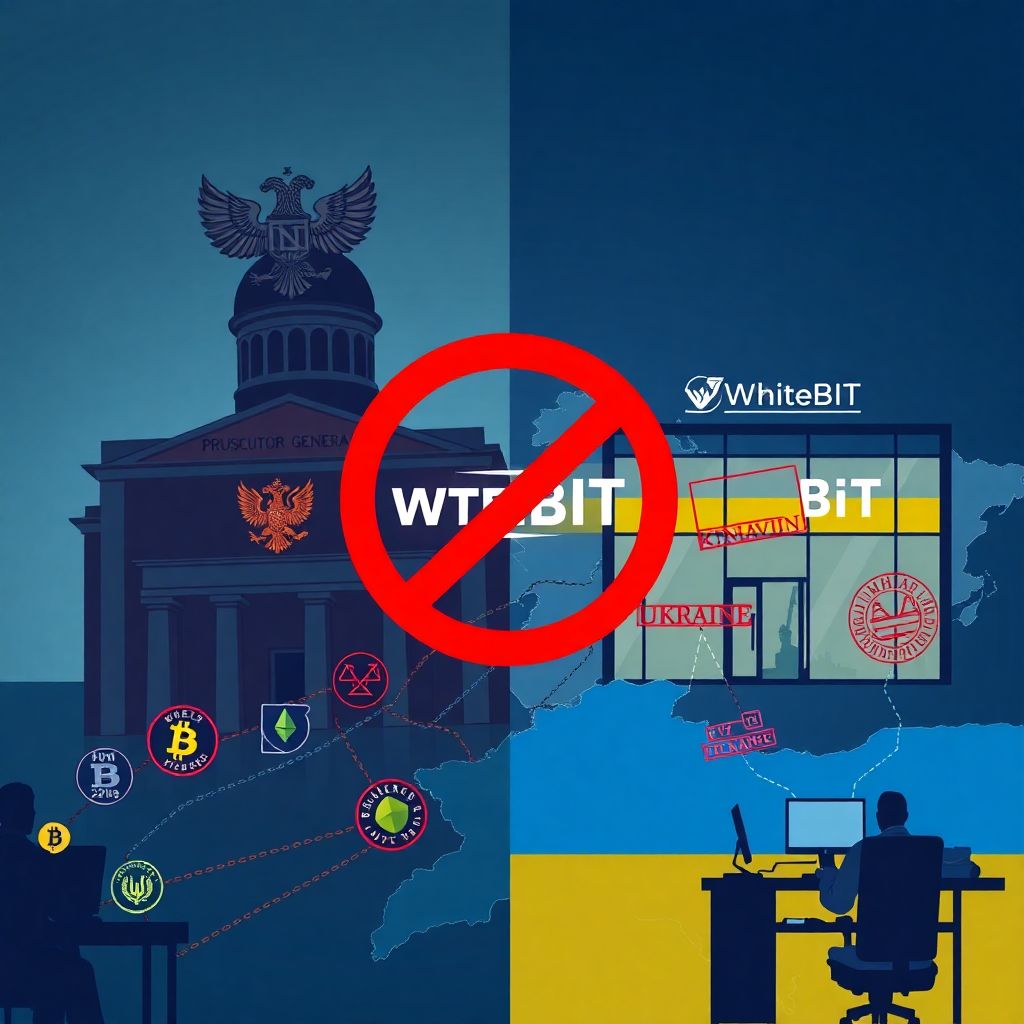
Russia has formally outlawed crypto exchange WhiteBIT, branding the company and its parent W Group “undesirable organizations” because of their open support for Ukraine as the war drags into a fourth year.
The decision, announced by the Prosecutor General’s Office of the Russian Federation, effectively shuts WhiteBIT out of the Russian financial system. The designation makes it illegal for the exchange or its parent firm to open or maintain bank accounts, move money, or provide any kind of service to clients on Russian territory. Local entities and individuals who continue to cooperate with “undesirable organizations” can face administrative and, in some cases, criminal liability under Russian law.
Authorities framed the move as a national security measure. In their statement, prosecutors pointed to WhiteBIT’s assistance to Ukraine’s war effort, arguing that the company’s activities “pose a threat to the constitutional order and security” of Russia. The decision aligns with Moscow’s broader strategy of targeting foreign and Ukrainian-linked companies that offer financial or logistical backing to Kyiv.
WhiteBIT, though currently run from Vilnius, Lithuania, has deep Ukrainian roots. The exchange was founded in Kharkiv by entrepreneur Volodymyr Nosov and quickly evolved into one of the largest crypto trading platforms to emerge from the region. Over the past few years, WhiteBIT has positioned itself as a pro-Ukrainian business, promoting fundraising initiatives, humanitarian campaigns, and digital infrastructure projects tied to Ukraine’s resistance and post-war rebuilding plans.
The company has also been expanding aggressively beyond Eastern Europe. Roughly a year ago, WhiteBIT opened offices in New York and launched a dedicated platform for U.S. traders, signaling an ambition to compete in major Western markets. That international profile, combined with a strong pro-Ukraine stance, has made the exchange a symbol of how the crypto industry can become entangled in geopolitical fault lines.
By blacklisting WhiteBIT and W Group, Russia is using one of the most severe legal tools at its disposal. Being labeled “undesirable” is harsher than ordinary sanctions or simple blocking measures: it not only bans an organization’s operations but also criminalizes participation in its activities. In practice, this means Russian citizens, banks, and companies risk penalties if they work with WhiteBIT in any form, even indirectly.
For Russian users who previously traded on WhiteBIT, the decision raises urgent practical questions. While Moscow cannot directly seize funds held in wallets outside its jurisdiction, it can prosecute individuals who continue to interact with the platform. Traders still accessing the exchange via VPNs or intermediaries could become targets under laws aimed at stopping cooperation with prohibited organizations. The ruling will likely force many Russian clients to withdraw assets where possible and move to other services that remain legal in the country.
For WhiteBIT itself, the economic impact from losing the Russian market is likely limited compared to the political significance of the ban. Russia has already restricted large parts of the international crypto ecosystem, and many Western or Ukrainian-linked firms had either exited or drastically scaled down their presence. The designation, however, sends a clear warning to other companies: public support for Ukraine, especially in financial or technological form, can trigger aggressive countermeasures from Moscow.
The case also underscores how cryptocurrencies and exchanges have become part of the broader battlefield around the Ukraine war. Since 2022, digital assets have been used both for fast cross-border donations and for attempts to bypass sanctions. Kyiv has actively embraced crypto as a parallel fundraising channel, while Western regulators have tightened surveillance of Russian-linked wallets and platforms. Against this backdrop, any exchange seen as materially assisting one side is increasingly treated as a strategic actor rather than a neutral business.
Russia’s move fits into a domestic pattern of expanding control over the information and financial space. Authorities have been systematically blocking media outlets, NGOs, and foreign tech companies they accuse of “discrediting” the Russian army or supporting Ukraine. Adding a crypto exchange to the “undesirable organizations” list extends that logic into the digital asset sector and demonstrates that even relatively new financial technologies are not exempt from traditional political pressure.
At the same time, the designation highlights a dilemma for global crypto businesses: to what extent can they operate across jurisdictions engaged in open conflict while maintaining a consistent ethical and commercial strategy? WhiteBIT has made a deliberate choice to align itself with Ukraine, both symbolically and materially. That positioning bolsters its reputation among Ukrainian users and many Western supporters, but it also guarantees exclusion from markets aligned with Russia and increases the risk of retaliatory legal action.
For regulators outside the region, the incident serves as another reminder that crypto is no longer a marginal or apolitical niche. Exchanges now function as infrastructure for cross-border capital flows, crowdfunding, and, in wartime, rapid financial mobilization. As a result, states are more inclined to treat major platforms like quasi-banks or strategic communication channels, subject to geopolitical calculations rather than purely technical regulation.
In practical terms, the decision is unlikely to halt Ukrainians or their allies from using crypto to route funds into the country. The decentralized nature of blockchain networks allows transactions to bypass individual platforms, and users can switch between exchanges or rely on non-custodial tools. However, the ban may have a chilling effect on any firms still trying to maintain a neutral stance between Russia and Ukraine, nudging them to clarify their positions or quietly exit contested markets.
For Russian crypto users more broadly, the environment continues to narrow. Over the past several years, they have seen a growing list of foreign services restricted or blocked, driving more activity toward domestic platforms or gray-market intermediaries. This fragmentation undermines one of crypto’s original promises—open, borderless access to financial tools—and replaces it with a patchwork of politically segregated ecosystems.
From a business strategy perspective, WhiteBIT’s leadership will now have to double down on markets where its pro-Ukraine identity is seen as an asset rather than a liability. That includes the EU, parts of Asia, and North America, where regulatory scrutiny is high but political alignment with Kyiv is stronger. Building trust there will require not only technical reliability and compliance, but also clear communication about how the company manages sanctions, screening, and cross-border transactions in a wartime context.
For users outside Russia considering which exchanges to use, the episode is a reminder to factor geopolitical risk into their decisions. Beyond liquidity, fees, and security practices, it is increasingly relevant to ask: how might the home jurisdictions of an exchange, or its political affiliations, affect long-term access to funds? Platforms deeply tied to one side in a major conflict may face sudden regulatory shocks, asset freezes, or access issues in opposing jurisdictions.
Ultimately, Russia’s ban on WhiteBIT is less about the direct economic leverage of a single exchange and more about the message it sends. It signals that digital asset platforms will be treated as part of the wider infrastructure of modern conflict, subject to the same instruments of state power as banks, media outlets, and tech giants. As the Ukraine war continues with no clear end in sight, similar confrontations between governments and crypto firms are likely to become more frequent and more consequential for both the industry and its users.