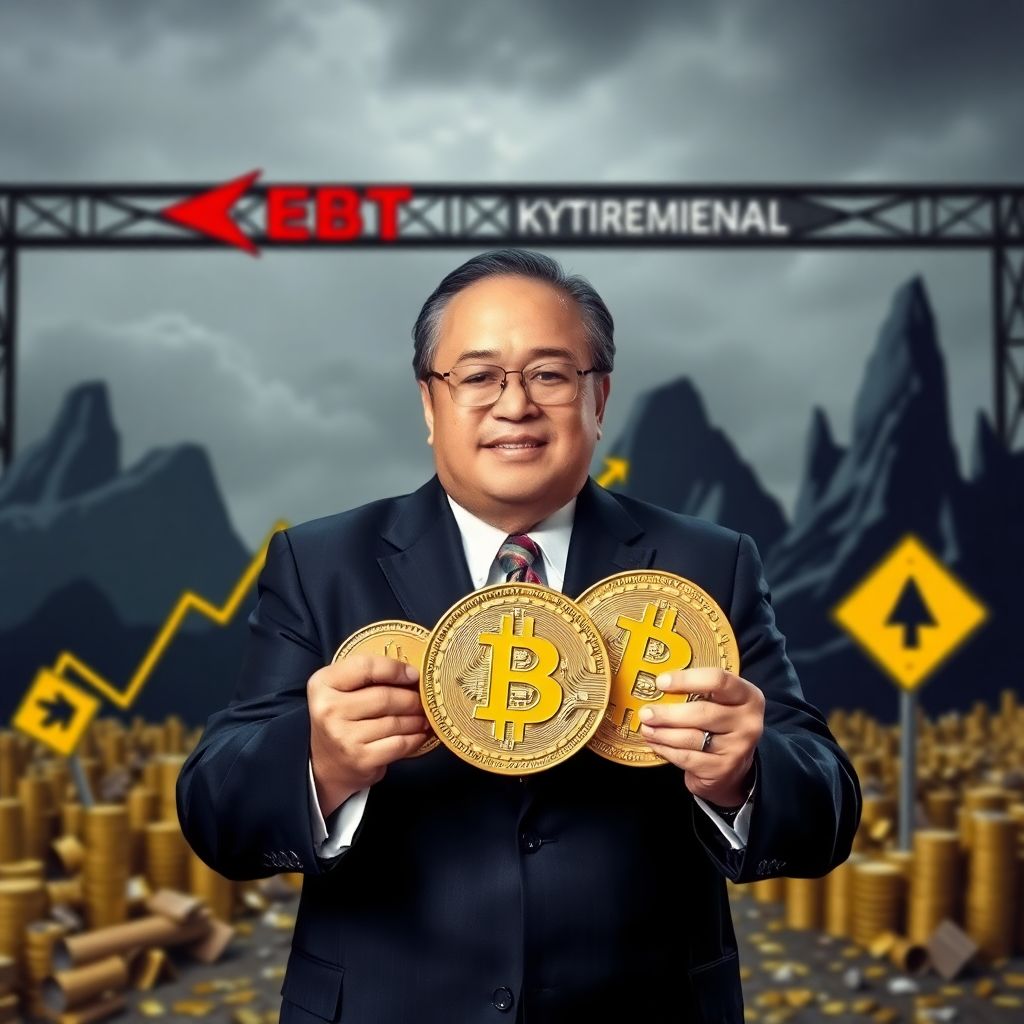
Robert Kiyosaki issues fresh warning on Bitcoin, debt and the broken retirement model
Robert Kiyosaki has renewed his criticism of the modern financial system, arguing that the economic pressure many households feel today is the direct result of policy changes made in the 1970s. At the same time, he is doubling down on his support for Bitcoin, gold and silver as protection against what he sees as a fragile, debt-fueled economy and an increasingly unsafe retirement landscape.
According to Kiyosaki, 1974 was a pivotal year that quietly reshaped how money, savings, and retirement function in the United States. In a recent post on X, he wrote that “the future created in 1974 has arrived,” suggesting that today’s inflation, mounting debt, and retirement insecurity can be traced back to decisions made five decades ago.
He links that turning point to the consolidation of the petrodollar system, which tied global oil trade to the US dollar and reinforced the currency’s dominance. In his view, this arrangement enabled Washington to expand debt and money supply more aggressively, pushing long-term inflation into the financial system and eroding the purchasing power of ordinary savers over time.
Another key development Kiyosaki highlights from that period is the transformation of retirement planning. He points to the Employee Retirement Income Security Act (ERISA) and the subsequent rise of defined-contribution plans, such as 401(k)-style accounts, as a fundamental break from the older pension-based model. Under that earlier structure, many workers could count on defined-benefit pensions that promised a fixed, lifetime income after they left the workforce.
Kiyosaki argues that the shift away from guaranteed pensions toward market-based retirement accounts transferred a huge amount of risk from employers and the state onto individuals. Instead of receiving a predetermined monthly check, workers now depend heavily on how much they save, how well their investments perform, and when they happen to retire in the market cycle.
In his latest warning, he said that “millions of baby boomers will soon find out they have no income once they stop working,” connecting the end of traditional pensions to the growing anxiety around retirement security. Kiyosaki believes that many older workers are overexposed to stock and bond markets through their retirement accounts, while being underprepared for inflation, currency debasement, and potential market downturns.
This concern underpins his long-standing advocacy for what he calls “real money”: gold, silver, and more recently, Bitcoin. In his commentary, he once again labeled these assets as alternative stores of value that are not directly tied to government policy or central bank decisions. He encourages people to improve their financial education so they can understand why such assets may serve as hedges against inflation and systemic risk.
Kiyosaki has repeatedly framed gold and silver as historic forms of money, while portraying Bitcoin as a digital counterpart with a fixed supply and global accessibility. In prior remarks, he suggested that if a major financial “bubble” bursts, capital could rapidly flow from traditional markets into scarce assets, potentially driving Bitcoin’s price dramatically higher. He has even floated the possibility that Bitcoin could reach 750,000 dollars within a year following a severe crash in conventional financial markets.
At the time of his latest comments, Bitcoin was trading near 66,826 dollars, far below the level he speculates it could ultimately achieve but still within a range where many investors remain cautious. Market sentiment around Bitcoin has recently cooled, with data showing a notable rise in bearish discussions across social platforms.
Analytics from Santiment indicate that the ratio of bullish to bearish comments has dropped to 0.81, signaling that negative views currently outnumber positive ones. This reflects weaker confidence among traders and a broader mood of uncertainty after a volatile period for digital assets. Yet, Santiment also notes that extremes in fear and pessimism sometimes act as contrarian indicators, with prices occasionally moving higher once sentiment becomes too negative.
Kiyosaki’s stance fits neatly into this contrarian narrative. He tends to view periods of fear in both traditional and crypto markets as opportunities rather than threats, especially for those who have prepared in advance with diversified holdings that include hard assets. In his framework, market downturns do not invalidate the case for Bitcoin, gold or silver; instead, they expose the vulnerabilities of a system built on leverage, low interest rates and constant money creation.
His critique goes beyond investment choices and touches on the structure of retirement planning itself. The move toward self-directed, market-dependent accounts has given people more theoretical control, but it has also demanded a level of financial literacy many never receive. Kiyosaki argues that the average worker is not equipped to actively manage risk, rebalance portfolios, or factor in long-term inflation, leaving them exposed if markets underperform near their planned retirement date.
Rising life expectancy adds another layer of risk. If people live 20 to 30 years after leaving full-time work, a poorly funded 401(k) or similar plan may deplete far too early. Combined with medical costs and housing expenses, this can create a scenario where older adults must either delay retirement, reduce their standard of living, or return to work unexpectedly. This is the situation Kiyosaki warns many baby boomers could face as they discover their savings were never sufficient for a long retirement in an inflationary environment.
From his perspective, relying solely on paper assets and government-backed currencies in such a scenario is dangerous. He promotes a mix that includes physical metals and Bitcoin as part of a broader strategy that might also encompass real estate and business ownership. The core idea is to build streams of income and hold assets that do not depend entirely on the stability of the current monetary and pension systems.
For younger generations, Kiyosaki’s warning can be seen as a call to rethink retirement planning much earlier in life. Instead of treating a company plan as a set-and-forget solution, he suggests taking an active role: understanding how inflation erodes savings, recognizing that stock markets can go through long periods of stagnation, and being open to alternative assets that may protect purchasing power over decades.
At the same time, his support for Bitcoin is not without significant risk. Digital assets are highly volatile, can suffer deep drawdowns, and remain subject to evolving regulation and technological uncertainty. Even within Kiyosaki’s own message, the implication is not to bet everything on a single asset, but to recognize that the conventional “60/40 stocks and bonds” approach may not be robust enough for the kind of economic shocks he anticipates.
The tension between near-term sentiment and long-term conviction is central to how many investors interpret his remarks. While current data show growing skepticism toward Bitcoin, Kiyosaki portrays these phases as temporary noise against a backdrop of structural issues: expanding government debt, persistent deficits, demographic pressures, and the lingering consequences of policy actions taken since the 1970s.
In practice, his advice distills into three themes: question the sustainability of the existing retirement model, invest time in financial education, and consider holding part of one’s wealth in assets outside the traditional banking and pension system. Whether or not one agrees with his more extreme price predictions, his warning is aimed at provoking individuals to look beyond official assurances and glossy retirement projections.
As the baby boomer generation moves deeper into retirement and younger workers confront housing costs, student loans, and unstable job markets, the questions Kiyosaki raises about income security and monetary policy will likely remain at the center of public debate. Bitcoin, gold and silver, in his telling, are not magic solutions, but symbols of a broader strategy: preparing for a future shaped by decisions made long ago, rather than assuming the system will always deliver on its promises.