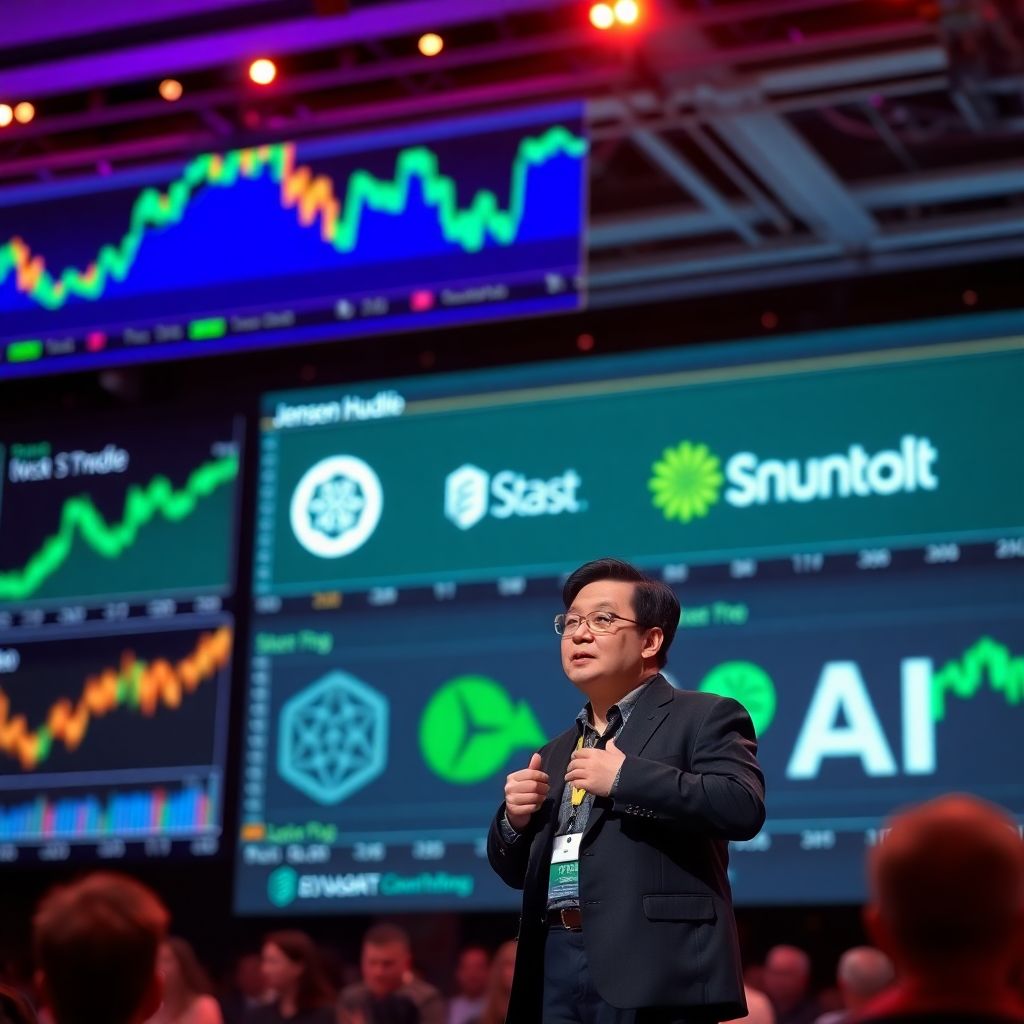
Nvidia appears to be closing the chapter on its role as a major equity backer of OpenAI and Anthropic, according to CEO Jensen Huang-just as both AI labs edge toward public listings and grapple with mounting scrutiny.
Speaking at the Morgan Stanley Technology, Media, and Telecom conference in San Francisco on Wednesday, Huang said Nvidia is “likely done” putting fresh capital into the two flagship AI developers. The chipmaker has been one of the most important financial and strategic partners for both firms, but Huang signaled that the window for such large private deals is effectively shut.
Nvidia recently finalized a roughly $30 billion investment in OpenAI-a dramatic reduction from the headline $100 billion package widely discussed last September-and that, Huang suggested, will probably be the company’s final major check into Sam Altman’s firm. A similar story applies to Anthropic, where Nvidia injected around $10 billion in November. Those huge commitments helped cement Nvidia’s role at the center of the generative AI boom, but they may also be the last of their kind for these particular partners.
Officially, the explanation is straightforward: both OpenAI and Anthropic are now believed to be on track for initial public offerings, potentially later this year. Once a company is actively preparing to go public, large late-stage private financings become far less common-and more complicated. From Huang’s perspective, this is the natural endpoint of Nvidia’s role as a pre-IPO investor.
“This might be the last time we’ll have the opportunity to invest in a consequential company like this,” he told the audience, framing the OpenAI deal as the closing move in a very specific chapter of Nvidia’s growth strategy. In other words, the company saw a rare window to deepen its influence over a pivotal AI player before public markets take over.
In theory, late-stage investors can and do participate right up until an IPO pricing. Private rounds occurring months, or even weeks, before a listing are not unusual in tech. That’s why the downsizing of Nvidia’s OpenAI commitment-from a touted $100 billion to a finalized $30 billion-is so striking. The reduction doesn’t appear to be about access alone, but about a fundamental reassessment of how much exposure Nvidia actually wants to a small group of AI labs that may soon be under even more intense regulatory and political scrutiny.
This pivot also comes at a delicate moment for both OpenAI and Anthropic. The two labs dominate the generative AI conversation, but they also sit at the center of debates over data usage, safety practices, and the societal risks of increasingly capable models. Any strategic investor has to weigh not just financial upside, but the reputational and regulatory spillover that can come from being too tightly coupled to a single, controversial player.
For Nvidia, that calculation is especially complex. The company’s core business is selling GPU hardware and associated software platforms that power AI workloads worldwide. Its objective is not to own the entire AI stack, but to ensure that as many developers and enterprises as possible build on its chips. Deep equity entanglements with a small number of “AI champions” can start to send the wrong message to everyone else in the ecosystem.
By signaling that the OpenAI and Anthropic deals are likely the last of their scale, Huang is quietly rebalancing Nvidia’s position: from being perceived as a kingmaker backing just a few model providers, toward being an arms dealer serving all sides. That stance matters when cloud providers, startups, and enterprises are deciding whose infrastructure to trust as neutral and long‑term.
There is also a governance and control angle. As OpenAI and Anthropic move closer to IPOs, their boards, capital structures, and fiduciary obligations will change. Public shareholders expect clear, independent strategies and maximum flexibility in choosing partners. A strategic investor that is also the core hardware supplier can raise questions about conflicts of interest, preferential treatment, or lock‑in. Stepping back from further equity commitments may actually preserve Nvidia’s ability to be a preferred vendor to both labs without constantly justifying its dual role.
From a capital allocation standpoint, Nvidia has more options than ever. Its valuation and cash generation give it ample firepower, but that does not mean it should continue concentrating tens of billions into only two companies-especially when the broader AI ecosystem is exploding with new players in open-source models, agent frameworks, domain‑specific AI, and data infrastructure. Diverting some of that investment capacity into a wider range of startups and mid‑stage companies lets Nvidia seed demand for its chips across many verticals instead of doubling down on just two juggernauts.
Another subtle factor: as OpenAI and Anthropic approach public markets, their valuations are becoming more sensitive to interest rates, macro conditions, and shifts in investor sentiment toward AI. Private investors entering at towering pre‑IPO valuations are implicitly betting that the IPO will either meet or exceed those levels. Even for a giant like Nvidia, taking that kind of concentrated mark‑to‑market risk in a single name-especially after a historic bull run in AI‑related equities-may not be the most prudent use of capital.
There is also a strategic hedge component. Nvidia’s dominance in AI hardware has triggered antitrust discussions and calls for closer oversight worldwide. If regulators begin probing vertical integration in AI-where the same company controls chips, software platforms, and holds large stakes in model providers-Nvidia will want to show that its financial interests are diversified and that it is not orchestrating a closed, tightly controlled AI stack. Limiting further investment in OpenAI and Anthropic can be interpreted as a pre-emptive move to keep regulatory risk manageable.
At the same time, exiting the role of aggressive investor does not mean Nvidia will loosen its operating ties. On the contrary, as AI systems become more compute‑hungry, both OpenAI and Anthropic will remain among Nvidia’s most important customers. Long‑term supply agreements, joint engineering efforts, optimization of models for new GPU architectures, and deep software integrations can all proceed without additional equity checks. In many ways, the real strategic value for Nvidia lies in those technical and commercial linkages, not in the ownership line on its balance sheet.
For OpenAI and Anthropic, a tapering of Nvidia’s investment appetite is a mixed signal. On one hand, it reinforces the idea that they are maturing into public, independent entities, no longer reliant on a handful of strategic patrons. On the other, it underscores the need to court a broader base of institutional investors who are less interested in GPU guarantees and more focused on revenue, margins, and sustainable business models. As they move toward IPOs, both labs will have to articulate not only their technological edge, but their path to profitability in a market where competition from big tech and open source is accelerating.
Looking ahead, Nvidia’s stance could reshape how capital flows into the next wave of AI firms. Instead of megadeals with a few headline‑grabbing labs, the company may favor a portfolio of smaller, more targeted investments-into specialized model builders, tools for safety and alignment, AI‑native applications in healthcare and finance, and infrastructure that makes large models cheaper and easier to deploy. That approach would spread Nvidia’s influence more widely while still anchoring demand for its chips.
The broader lesson for the AI sector is that strategic money behaves differently as companies approach the public markets. Early and mid‑stage rounds often value access to technology and partnerships as much as financial return. But once IPOs are on the horizon, those deals must coexist with the expectations of public shareholders, regulators, and a more skeptical investing public. Nvidia stepping back from further huge checks into OpenAI and Anthropic is a sign that this transition is underway-and that the next phase of the AI boom will be shaped as much by capital discipline and market structure as by model breakthroughs.
In this context, Huang’s seemingly simple remark about it being the “last time” Nvidia can invest in a company of this significance sounds less like a lament and more like a pivot point. It marks the end of an era where a small circle of tech giants quietly underwrote the most ambitious AI labs behind closed doors, and the beginning of a period where public markets, regulators, and a far larger set of stakeholders will help decide who leads the next generation of artificial intelligence.