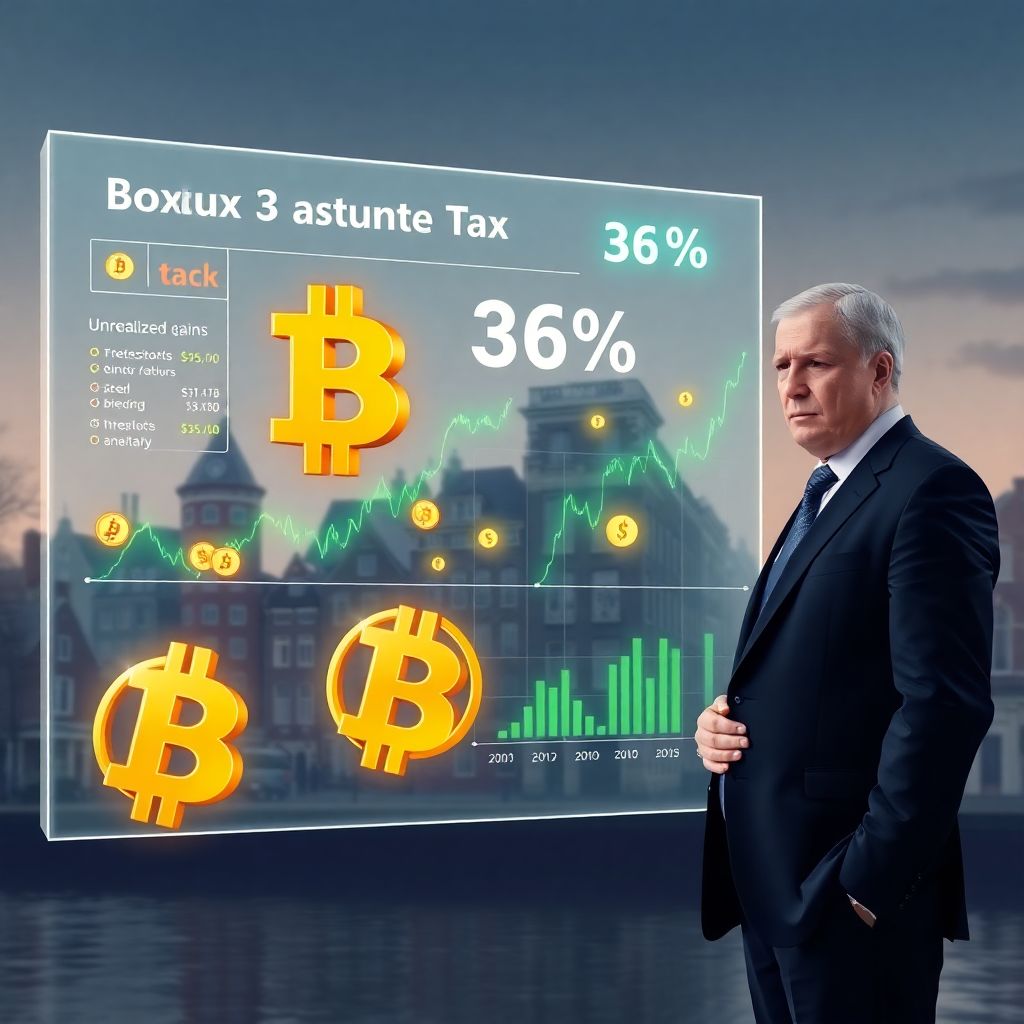
Netherlands to Tax Unrealized Bitcoin and Crypto Gains From 2028: What Investors Need to Know
Starting January 1, 2028, the Netherlands plans to radically overhaul how it taxes private wealth, including Bitcoin and other cryptocurrencies. Under the new Box 3 “Actual Return Tax” regime, Dutch residents will have to pay tax not only on gains they realize when selling assets, but also on unrealized increases in value that exist only on paper.
This shift means holders of Bitcoin, other digital assets, stocks, bonds, and similar liquid investments could face annual tax bills based on year‑to‑year price changes, even if they never sell a single coin or share.
Core of the Reform: Taxing Actual Annual Returns
Under the current Box 3 system, Dutch taxpayers are taxed on an assumed or deemed return on their assets, regardless of how those assets actually perform. The new law replaces that with a tax on the *real* yearly return.
For most liquid financial assets, including:
– Bitcoin (BTC) and other cryptocurrencies
– Publicly traded stocks and ETFs
– Bonds and other marketable securities
– Certain liquid investment products
the government will measure their value at the beginning and end of each tax year. Any increase in value during that period will be treated as taxable return, even if the investor holds the asset and does not sell.
The expected tax burden is set at 36% of this actual annual return. So if a portfolio of crypto and stocks increases by 10,000 euros in a given year, the Box 3 tax on that portion would be roughly 3,600 euros, subject to allowances and offsets.
How the Capital Growth Method Works
For liquid assets, tax authorities will apply a capital growth method:
1. Determine the fair market value of each asset on January 1.
2. Determine the fair market value on December 31 of the same year.
3. Calculate the difference.
4. Treat any positive difference (gain) as taxable return for that year.
This applies regardless of whether the investor sold the asset, received dividends, or generated any actual cash flow. The gain is treated as if it were income that can be taxed annually.
For volatile assets such as Bitcoin and altcoins, this is particularly significant. A rapid rise in price during the year, even if temporary, could create a large taxable gain at year end—followed by a price crash in the following months that does not erase the previously incurred tax liability.
Limited Relief: Loss Carryforwards and a Small Tax-Free Allowance
The system does include some mitigating features:
– Loss carryforward: If an investor’s portfolio suffers an unrealized loss in a given year, that loss can be carried forward to offset unrealized gains in future years. This is intended to smooth out some of the impact of market volatility over time.
– Tax-free threshold: A proposed annual tax-free allowance of 1,800 euros per person will apply to the total Box 3 result. Only returns (gains) above that amount would be taxed.
However, these relief mechanisms are relatively modest compared with the potential tax burden faced by investors in fast‑moving asset classes like crypto. Loss carryforwards only help in future years, and the tax-free threshold is small for anyone with a substantial portfolio.
Real Estate and Start-Ups Treated More Leniently
Not all asset classes fall under the new unrealized-gain framework.
The reform explicitly excludes:
– Owner-occupied property and certain real estate holdings
– Qualifying investments in start‑ups and some private businesses
These assets will continue to be taxed only when gains are realized—typically upon sale or when another taxable event occurs. That means long‑term holders of property or certain young companies will not face annual taxation on paper gains.
This difference in treatment may influence how Dutch investors allocate capital. Some may gradually reduce exposure to heavily taxed liquid assets such as crypto and equities in favor of real estate or qualifying start‑up investments, which remain taxed on a realization basis.
Why the Netherlands Is Changing the Rules
The shift toward taxation of actual returns is rooted in a series of decisions by the Dutch Supreme Court. The court found that the previous Box 3 regime—based on assumed returns that often bore little relation to real market outcomes—was unlawful and unfair to many taxpayers, particularly in low‑yield environments.
Under the old model, savers and conservative investors could be taxed on a notional return higher than what they actually earned, while those with high‑yielding or high‑risk portfolios could effectively benefit. The new framework aims to align taxation more closely with what investors actually gain or lose each year.
From a fiscal perspective, the government has strong incentives to implement the reform on schedule. Official estimates suggest that delaying the change beyond 2028 would cost the state between 2.3 and 2.5 billion euros annually in forgone revenue.
Critics Warn of Liquidity and Volatility Risks
Investors, tax professionals, and some lawmakers have voiced strong concerns over the reform—particularly its impact on liquidity.
Taxing unrealized gains means:
– Individuals may owe tax even if their assets produce no cash income.
– To pay the tax bill, many will need to sell part of their portfolio each year.
– Forced sales could occur at unfavourable times, especially after strong price appreciation followed by sudden downturns.
The risks are magnified in crypto markets, where prices can move dramatically within weeks or even days. An investor could face a large tax liability on a year‑end valuation peak, then watch their holdings plunge in value soon after, leaving them with a tax bill based on gains that have effectively vanished.
For long‑term “HODLers” of Bitcoin and other cryptocurrencies—who often deliberately avoid trading and rely on multi‑year appreciation—this approach fundamentally changes the cost of holding. The traditional idea of sitting through market cycles without realizing gains becomes more expensive in tax terms.
Enhanced Surveillance Through EU‑Wide Crypto Reporting
To enforce the new rules effectively, the Netherlands will rely on expanded data‑sharing requirements for financial intermediaries and crypto platforms.
By 2028, crypto‑asset service providers operating in or serving residents of EU member states will have to comply with the DAC8 framework. This requires them to report detailed data to national tax authorities, including:
– User balances
– Transaction histories
– Transfers between wallets and platforms
In the Netherlands, this information will go directly to the national tax authority (Belastingdienst). Crypto holdings and trades will therefore be visible to the authorities in a manner similar to traditional bank accounts and investment portfolios.
For Dutch crypto investors, this means that underreporting or omitting digital assets from Box 3 declarations will become far more difficult and risky. Transparency will be the norm, and cross‑checking data between institutions will likely be automated and routine.
How This Move Positions the Netherlands Globally
Tax policy experts note that taxing unrealized gains on such a broad scale places the Netherlands among the most aggressive jurisdictions in the world when it comes to wealth taxation—especially with respect to liquid and volatile assets.
Most countries still tax capital gains primarily at the moment of realization: when an asset is sold, exchanged, or otherwise disposed of. While some systems impose wealth taxes based on asset values, taxing year‑to‑year paper gains at a relatively high rate is far less common.
As a result, the Dutch reform is being closely watched by international observers. Its real‑world impact on investment behaviour, capital allocation, and market stability could influence whether other countries consider similar measures—or decide they are too disruptive.
Strategic Implications for Crypto Investors
For individuals and institutions holding Bitcoin and other digital assets in the Netherlands, the new framework demands a rethink of strategy:
– Portfolio planning: Investors may need to design portfolios with tax‑driven liquidity in mind, ensuring sufficient stable assets or cash reserves to meet annual liabilities.
– Rebalancing policies: Automatic or periodic rebalancing could help manage realized and unrealized gains more deliberately, though this may trigger additional taxable events.
– Market‑timing pressure: The incentive to reduce year‑end exposure to volatile assets could become strong, particularly if prices surge during the year. This may create new patterns in trading behaviour around the close of each tax year.
– Long‑term holding vs. active trading: Traditional buy‑and‑hold strategies in Bitcoin may become less tax‑efficient, while some investors shift toward more tactical approaches that aim to smooth returns and avoid extreme year‑end spikes.
Professional tax advice is likely to become essential for anyone with significant crypto holdings, not only to ensure compliance but also to structure investments in a way that doesn’t unintentionally amplify tax exposure.
Potential Market Effects and Behavioural Shifts
If implemented as planned, the reform could reshape parts of the Dutch investment landscape:
– Shorter holding periods: Knowing that an unrealized gain will be taxed each year may encourage investors to realize and reinvest more frequently, rather than keeping assets for very long horizons.
– Shift to less volatile assets: Some may reduce exposure to high‑volatility cryptocurrencies in favour of more stable securities or bonds, in order to limit large swings in taxable returns.
– Increased interest in excluded assets: Property and qualifying start‑up investments, which remain on a realization basis, may attract more attention as relatively tax‑efficient alternatives.
– Potential impact on local crypto businesses: If domestic investors become less active, local exchanges, brokers, and service providers could see changes in demand, trading volumes, and product preferences.
At the same time, the actual impact will depend heavily on how markets evolve and how taxpayers adapt over several years. Enforcement practices, future political debates, and possible adjustments to rates or thresholds could all shape outcomes.
Key Considerations Ahead of 2028
With the effective date still several years away, Dutch residents and businesses have time to prepare—but not to ignore the changes. Practical steps investors are likely to consider include:
– Mapping out current portfolios and identifying which assets will be subject to annual unrealized‑gain taxation.
– Stress‑testing tax scenarios under different market conditions, particularly for crypto and high‑beta stocks.
– Evaluating whether to rebalance into assets that are taxed only upon realization or exempted under the new regime.
– Implementing better record‑keeping and using tools that track historical values, gains, and losses across all platforms and wallets.
– Monitoring political and legislative developments, as details of the reform could still be refined before 2028.
The Dutch Box 3 reform marks a clear turning point: for Bitcoin and other cryptocurrencies, the era of simply holding and waiting for long‑term, largely untaxed appreciation in the Netherlands is coming to an end. From 2028 onward, investors will be taxed not just on what they cash out, but on what they gain on paper each year—forcing a fundamental reconsideration of how to build and manage wealth in a world where unrealized gains are no longer tax‑free.