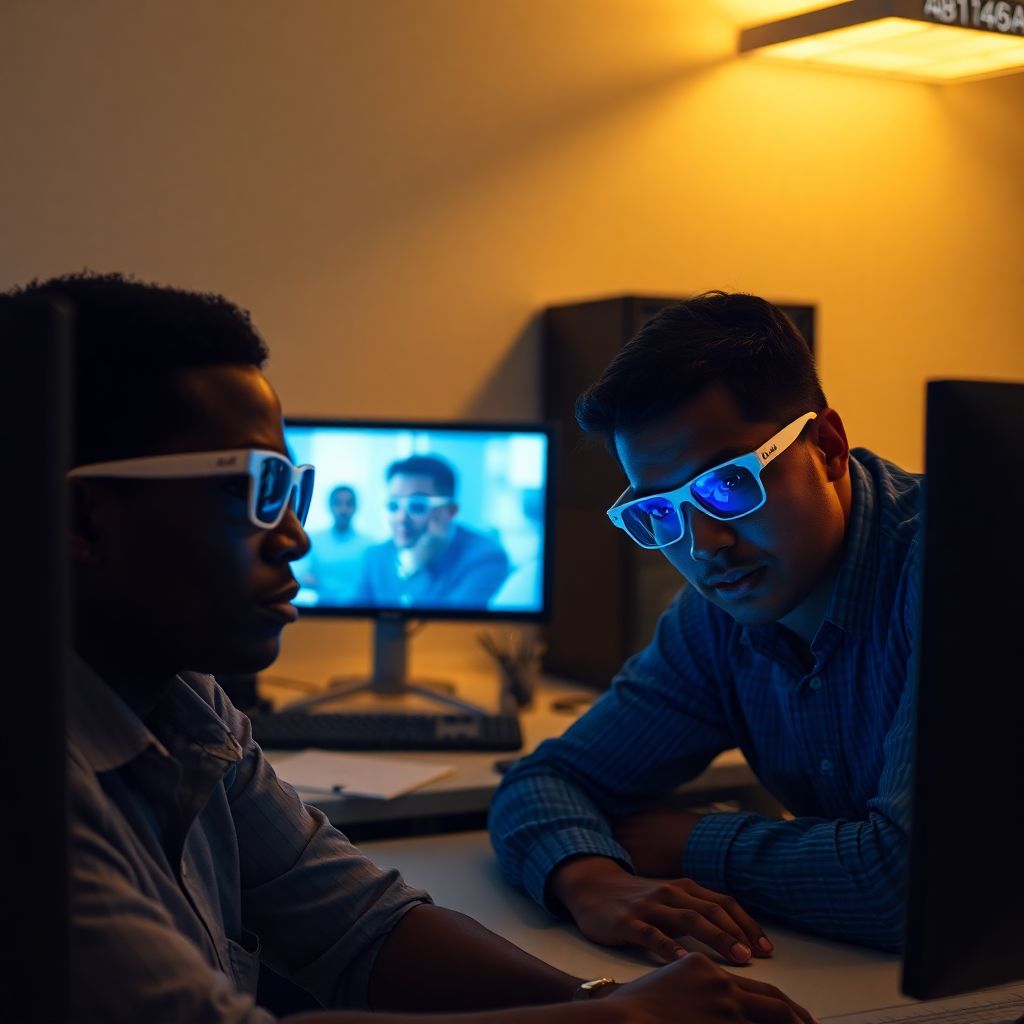
Inside Meta’s Ray-Ban Smart Glasses Backlash: Why Regulators Are Alarmed
A quiet experiment with artificial intelligence has turned into a full-blown privacy headache for Meta. The company’s Ray-Ban smart glasses-marketed as a sleek fusion of fashion, camera, and AI assistant-are now at the center of a controversy over how intimate, often deeply personal footage is collected, handled, and used to train Meta’s algorithms.
At the heart of the storm is a Kenyan data-labeling firm that says it has been tasked with reviewing and annotating videos captured by users of the glasses. According to people who worked with the material, some of the content was shockingly private. They describe scenes of people going to the bathroom, undressing, or engaging in other activities they clearly did not expect would become training data for a tech giant’s AI models.
“In some videos, you can see someone going to the toilet, or getting undressed,” one worker said. “I don’t think they know, because if they knew, they wouldn’t be recording.” The account raises a blunt question: how many people, caught in the periphery of someone else’s smart glasses, realize they are being filmed at all-let alone that the footage could be shipped across borders and poured into machine-learning systems?
Privacy advocates say the case highlights a deeper problem with wearable devices that blend constant recording with cloud-based AI. John Davisson, Deputy Director of Enforcement at the Electronic Privacy Information Center, argues that these products push past traditional consent frameworks. “The wearer of the glasses cannot consent on behalf of all of the people they are encountering as they go through the world,” he notes. When every bus ride, bar visit, classroom, or doctor’s waiting room can be quietly documented, the burden of privacy shifts from the recorder to everyone else around them.
Ray-Ban smart glasses were pitched as a natural, almost invisible way to capture life’s moments: tap the side of the frame, and you can snap a photo, start a video, or call up Meta’s AI assistant to describe what you’re seeing. Small LED lights are supposed to indicate when recording is in progress. But critics say the signals are too subtle, too easy to miss, and too easy to ignore in crowded or chaotic environments. For bystanders, the line between everyday social interaction and being turned into training data is blurred-often without their knowledge.
The revelations about offshore AI training only amplify those concerns. Workers at the Nairobi-based company describe reviewing thousands of clips to tag objects, activities, and environments-standard work in the AI industry, but unusually sensitive when the raw material is real people’s private lives, captured through a hidden-in-plain-sight camera. Human reviewers are not just seeing de-identified datasets. They are watching unfiltered slices of reality, often with faces, homes, workplaces, and children clearly visible.
That raises several intertwined issues. First, there is the question of meaningful consent: did users of the glasses fully understand that their recordings might be used to train AI, that human contractors in another country might view them, and that those subjects in the background had no say at all? Second, there is the risk of data exposure. Even if Meta has contractual safeguards in place, the more hands and systems the footage passes through, the greater the chance of leaks, misuse, or unauthorized copying.
Regulators are taking notice. Data protection authorities in multiple jurisdictions have already been watching smart glasses closely, concerned that they normalize mass recording in public and semi-private spaces. The offshore dimension-sending sensitive footage from mostly Western users to labeling hubs in Africa or Asia-adds a layer of cross-border data transfer issues. Under many privacy frameworks, especially in Europe, sending personal data to countries with weaker protections requires strict safeguards and clear legal justification. Whether those conditions are truly met when it comes to intimate, real-world video is now under sharper scrutiny.
This controversy also exposes a structural tension in AI development: modern models crave vast amounts of diverse, real-world data to become “smarter,” more context-aware, and more helpful. Companies want AI assistants that can recognize objects, interpret scenes, describe surroundings for visually impaired users, and answer questions about whatever the camera sees. But the most valuable training material-the messy, uncurated reality of daily life-is also the most dangerous from a privacy perspective. Toilets, bedrooms, hospitals, therapy offices, classrooms, and family dinners are exactly the places people expect not to be observed by unknown strangers or opaque algorithms.
Meta, like many tech companies, has promoted features such as opt-in data sharing, the ability to delete content, and policies against certain types of use. But experts argue that the user interface and marketing often downplay the downstream uses of captured data. Fine-print disclosures and toggles buried in settings are no match for the intuitive assumption that wearing stylish glasses with a camera is “just like using a phone,” when in reality it can be far more intrusive and persistent.
A particular flashpoint is the concept of “incidental capture.” Even if a Ray-Ban wearer believes they are only recording themselves or their surroundings for personal use, the camera inevitably sweeps up strangers, license plates, children in playgrounds, or patients in a clinic waiting room. Those people did not agree to be part of a dataset. Yet their images-and sometimes audio-may be stored, processed, and analyzed. In some jurisdictions, that can conflict with data protection rules that require a clear legal basis, purpose limitation, and data minimization.
Workers on the AI labeling side face their own set of harms. Reviewing sensitive footage for hours a day can be psychologically draining, especially if the material includes nudity, medical situations, or distressing scenes. Many of these workers are employed under precarious conditions, with limited mental health support and little say in what they are required to view. The Ray-Ban smart glasses case therefore intersects not only with privacy law, but with digital labor rights and the ethics of outsourcing the “invisible work” behind AI.
Technologists and policy experts suggest several ways forward. One approach is to radically tighten what kinds of content can be used for AI training: excluding any footage from bathrooms, bedrooms, or clearly sensitive contexts; automatically blurring faces and other identifiers; and using on-device processing where possible so raw footage never leaves the glasses or the user’s phone. Another is to introduce stronger visual and audible cues during recording, making it obvious to everyone nearby that a camera is on-more like a bright recording light on a camcorder than a tiny, easily-overlooked LED.
Some argue that regulators should go further and treat always-on or easily-concealable cameras as a special category of risk, subject to stricter rules than smartphones. This could include location-based bans (for example, in schools, hospitals, and government offices), mandatory impact assessments before launching in certain markets, and clear obligations to avoid using sensitive footage for training commercial models. In extreme cases, authorities could even restrict or prohibit specific features if they are found to be incompatible with fundamental rights.
For consumers considering a pair of Ray-Ban smart glasses, the controversy is a reminder to look beyond the marketing gloss. Before enabling any AI or cloud features, users should review what kinds of data are collected, where it goes, and how it may be repurposed. Turning off automatic uploads, regularly deleting stored clips, and being mindful of where and when recording is appropriate are practical steps that can reduce the privacy footprint-even if they do not fix the systemic issues.
The broader tech industry is watching, because Meta’s experiment is a test case for the future of wearable AI. If companies want to embed cameras and microphones into everything from glasses to earbuds to clothing, they will need to confront not only what is technically possible, but what is socially acceptable and legally defensible. That means treating bystanders-not just paying customers-as stakeholders whose rights and expectations matter.
Ultimately, the Ray-Ban smart glasses saga illustrates a simple but uncomfortable truth: AI thrives on human experience turned into data, yet humans rarely understand or control how that transformation happens. Until that gap is closed-through stronger laws, better design, and true transparency-every new “smart” device risks becoming another flashpoint in the ongoing battle over privacy in the age of ubiquitous surveillance.