MAGA’s ‘Golden Calf’: How a Giant Trump Statue Became the Center of a Chaotic Crypto Gamble
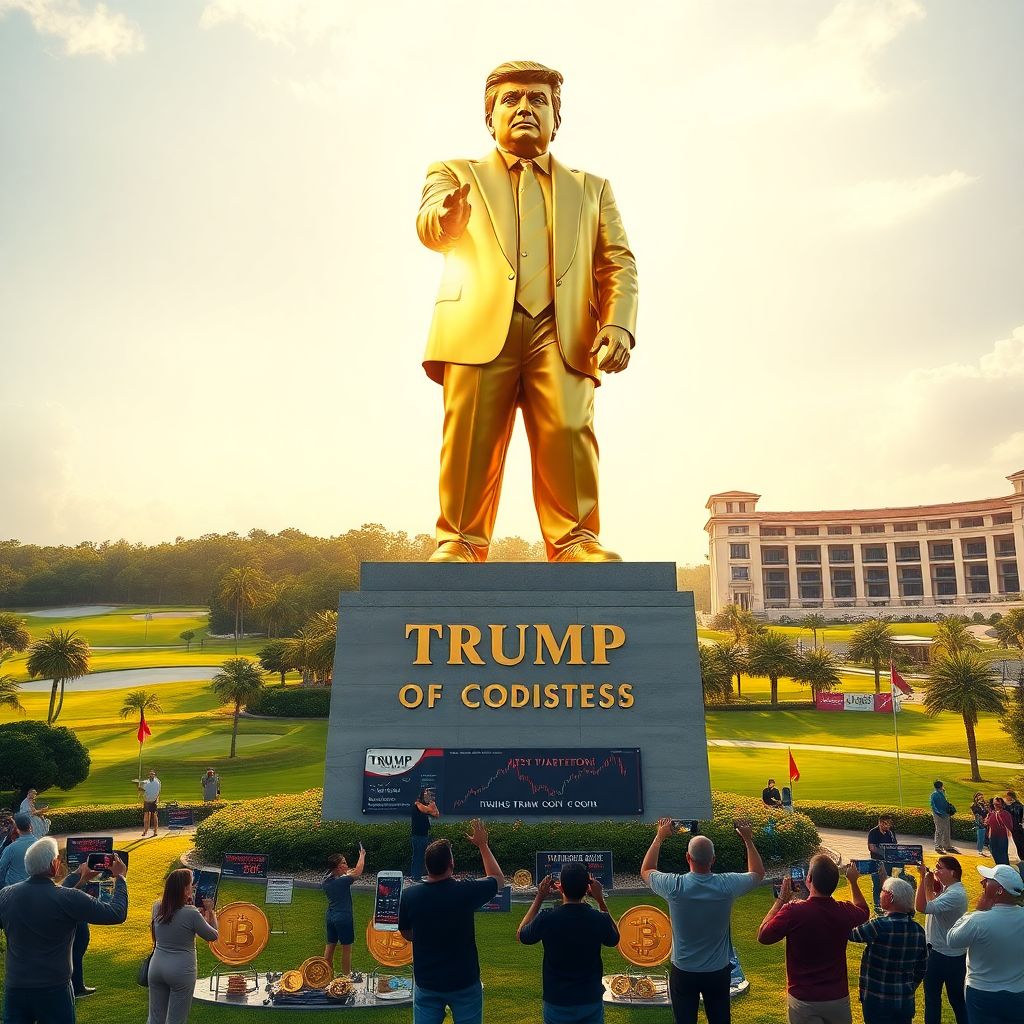
A towering, gold-gilded likeness of Donald Trump now looms over one of his golf resorts, perched on a 7,000‑pound pedestal. Standing about 15 feet tall, cast in bronze and finished with gold leaf, the statue has been christened “Don Colossus.” On the surface, it looks like another over-the-top tribute to a former president who now faces 34 felony counts. In reality, it is the physical centerpiece of one of the strangest cryptocurrency escapades of the Trump era.
Far from being a simple piece of political fan art, Don Colossus emerged from a speculative bet by a group of cryptocurrency investors. They pooled roughly $300,000 to commission the statue, intending it to serve as both a monument to Trump and a flashy marketing engine for their token — a memecoin called PATRIOT. The coin, built around MAGA branding and Trump fandom, offered little practical utility, but promised a quick ride on the wave of political enthusiasm and internet speculation.
The launch of PATRIOT in late 2024 coincided with Trump declaring his ambitions to transform the United States into the “crypto capital of the planet.” Against that backdrop, the token briefly surged. Traders hoping to get in early on the next viral success piled in, and the image of a golden Trump towering over his supporters proved tailor-made for promotion. For a short period, PATRIOT appeared to validate the dream that political fervor plus crypto hype could mint fortunes overnight.
But the honeymoon evaporated almost as fast as it began. Within months, PATRIOT’s price collapsed, shedding more than 90 percent of its value. Internal disputes among backers, delays in delivering promised features, and a general cooling of speculative mania all played a role. What had been marketed as a patriotic people’s token started to resemble a familiar story in the meme-coin world: a rush of excitement followed by confusion, infighting, and financial disappointment.
As the token tanked, the statue at the center of the promotion acquired a very different meaning. Initially planned as the crowning moment of a triumphant unveiling — a real-world symbol of digital wealth and political devotion — Don Colossus instead became a visual metaphor for the volatility and fragility of memecoins. Its gleaming surface concealed a messy history of broken expectations, legal wrangling, and clashing egos.
Despite the chaos, the sheer spectacle of the sculpture ensured it never faded into the background. The gold leaf shimmer, the imposing scale, and its placement at a Trump-branded resort made it an irresistible prop in a continuing effort to salvage the PATRIOT project. Crypto promoters and right-wing activists leaned heavily on social media, circulating images and videos of the statue in hopes that renewed visibility might spark another price run for the struggling token.
Behind the scenes, however, the story was even more tangled. The statue’s creation triggered a dispute with Ohio sculptor Alan Cottrill, who said he was owed $75,000 for intellectual property rights related to the design and its commercial use. According to his account, the investors not only commissioned the work but also leveraged his artistic concept heavily in promotional material, without fully compensating him. The disagreement escalated into a standoff in which Cottrill threatened to withhold the statue until he received payment in full.
Despite that friction, construction moved forward. By January 2026, a massive concrete-and-stainless-steel base had been installed at a Trump golf complex, ready to bear the weight of Don Colossus. The pedestal itself became part of the spectacle: a literal platform elevating not just Trump’s image, but an entire narrative about wealth, loyalty, and the promise — or illusion — of crypto-fueled prosperity.
Meanwhile, the political and financial environment around the project shifted again. Though the Trump family kept an official distance from PATRIOT, Trump himself did not ignore it. He amplified the coin’s visibility by referencing it in media and directing attention toward coverage that cast it in a favorable light, ensuring that PATRIOT remained in the MAGA conversation even as its chart bled red.
Complicating matters further, Trump launched his own cryptocurrency, dubbed Official Trump (with the ticker TRUMP), just ahead of the planned PATRIOT unveiling. That move instantly changed the dynamics. For many supporters and speculators, there was little reason to back a loosely affiliated memecoin when they could buy the token that carried Trump’s name directly. Interest migrated swiftly. The timing was brutal for PATRIOT: as TRUMP gained traction, PATRIOT’s already weak momentum all but vanished.
The result was a sort of proxy battle between two visions of Trump-themed crypto: one grassroots and chaotic, the other more tightly controlled and officially branded. In practice, the “official” token overshadowed the unofficial one, turning PATRIOT from a flagship project into a cautionary footnote about what happens when fan-driven speculation collides with a more centralized, personality-driven brand.
Even so, the saga refused to die. Investors and organizers pressed ahead with plans to unveil Don Colossus at Trump’s resort in Doral, Florida. For them, the statue remained both a sunk cost and a last, best hope: a monumental advertisement that might reignite curiosity around PATRIOT or at least preserve the mythos of the project. Trump has reportedly signaled interest in attending the unveiling, though no date has been formally announced, adding another layer of anticipation to an already charged storyline.
While that date remains uncertain, Cottrill’s grievances persist. He has yet to receive what he considers full and fair payment for his work and its promotional exploitation. His situation underscores a less glamorous dimension of crypto marketing: behind every glossy visual campaign are artists, fabricators, and contractors who expect traditional forms of compensation — in cash, not tokens and promises.
For supporters of PATRIOT, the narrative they promote is more idealistic. In their telling, the project was never primarily about making quick money. It was described as a “people’s token,” meant to celebrate Trump and his base, channeling their loyalty into a digital asset they could collectively own and champion. From that perspective, Don Colossus is a kind of civic monument for a political movement, translated into both bronze and blockchain.
Yet from the outside, the project looks less like a democratic experiment and more like an emblem of memecoin culture itself. Tokens built around jokes, celebrities, or political slogans tend to thrive not on fundamentals, but on attention. They spike when they capture the zeitgeist and crater just as fast when sentiment shifts. In that sense, PATRIOT’s trajectory — euphoric launch, bitter disputes, steep crash — follows a pattern seen repeatedly across the crypto landscape.
The Trump statue adds a new, almost biblical layer to that pattern. To critics, Don Colossus resembles a modern “golden calf”: a gleaming idol erected at the intersection of politics, money, and worshipful fandom. Its existence raises uncomfortable questions. Is it a work of art, a political shrine, or an investment advertisement? Is it a tribute to a leader, or to the speculative spirit that has defined so much of the crypto era?
The project also illustrates how political branding and crypto speculation can become deeply entangled. In an age where public figures are treated like brands and tokens function as tradable loyalty badges, the line between political support and financial opportunism blurs. When a political movement spawns a coin, a statue, and an online campaign, participation can mean anything from cultural identification to outright gambling.
For ordinary investors, the PATRIOT story offers several lessons. First, marketing spectacle — even on the scale of a 15‑foot golden statue — is no substitute for clear utility or transparent governance. Second, projects built heavily around a single personality or movement can be upended instantly if that figure launches a competing product, shifts their endorsement, or simply changes priorities. And third, the real risks in memecoins often emerge not in the glossy pitches, but in the messy human realities: contract disputes, leadership conflicts, and misaligned incentives.
On the artistic side, Don Colossus raises questions about how public art is being repurposed in the digital age. Sculptures have long been used to project power, shape memory, and signal allegiance. Now they are also being drafted into the service of speculative digital assets. When an artist’s work doubles as a logo, billboard, and token icon, the tension between creative expression and commercial exploitation becomes harder to ignore.
Politically, the statue and the token together highlight how Trump-era branding continues to evolve. Even outside formal campaigns, his name and image remain valuable commodities — leveraged by allies, opportunists, and Trump himself. Whether or not PATRIOT ultimately recovers any value, the experiment has already shown how easily a political symbol can be turned into a speculative tool, and how quickly that tool can backfire.
As of now, Don Colossus stands — or is poised to stand — as a monument not only to Trump, but to the restless, risk-hungry culture that flourished around him. Its backers insist the story isn’t over, that a resurgence is still possible if attention swings back their way. Skeptics see in it a finished parable: a lavish, gleaming reminder that in the world of memecoins, the line between devotion and delusion is as thin as a layer of gold leaf.
Whether the unveiling in Doral becomes a triumphant rally or a curious photo op for a faded project, the statue has already secured its place in the lore of crypto and politics. It encapsulates a moment when digital speculation reached out into the physical world, wrapping a political figure in gold and betting that the spectacle alone could turn belief into profit. For now, it stands less as a testament to lasting value and more as a towering, metallic warning about the cost of worshipping volatility.