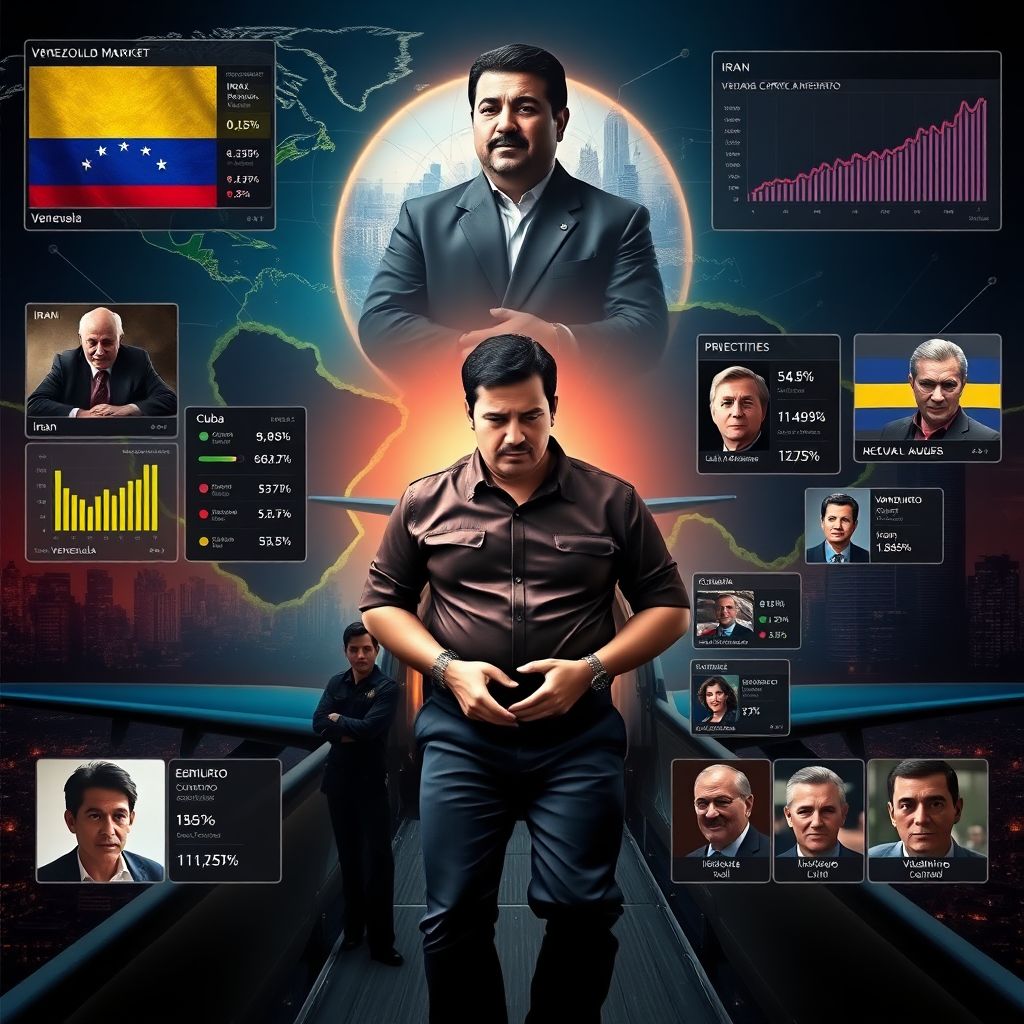
Maduro’s arrest sparks a global “regime‑change trade” among crypto risk‑takers
The U.S. capture of Venezuelan strongman Nicolás Maduro has transformed global prediction markets into a real‑time dashboard for regime‑change speculation. What began as a dramatic operation in Caracas—ending with Maduro and his wife flown to New York to face federal narco‑terrorism and related charges—has rapidly evolved into a worldwide recalibration of political risk, priced minute by minute in crypto.
On decentralized betting platforms where users stake cryptocurrencies on real‑world outcomes, Maduro’s downfall is no longer treated as an isolated Latin American event. Instead, traders are treating it as a template for how quickly entrenched regimes can unravel once the United States signals it is willing to move from sanctions and pressure campaigns to direct intervention.
Iran becomes the next focal point
The most striking spillover has appeared in markets linked to Iran. On Polymarket, one of the highest‑profile crypto prediction venues, more than 1 million dollars in volume changed hands in a single day on contracts tied to the future of Iran’s Supreme Leader, Ali Khamenei.
A contract titled “Khamenei out as Supreme Leader of Iran” showed a sharp repricing of expectations:
– around an 11% implied probability of Khamenei losing his post by January 31,
– approximately 34% by the end of June 2026,
– climbing to roughly 47% by the close of 2026.
For traders, those numbers do not necessarily mean they believe a change is likely in absolute terms. Instead, they reflect how quickly the perceived tail risk of sudden regime change has expanded. After the Maduro operation, the market’s message is clear: if one long‑standing authoritarian leader can be removed and extradited, others may not be as secure as they appear.
Middle East escalation risk gets repriced
It is not only leadership transitions that are being traded. Contracts tied to potential conflict in the Middle East have also surged in activity. One widely watched bet prices the likelihood that Israel will conduct a strike on Iran before March 31, 2026. Following the news of Maduro’s capture, this market swung sharply, moving toward nearly coin‑flip odds—an increase of about 22 percentage points in a single day.
Traders appear to be connecting the dots: a bold U.S. move in Venezuela suggests a more assertive posture globally, which in turn could amplify confrontation risks with regional adversaries. While none of this guarantees actual military escalation, prediction markets are functioning as a barometer of perceived geopolitical temperature—and the reading has moved decisively hotter.
Venezuela: the core trade remains succession
Despite the global spillover, Venezuela itself remains the single most actively traded storyline. A prominent Polymarket contract asks who will be recognized as the country’s leader by the end of 2026. Nearly 895,000 dollars in volume has already flowed into this market, underlining how uncertain the post‑Maduro landscape appears, even to seasoned political bettors.
Current pricing implies:
– interim President Delcy Rodríguez is in pole position, with about a 44% probability of holding power at the end of 2026,
– opposition figure María Corina Machado hovers near 14%,
– fellow opposition politician Edmundo González trades slightly higher, around 15%,
– Defense Minister Vladimir Padrino López trails at roughly 7%.
This distribution suggests that traders expect some form of continuity within the existing power structure, rather than a clean opposition takeover or a rapid transition to fully democratic governance. That reading has been reinforced by reports that U.S. officials, in internal discussions, weighed “stability‑first” options—favoring a managed succession inside the regime’s ranks over a chaotic power vacuum.
“Stability first” and the politics behind the odds
The notion that Washington might prioritize continuity over disruption is central to how these markets are being priced. If U.S. policymakers remain focused on avoiding wide‑scale instability, traders infer that figures like Rodríguez or Padrino López could be acceptable successors, preserving much of the existing apparatus while formally turning the page on Maduro himself.
By contrast, opposition leaders such as Machado and González represent a more dramatic break, potentially ushering in new economic policies, renegotiated oil deals, and a restructuring of Venezuela’s foreign alliances. Because those scenarios involve greater uncertainty—and a higher risk of interim turmoil—markets currently assign them lower probabilities, despite their popularity among pro‑democracy advocates.
Trump’s rhetoric widens the field: Cuba and Colombia enter play
If the Maduro operation lit the fuse, off‑the‑cuff comments by former President Donald Trump have helped accelerate the firestorm across the region. Speaking aboard Air Force One, Trump mused that a military operation in Colombia “sounds good” and described Cuba as “ready to fall,” language that immediately rippled through prediction platforms.
Trump later sharpened his tone on Cuba, stating that the island “could be next” and underscoring its heavy economic dependence on Venezuelan oil and financial support—flows that may now be disrupted or cut off. Traders, ever alert to signals from Washington, quickly adjusted positions across multiple Latin American contracts.
Cuba: regime fragility gets repriced downward
Despite the dramatic rhetoric, the odds on Cuban leadership change have actually softened as the initial frenzy cooled. A contract speculating on whether President Miguel Díaz‑Canel would leave office by June 30 now reflects about a 20% probability—down sharply from 61% on January 3, when reports of Maduro’s capture first surfaced.
The initial spike appears to have been driven by emotion and headline‑chasing: if Maduro could fall, perhaps Havana was next. As more details emerged and no immediate follow‑through materialized from U.S. officials, traders reassessed, concluding that the Cuban state’s entrenched security apparatus and decades of survival against sanctions make rapid regime collapse less likely. The retreat from 61% to 20% shows the corrective, self‑balancing nature of prediction markets once speculative exuberance meets cooler analysis.
Colombia: political risk surges into the year’s end
Colombia, however, has seen a very different pattern. After Trump floated the idea of an “Operation Colombia” while criticizing leftist President Gustavo Petro, markets moved aggressively. Contracts pricing the probability that Petro would be out of office by the end of June implied around a 15% chance. But for the end of the year, odds were marked up to as high as 95%.
Such an extreme year‑end figure reflects more than literal expectations of a U.S. invasion. Traders are also incorporating domestic volatility: Petro’s tensions with business elites, conservative opposition forces, and elements within the security establishment. Combined with external pressure and combative rhetoric from abroad, these factors are being treated as ingredients in a potentially explosive mix.
Whether those odds ultimately prove accurate is secondary to what they reveal: markets see Colombia’s political trajectory as highly unstable in the wake of Maduro’s capture, with an unusually wide range of possible outcomes for Petro’s presidency.
How prediction markets turn geopolitics into tradable risk
Behind the headlines, the Maduro episode illustrates how crypto‑based prediction platforms are becoming shadow risk desks for geopolitics. Each contract reduces a complex political story to a binary outcome—Maduro there or gone, Díaz‑Canel in office or out, Khamenei still Supreme Leader or replaced by someone else. Traders then express their views by buying or selling those outcomes at specific prices representing implied probabilities.
If a contract trades at 0.40 dollars, for example, the market is saying there is about a 40% chance of that scenario occurring by the designated deadline. Participants who believe the real odds are higher than 40% will buy, expecting profits if the price later rises toward what they see as a more accurate probability. Those who think the risks are overstated may sell, betting the contract will decline.
Maduro’s capture has injected a new variable into these calculations: the willingness of the United States to act decisively, even at significant diplomatic cost. That perceived shift in Washington’s risk tolerance is now being priced not just in Venezuela, but across a map of governments seen as fragile, isolated, or heavily dependent on external patrons.
Why crypto gamblers care about regime change
Many of the traders participating in these markets are not traditional political analysts. Yet the incentives they face push them to synthesize information from news, intelligence leaks, local reporting, economic data, and historical precedent. Political upheaval matters because it can impact:
– oil exports and energy prices,
– currency stability and inflation,
– debt repayments and default risk,
– migration flows and regional security,
– the legal treatment of foreign corporations and investors.
Crypto bettors attempt to get in front of these shifts, believing that understanding the trajectory of power—who rules, who falls, and how quickly—can generate returns that rival or outperform conventional financial trades. Maduro’s fall, in this context, is not just a moral or ideological event; it is a catalyst that reshapes their probabilistic models for multiple countries at once.
A new template for “regime‑change trades”
For some participants, the Venezuelan episode has become a playbook. They look for regimes that share similar characteristics with Maduro’s Venezuela: concentrated power, allegations of corruption or criminal activity, heavy reliance on a single commodity or foreign patron, and strained relations with Washington. Once such a profile is identified, they scan for catalysts—economic shock, sanctions, internal splits within the ruling elite, or hawkish rhetoric from major powers.
Crypto markets allow them to express these views rapidly and at scale, placing “regime‑change trades” across an array of authoritarian or semi‑authoritarian states: buying contracts on leaders leaving office, hedging with counter‑bets on continuity, or constructing portfolios that span entire regions. Maduro’s capture is read as proof that shocks once considered far‑fetched can suddenly become real, turning long‑shot wagers into outsized payoffs.
The limits—and dangers—of crowd‑sourced geopolitics
Yet the speed and drama of these repricings highlight the limits of prediction markets as well. They are vulnerable to rumor, political grandstanding, and misunderstanding of local dynamics. A single provocative comment by a U.S. politician can temporarily double or triple odds in a contract, even if on‑the‑ground conditions have barely changed.
Moreover, high‑profile wins—like traders who reportedly multiplied their funds on bets related to Maduro’s arrest—can encourage excessive risk‑taking. New participants may conflate a lucky break with a systematic edge, underestimating how much geopolitics resists tidy quantification. For every successful regime‑change bet, there are dozens of slow‑burn situations that drag on for years, grinding down capital and patience alike.
From Caracas to Tehran: a world repriced
Still, one conclusion is inescapable: Maduro’s capture has redefined how crypto gamblers, and increasingly some institutional players, think about political durability. Venezuela is now a test case for what happens when a long‑standing strongman is removed under U.S. custody and an uneasy search for “stability‑first” successors begins.
From Cuba to Colombia, and all the way to Iran, traders are re‑evaluating which governments might be more vulnerable than previously assumed—and how fast change could arrive once pressure crosses a certain threshold. The regime‑change trade, supercharged by decentralized markets and instant global liquidity, has become a permanent feature of the geopolitical landscape.
Whether these bets prove prescient or wildly wrong, they provide a stark snapshot of how a single arrest in Caracas has convinced thousands of market participants that the world’s political map may be far more fluid—and far more tradable—than it looked just weeks ago.