The Mood at Miami’s ‘Davos for Degens’ as Bitcoin and Ethereum Went Off a Cliff
On paper, the gathering in downtown Miami was built for people who live for volatility. Attendees self-identified as “degenerate” traders, the kind who treat double‑digit drawdowns as a badge of honor and pass around screenshots of six‑figure losses like trading cards. Yet by the final day of [REDACTED] Live—dubbed by some as a kind of “Davos for degens”—the room felt surprisingly empty.
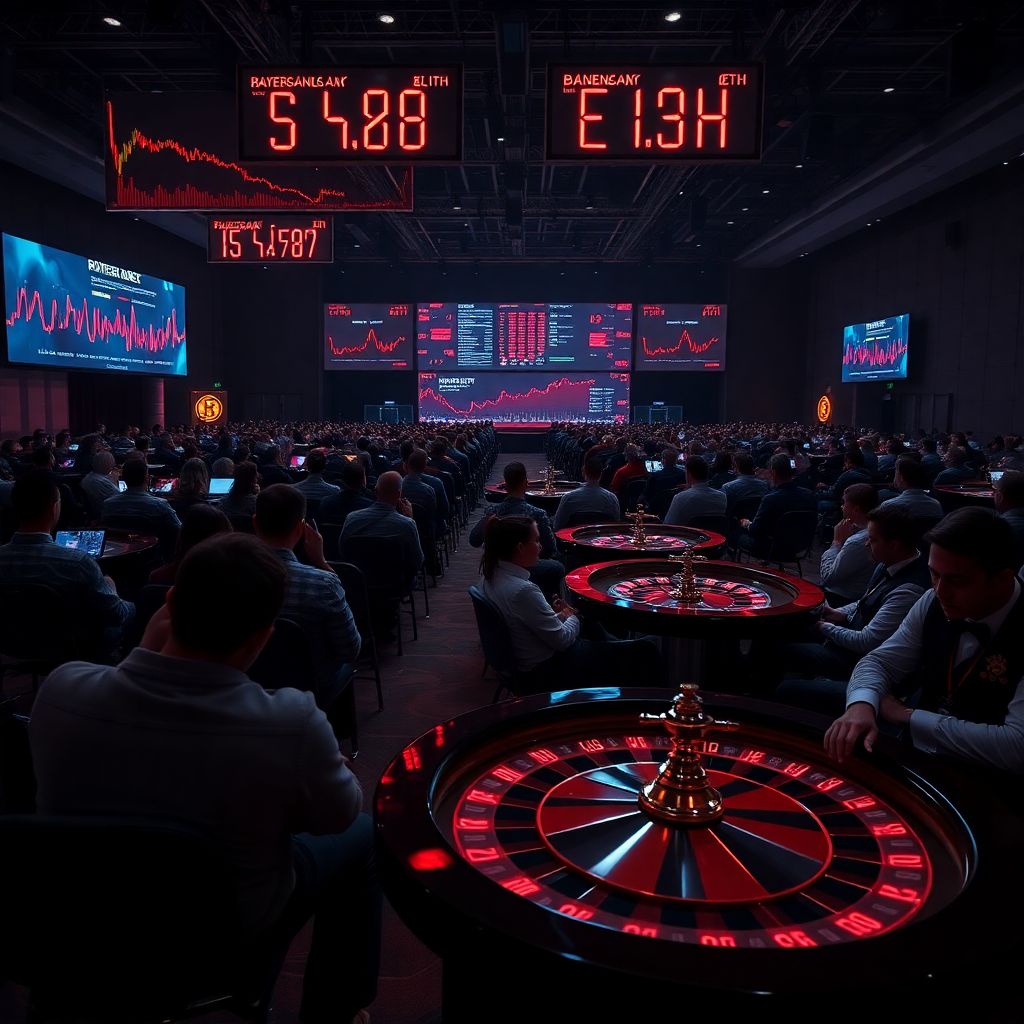
The blackjack and roulette tables set up on the conference floor captured the mood better than any price chart. Dealers in pressed vests and bowties stood idle, shuffling decks no one touched, spinning wheels for no one in particular. The spectacle was there, but the appetite for further risk simply wasn’t. While the chips sat untouched, Bitcoin and Ethereum were doing the gambling on everyone’s behalf—plunging in real time, dragging the rest of the crypto market and even precious metals down with them.
The slide in Bitcoin and Ethereum, initially dismissed by some as another healthy correction, quickly turned into something uglier. Conversations that started with jokes about “buying the dip” drifted into uneasy silence as phones lit up with liquidation alerts and margin calls. Panels continued on stage, but eyes were glued to screens: candlesticks, funding rates, liquidation heatmaps. Each new red candle did more to shape the conference’s tone than any keynote.
For a group that traditionally delights in spectacular blow‑ups, the crowd was unusually subdued. People who might once have posted their losses for sport now quietly closed their laptops or slipped to the back of the room. That familiar culture of glorifying giant red numbers felt out of step with the moment. The jokes landed more softly, the laughter shorter. Many traders simply looked exhausted.
The scene contrasted sharply with the city’s pandemic‑era crypto mania. Back then, Miami was the avatar of digital-asset excess: NFT parties that lasted until sunrise, meme tokens launched from poolside cabanas, a general sense that every coin was going “to the moon” eventually. This time, the backdrop was the same—palm trees, humidity, neon—but the energy was different. The crowds were thinner, the sponsorships less ostentatious, and the bravado more measured.
That didn’t mean people had become conservative overnight. [REDACTED] Live still leaned hard into its identity as a playground for high‑risk traders. Panels focused on leverage, options strategies, and exotic derivatives. Speakers took the stage with slides full of 100x screenshots and charts of spectacular run‑ups. The tagline could just as easily have been: “If it can’t blow up your account, why bother?” But with the market unraveling in parallel, the theoretical danger suddenly felt very real.
One recurring phrase surfaced across talks and hallway debates: “fundamental value.” Not long ago, that kind of language would’ve been written off as boomer logic at a conference like this. Now, it was coming from people who had built their reputations on riding unsustainable trends. Traders talked about revenues, real-world demand, cash flows, and whether any of the tokens they were flipping actually did something that would matter five years from now.
A similar shift was visible on the institutional side. A handful of fund managers used the chaos as a backdrop to pitch themselves as the “adults in the room,” arguing that the future of high-risk trading would be less about blind degen bets and more about structured products, hedging strategies, and disciplined risk controls. It was an odd juxtaposition: on one end of the floor, a talk about balanced portfolios and downside protection; on the other, silent roulette tables and attendees watching their favourite coins melt down.
Hovering over everything were ghosts of the last cycle—most notably FTX. Several sessions alluded, directly or indirectly, to the exchange’s collapse and the way its implosion reshaped both regulation and sentiment. Any time someone mentioned custodial risk, centralized platforms, or opaque balance sheets, the subtext was obvious. Offstage, the comparison came up even more bluntly: “This feels like when FTX started to wobble,” one trader muttered, staring at a sea of red on his phone.
Those flashbacks weren’t just about the fear of another major institutional failure. They also touched a more personal nerve: many in attendance had been wiped out, at least once, in previous blow‑ups. The crash underway during the conference wasn’t their first rodeo. But for some, it was the first time they were watching it unfold without the euphoria and limitless optimism of 2020–2021 in the background. Where the old cycle was fueled by stimulus checks and meme‑driven liquidity, this one felt more constrained, more scrutinized, more fragile.
Still, there was a notable absence: panic. Instead of screaming or dramatic exits, the prevailing emotion was a kind of weary acceptance. People scrolled through charts, adjusted positions, and cracked gallows-humor jokes about “revisiting 2018 prices.” A few diehards continued to double down, buying into the slide with the conviction that every deep crash is simply the prelude to the next blow‑off top. Others quietly moved into stablecoins and sat out the final phases of the drop.
By the event’s close, the attrition was visible. Seats that had been full on day one were half empty. Some traders left early to reassess their books elsewhere. Others lingered in the hotel bar, talking less about their latest “10x play” and more about how to survive long enough to see the next cycle. The mythology of the indestructible degen was still alive, but it had acquired an addendum: being able to walk away from the table mattered, too.
The Miami crypto scene itself—once a symbol of unstoppable growth—seemed to be undergoing a similar reckoning. Local builders talked about pivoting away from pure speculation and toward products that might actually generate sustained demand: infrastructure, payments, gaming, tokenization of real‑world assets. The rhetoric of “number go up” hadn’t disappeared, but it was increasingly joined by questions about utility, regulation, and institutional compatibility.
Behind the conference branding and the casino aesthetics, a deeper story was playing out: the maturation of a culture that had built its identity around recklessness. The whole “Davos for degens” label was meant as a flex, a way of saying this was the anti‑establishment elite of high-risk finance. Yet many of the conversations that resonated most were the sober ones—about how to size positions properly, how to avoid cascading liquidations, how to manage mental health when your net worth can swing 50% in a week.
The crash also sharpened long‑standing debates about whether Bitcoin and Ethereum still behave like uncorrelated assets. Several panels touched on how tightly crypto had moved with other risk markets in recent years. That the sell‑off extended to precious metals only deepened the sense that something broader was happening in macro, beyond the confines of any one asset class. A few speakers argued that this could eventually strengthen Bitcoin’s case as “digital gold,” but in the moment, the narrative was overshadowed by the reality of portfolio drawdowns.
While Ethereum’s decline sparked the usual discussions about scaling, staking yields, and competition from newer chains, the dominant takeaway was more psychological than technical: even blue-chip tokens are not safe havens in a true liquidity shock. Long-time participants knew this; newer entrants were learning it in real time, some for the first time with meaningful capital at stake.
Outside the official program, the conversations were more raw. People compared notes on which exchanges handled the volatility gracefully and which ones buckled under load. They traded stories of liquidation chains: one big margin wipe triggering forced sales elsewhere, feeding a feedback loop that dragged majors and altcoins lower together. There was frustration, but also an almost scientific curiosity about how the structure of the market amplified the move.
In the end, [REDACTED] Live managed to capture a uniquely liminal moment for crypto. It was neither the unbridled exuberance of the pandemic boom nor the absolute desolation of a full-blown bear-market bottom. Instead, it felt like an inflection point—where the culture of the degen was colliding with the realities of a more regulated, more interconnected financial system, and with the hard math of risk and reward.
As attendees filtered out into the Miami night, the charts still looked terrible. Bitcoin and Ethereum remained deep in the red, and the broader market showed little sign of an immediate bounce. Yet, amid the losses and fading crowds, a throughline persisted: people were already scheming about the next opportunity. For better or worse, that is the engine that keeps this corner of finance alive.
Maybe that’s the real difference between a traditional elite summit and this so‑called “Davos for degens.” In the Alps, the discussion revolves around preserving wealth and managing global stability. In Miami, even in the middle of a crash, the focus remained on how to turn chaos into the next asymmetric bet. The tables might have been quiet this time, but nobody believed they would stay that way for long.