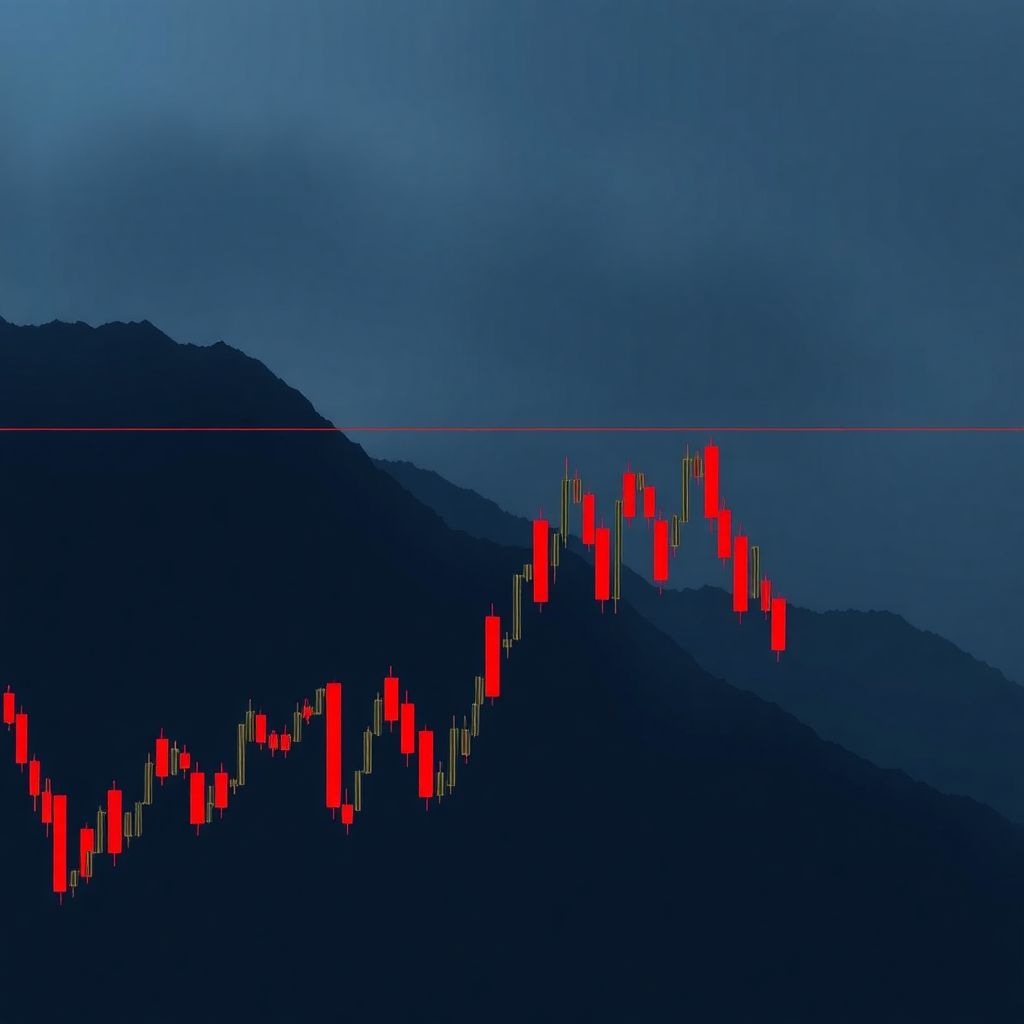
Ethereum price stalls at $2,200 as selling pressure takes control, reinforcing a bearish tilt within an established trading range. After a brief attempt to push through this key resistance area, ETH failed to maintain momentum above the value area high, confirming a rejection that now increases the likelihood of a rotation toward lower support levels.
From a technical perspective, the recent move has underlined the fragility of Ethereum’s bullish attempts in the short term. The $2,200 zone has repeatedly acted as a ceiling, and the latest failure to reclaim and hold this level suggests that buyers are losing conviction. Instead of following through with a breakout, price quickly reversed, slipped back under the value area high, and signaled that the upper boundary of the current range remains firmly defended by sellers.
The value area high, derived from the volume profile of recent trading activity, is particularly important in this context. This zone often marks where the bulk of trading volume transitions from accumulation to distribution. Each time Ethereum approaches this region, it essentially tests whether market participants are willing to absorb offers and push price higher, or whether sell-side liquidity overwhelms demand. The latest reaction confirms that, for now, the market still treats this area as a distribution point rather than a springboard for continuation.
The failure to sustain price above this key band not only validates resistance at $2,200 but also reinforces the range-bound nature of the current market structure. Instead of initiating a directional trend, ETH continues to oscillate between clearly defined boundaries. In such environments, price tends to rotate from one side of the range to the other, seeking liquidity at both extremes. With the upper region now rejected, attention naturally shifts toward the lower end of the spectrum, where support around $1,826 stands out as the next meaningful technical magnet.
This $1,826 area aligns with prior demand zones and has previously attracted dip buyers, making it a logical candidate for the next downside test if selling pressure persists. The more often Ethereum fails at the same resistance level, the more likely it becomes that the market will probe the opposite side of the range in search of fresh interest. Absent a strong surge in bullish volume, the path of least resistance tilts lower within the existing structure.
Market structure further supports this scenario. Ethereum has struggled to form convincing higher highs above $2,200, an essential requirement for a sustainable uptrend. Instead, price has carved out repeated rejections near this cap, signaling that each attempt to break through is met with aggressive supply. This pattern of lower momentum and failed breakouts often precedes range rotations or, in more severe cases, deeper corrections if support fails to hold.
Adding weight to the bearish case is the confluence of technical barriers clustered around the same zone. The intersection of the value area high with broader range resistance concentrates liquidity and trader attention. When multiple levels align in a narrow band, reactions from that area typically become more pronounced. The rapid reversal seen in recent candles is consistent with this kind of confluence-driven rejection, where both short-term traders and larger participants step in to sell.
It is worth noting that Ethereum did recently manage to rebound above the psychologically important $2,000 level, helped in part by improving sentiment and a sizeable purchase of more than 50,000 ETH by Bitmine. That bounce, however, has so far failed to transform into a sustained trend reversal. The persistent overhead resistance near $2,200 continues to cap rallies, implying that even sizable inflows and positive headlines are not yet sufficient to overpower the existing supply zone.
As long as daily or higher-timeframe closes remain beneath the value area high and the $2,200 resistance band, the odds favor a gradual drift or sharp rotation toward the lower boundary of the established range. This is a textbook behavior in consolidation phases: price oscillates, liquidity is harvested at one end, then the market migrates toward the opposite end where resting orders and sidelined participants await. Until buyers demonstrate the strength to reclaim and defend resistance, downside scenarios remain more probable within this framework.
The invalidation of this bearish bias is straightforward from a technical standpoint. Bulls would need to force a decisive break above $2,200, followed by sustained closes above the value area high. Only then would the current rejection narrative weaken, opening the door for a potential trend transition from sideways to upward. Without that shift, traders must respect the ongoing consolidation and the risk that ETH could revisit sub-$2,000 levels on its way toward deeper support.
At the same time, the broader narrative around Ethereum continues to evolve beyond pure price action. Vitalik Buterin’s recent characterization of Ethereum as one element within a wider network of “sanctuary technologies” highlights the project’s long-term aspirations. In this framing, Ethereum and similar open-source systems are designed not just as financial tools, but as infrastructures for preserving freedom, privacy, and resilience in an increasingly uncertain global environment. While such themes may not immediately influence intraday charts, they underpin long-range investor confidence and can shape how capital allocators view temporary price weakness.
For traders and investors trying to navigate this environment, the current setup calls for a clear separation of time horizons. Short-term participants must treat the $2,200 level and the value area high as immediate reference points: below them, the bias leans toward range rotation and potential tests of $1,826; above them, the landscape shifts toward breakout territory. Longer-term holders, in contrast, may interpret drawdowns within this range as part of a broader accumulation phase, especially if they align with structural narratives around Ethereum’s role in decentralized finance, infrastructure, and so-called sanctuary technologies.
Risk management becomes particularly important when markets are compressing inside well-defined ranges. Because volatility can contract for extended periods before suddenly expanding, traders often misjudge the probability of sharp moves when price finally leaves the range. With ETH pinned between $2,200 resistance and lower supports, strategies built around clear invalidation points and predefined position sizing are generally preferable to impulsive entries based solely on short-lived intraday swings.
Another dynamic to watch is liquidity behavior at both extremes of the range. Each move toward $2,200 that ends in rejection builds a cluster of trapped long positions, many of which may later be forced to exit on the way down, adding to selling pressure. Conversely, each dip closer to $1,826 or even below $2,000 has the potential to trigger stop orders and induce a liquidity flush, which sometimes precedes sharp short-covering bounces. Understanding how these pockets of orders can fuel moves in both directions helps explain why price can overshoot levels before snapping back.
Macro and cross-market correlations may also influence what happens next. Ethereum often trades in tandem with Bitcoin and broader risk assets, especially during periods of heightened macro uncertainty. If global markets lean risk-off, the $2,200 ceiling could harden further, accelerating a move toward lower supports. On the other hand, a renewed wave of risk-on sentiment or a strong breakout in Bitcoin could help Ethereum challenge resistance again, even if the technical picture currently favors caution.
On a more granular level, intraday traders might monitor how ETH behaves around intermediary levels between $2,000 and $2,200. Repeated failures to even approach $2,200 would indicate weakening buying interest, strengthening the case for a deeper push lower. In contrast, progressively higher lows coupled with steady attempts to pressure resistance could hint that accumulation is taking place beneath the surface, setting up a potential squeeze above the range in the future.
Ultimately, the current phase can be summarized as a battle between a resilient, yet unbroken, resistance zone and a set of supports that have not yet been thoroughly tested in the latest swing. Until one side of the range decisively gives way, Ethereum is likely to continue trading in a choppy, rotational fashion, frustrating momentum traders while offering opportunities for those comfortable operating within defined boundaries.
For now, the technical message remains clear: Ethereum’s inability to maintain levels above $2,200 and the value area high confirms that the upper edge of the range is still intact. This keeps the focus on the downside, with $1,826 emerging as a key area to watch should selling pressure continue to build. Only a strong and sustained reclaim of resistance would meaningfully shift this narrative and open the door to a more constructive outlook in the near term.