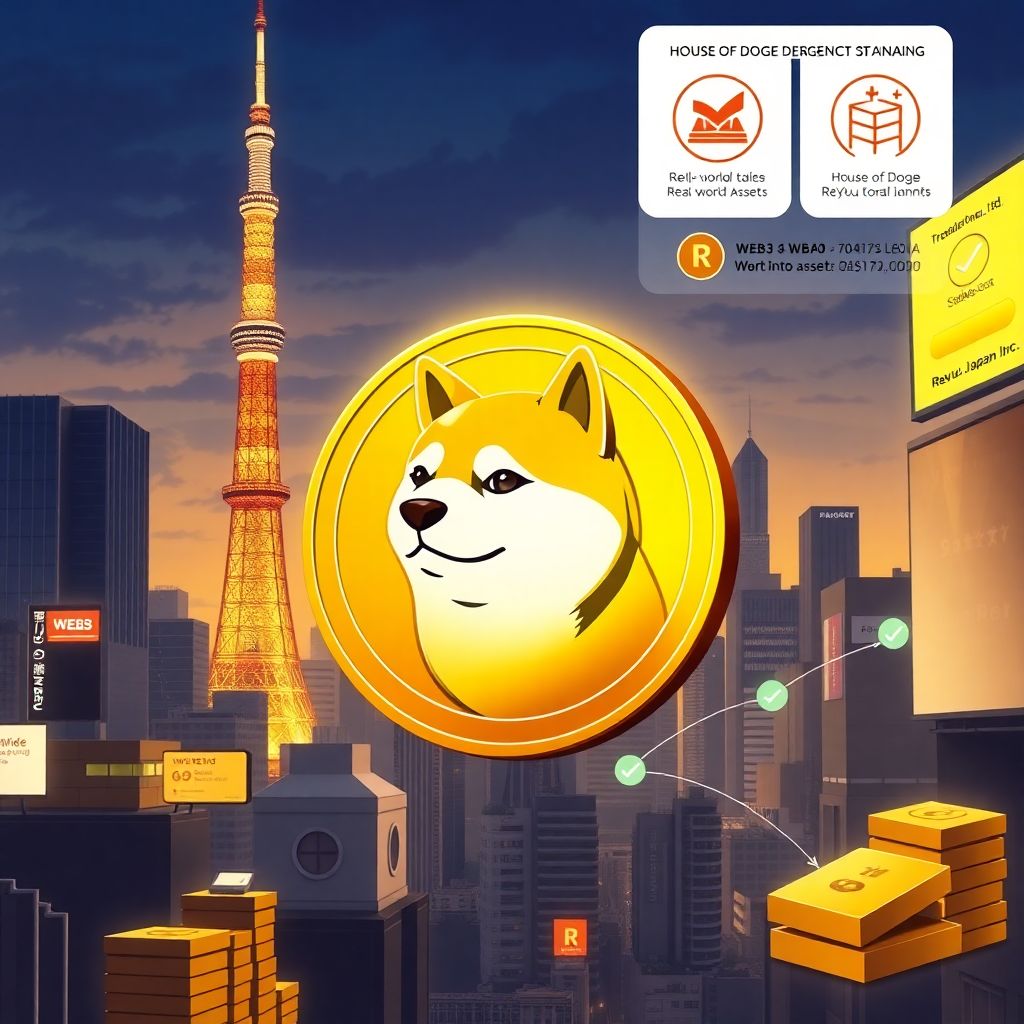
Dogecoin Targets Japan In New RWA And Adoption Push
Dogecoin’s ecosystem is preparing a focused expansion into Japan, with a new initiative that shifts emphasis from memes to real-world utility, asset tokenization, and regulated adoption. House of Doge, the corporate arm of the Dogecoin Foundation, has announced a strategic cooperation framework with two Japan-based partners aimed at developing localized Dogecoin use cases and real-world asset (RWA) projects tailored to the country’s regulatory environment.
Tripartite framework with Japan-focused partners
In a press release dated January 8, House of Doge revealed that it has entered into a three-way cooperation agreement with abc Co., Ltd. and ReYuu Japan Inc. Rather than unveiling a single product or platform, the partnership is structured as a long-term roadmap for future collaboration, outlining several workstreams designed to support regulated tokenization and payments-oriented integrations in Japan.
The framework positions Japan as a priority market for Dogecoin’s next stage of development. It signals a clear intent to move beyond purely speculative trading and cultural notoriety toward a more structured presence in financial products, compliant Web3 integrations, and on-the-ground usage.
Marco Margiotta, CEO of House of Doge, described the collaboration as a continuation of Dogecoin’s push into real-world applications. According to him, Japan is a “natural and culturally aligned market” for DOGE thanks to its strong adoption of digital technologies and openness to innovation. The partnership, he noted, is intended to foster responsible innovation, practical utility, and sustainable ecosystem growth rather than short-term hype.
Focus areas: gold-backed stablecoins, RWA listing, and Web3 use cases
The agreement lays out several potential areas of cooperation designed to “leverage the strengths of each party” for the benefit of the broader Dogecoin ecosystem. Among the most notable themes are:
– Promotion and adoption of gold asset-backed stablecoins
– Regulatory-focused work to list RWA tokens under Japan’s “green list” framework
– Creation of a joint fund within the Dogecoin ecosystem
– Development of next-generation Web3 use cases tied to real-world applications
Highlighting a path toward Japan’s green list underscores a strong focus on compliance, licensing, and market structure. This is a significant departure from the meme-heavy narrative that has traditionally defined Dogecoin in the eyes of the public. Instead, the project is explicitly engaging with regulated tokenization, asset backing, and integration into formal financial rails.
However, the announcement remains deliberately high-level. It does not specify which real-world assets might be tokenized, how exactly a gold-backed stablecoin would operate, or whether such instruments would be issued directly on the Dogecoin network or via parallel infrastructure. Likewise, there are no concrete details about launch timelines or specific products.
Complementary roles: ReYuu Japan, abc, and House of Doge
The three partners are being positioned as bringing different, complementary capabilities to the table.
– ReYuu Japan Inc. is described as focusing on business development and localization within Japan. This likely includes building local partnerships, adapting products to Japanese consumer and regulatory expectations, and navigating cultural nuances around payments and digital assets.
– abc Co., Ltd. is framed as a specialist in token-economy design, smart-contract development, and regulatory alignment, with a particular emphasis on real-world asset tokenization and compliant Web3 integration. In practice, this suggests abc will work on the technical and legal architecture needed to make tokenized RWAs and stablecoins workable under Japanese law.
– House of Doge serves as the ecosystem-level coordinator and infrastructure investor. Its role involves aligning Dogecoin’s infrastructure with these new use cases, supporting development, and ensuring that initiatives fit into the broader international strategy of the Dogecoin Foundation’s corporate arm.
Together, the companies aim to enable “localized and responsible” Dogecoin-related initiatives in Japan. Still, the press release stops short of naming specific merchants, financial institutions, or pilot programs, leaving investors and users to watch for future concrete deployments.
Japan’s “green list” and why it matters for Dogecoin
The reference to Japan’s green list is a key signal for how the partnership might unfold. Japan’s regulatory regime for digital assets is among the strictest in the world, requiring exchanges and issuers to navigate detailed listing and compliance requirements. The green list mechanism is designed to streamline listing for certain approved assets that meet regulatory and liquidity standards.
By explicitly targeting green list–eligible RWA tokens, House of Doge and its partners are positioning Dogecoin-related instruments in a framework that could make it easier for Japanese exchanges and financial institutions to interact with them. This suggests a strategy that aims to embed DOGE and DOGE-linked assets into the regulated financial system rather than operating solely on the edges of crypto markets.
If executed successfully, such positioning could open the door to:
– Broader access to DOGE or DOGE-linked products on Japanese exchanges
– Integration with licensed payment service providers
– Potential use cases in savings, settlement, or remittances where regulation is crucial
Why Japan is a strategic fit for Dogecoin
Japan has long been one of the most crypto-aware markets globally. From early Bitcoin exchanges to consumer-facing crypto payment experiments, the country has a history of both enthusiasm for and tight regulation of digital assets. It is also known for a strong pop-culture and meme ecosystem, which historically aligns with Dogecoin’s identity.
However, Dogecoin’s new narrative is less about meme culture and more about translating that cultural familiarity into concrete use cases. Japan’s tech-savvy population, advanced payment infrastructure, and established regulatory frameworks make it a compelling testing ground for:
– Retail payments denominated in DOGE or DOGE-linked stablecoins
– Loyalty and rewards programs powered by tokenized assets
– Tokenization of traditional stores of value like gold, integrated into everyday financial apps
Cultural resonance can help drive awareness, but the new plan suggests Dogecoin wants to link that awareness to compliant, real-world financial activity.
Gold-backed stablecoins: a shift toward value-linked instruments
One of the more intriguing aspects of the framework is the focus on gold-backed stablecoins. While Dogecoin itself is a volatile asset, pairing it with gold-linked tokens could create a two-layered ecosystem:
– DOGE as a high-liquidity, high-volatility medium of exchange and community token
– Gold-backed stablecoins as a value-preserving instrument for savings, settlements, or hedging
For Japanese users, a gold-backed stablecoin integrated with Dogecoin infrastructure could offer a combination of traditional value (gold) with modern rails (crypto and Web3). For Dogecoin, this represents an attempt to move from purely speculative use toward diversified financial products, potentially broadening its appeal to more risk-averse users and institutions.
That said, the technical, custodial, and legal complexities of managing gold reserves and ensuring transparent, compliant backing are substantial. The framework suggests intent, but actual product design and regulation-compliant custody structures remain to be seen.
Real-world assets and the broader crypto trend
The push into RWA is part of a larger movement in the crypto industry, where projects seek to tokenize assets such as real estate, commodities, bonds, or revenue streams. For Dogecoin, traditionally viewed as a meme coin, aligning with this trend is a clear attempt to reposition itself as a platform with serious financial potential.
Potential RWA use cases tied to this initiative could include:
– Tokenized claims on gold or other commodities
– Structured products combining DOGE with RWA-backed tokens
– Collateral mechanisms for lending or yield products in a compliant way
If these instruments are integrated into Japan’s regulated markets, Dogecoin could gain new legitimacy and a role in more traditional financial workflows, beyond speculative trading.
Beyond memes: reshaping Dogecoin’s image
House of Doge used the announcement to reinforce its overarching message: Dogecoin’s future is meant to be about practical utility, not just internet culture. The organization presents itself as committed to advancing DOGE as a widely accepted, decentralized global currency by investing in the infrastructure necessary to embed it into everyday commerce.
Its stated scope now spans:
– Payment systems and financial products
– Real-world asset tokenization
– Cultural and brand partnerships that connect DOGE to mainstream audiences
Framed this way, the Japanese expansion effort is a case study in how Dogecoin is trying to “go beyond the meme” and position itself as a serious player in the next phase of crypto adoption.
Challenges and uncertainties
Despite the ambitious framing, several uncertainties remain:
– Regulatory approvals: Achieving green list status or equivalent recognition for new tokens and products in Japan is a complex, time-consuming process. There is no guarantee of success or clear timeline.
– Product design details: Without specifics on which assets will be tokenized, where custody will sit, or which chain(s) will be used, it is difficult to assess technical feasibility.
– Market demand: Japanese consumers and institutions have many choices among stablecoins, RWAs, and payment assets. Dogecoin-linked products will need clear advantages to gain traction.
– Brand perception: Transitioning from “meme coin” to “regulated financial platform” is not straightforward. Dogecoin’s playful brand is an asset in terms of awareness but may be a liability when courting conservative institutions.
How House of Doge and its partners balance DOGE’s cultural roots with a more formalized financial image will be crucial.
Implications for Dogecoin adoption and market dynamics
If the framework leads to tangible products and integrations in Japan, several longer-term outcomes are possible:
– Increased DOGE usage in retail or online payments, particularly if integrated with local merchants or fintech apps
– New demand for DOGE as a gateway or governance token within an expanded ecosystem of RWA and stablecoins
– A stronger narrative for DOGE as a utility asset, which could influence how traders and long-term holders perceive its value
At the time referenced in the announcement, DOGE was trading at 0.14276 dollars. While price movements will continue to be influenced by broader crypto market conditions, regulatory news and new real-world use cases increasingly shape sentiment around established tokens like Dogecoin.
A test case for meme coins in regulated markets
This Japanese initiative could also serve as a wider test case for how meme-origin cryptocurrencies can evolve. Rather than abandoning their communities and cultural roots, they may attempt to overlay regulated financial layers on top of that base.
If House of Doge, abc, and ReYuu Japan can demonstrate:
– Compliant tokenization of real-world assets
– A gold-backed stablecoin that fits within Japanese rules
– Real payment and Web3 use cases for Dogecoin in daily life
then DOGE’s trajectory could become a template for other meme coins seeking to escape the purely speculative category.
For now, the partnership remains a roadmap rather than a finished product suite. Its significance lies less in immediate launches and more in the direction it signals: Dogecoin is deliberately targeting Japan as a key arena for its “next era of crypto utility,” where regulation, real-world assets, and payments stand alongside – and potentially beyond – the meme that started it all.