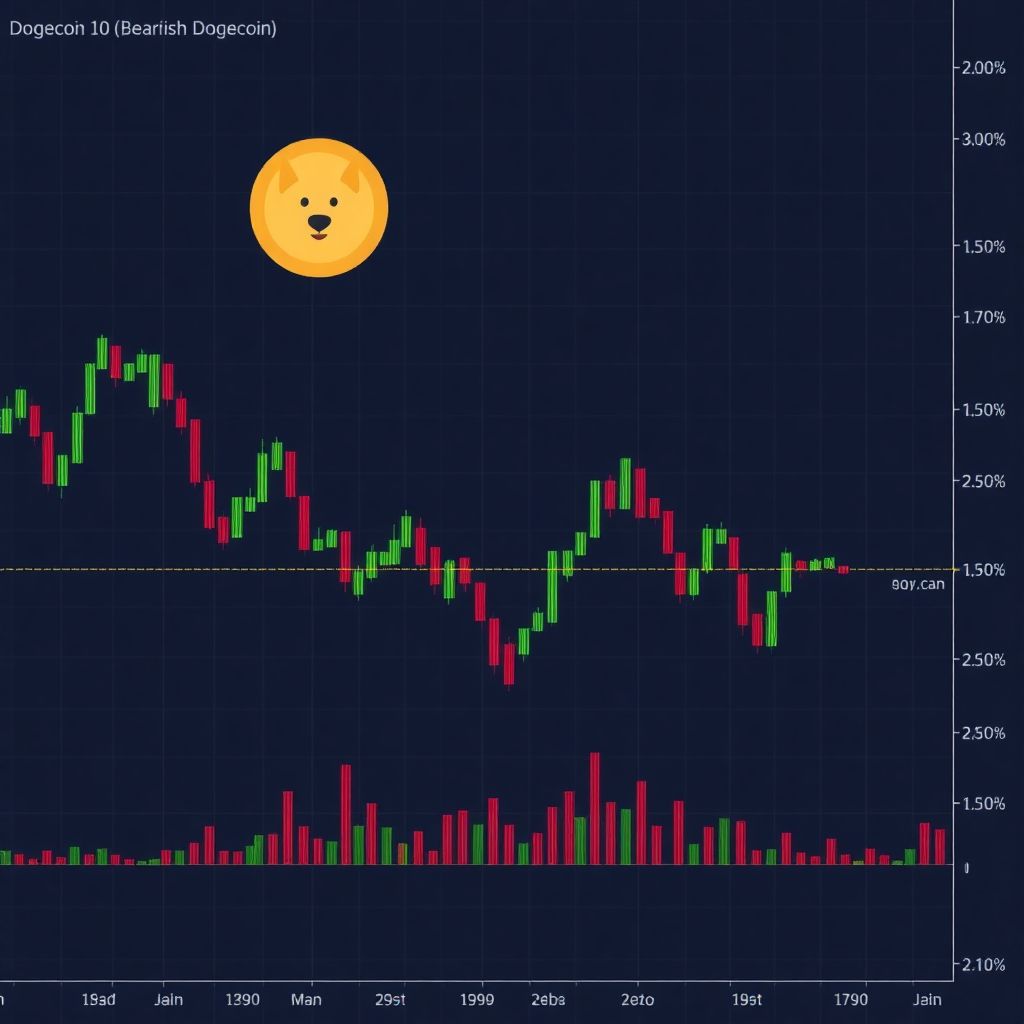
Dogecoin price eyes $0.06 as volume thins and moving averages stay firmly bearish
Dogecoin (DOGE) is flashing renewed downside risk, with one technical analyst warning that the memecoin could be on track for a slide toward the $0.06 area. Their view is built on a series of bearish signals on the weekly chart, including subdued trading volume, pressure from Bollinger Bands, and price action decisively below several major moving averages.
According to the analysis, Dogecoin’s weekly chart on Coinbase shows the token trading under a cluster of key trend indicators. Price currently sits beneath the 8-period exponential moving average (EMA), the 34-period EMA, the 50-period simple moving average (SMA), and the long-term 200-period SMA. When an asset trades below so many moving averages at once, especially on a higher timeframe like the weekly chart, it often reflects a structurally weak trend rather than just a short-term pullback.
The analyst argues that as long as DOGE remains below these moving averages, the broader weekly outlook stays bearish. Bulls would need to drive the price back above at least the 8-week EMA to start challenging that narrative. Reclaiming the 34 EMA, 50 SMA, and eventually the 200 SMA would be needed to reestablish a more constructive trend and signal that a durable recovery might be underway.
Bollinger Bands on the same chart reinforce the downside scenario. Dogecoin is currently trading closer to the lower band than to the middle band (typically the 20-period moving average), a configuration that often appears when an asset is under sustained selling pressure. The proposed target near $0.06 would actually push price below the currently displayed lower Bollinger Band, suggesting the analyst is anticipating an extended continuation of the downtrend rather than a simple retest of recent levels.
Volume data adds another layer of concern. The chart highlights that trading activity has been persistently weak, with no convincing surge in buy-side participation as price has drifted lower. Thin volume during a decline can indicate a lack of strong demand, making it easier for sellers to push the market down to prior support zones or even into new lows if buyers fail to step in.
The analysis also notes that DOGE has already slipped under the low set during the October 10 crash. Breaking a previous significant low often shifts market psychology, turning what had been viewed as a floor into a sign that sellers remain in control. The next notable support area on the chart lies around a price region last visited roughly three weeks ago, which also coincided with the August 2024 bottom. This confluence of former lows strengthens the case for that level as a key zone to watch if the market continues to soften.
The bearish thesis is therefore built on multiple pillars: Dogecoin trading below both short- and medium-term trend references, price hugging the lower Bollinger Band on the weekly timeframe, and a lack of strong volume to support any meaningful rebound. In this framework, buyers need to start by reclaiming the 8-week EMA to show that momentum is shifting. Failing that, the path of least resistance could remain pointed downward toward the $0.06 region.
From a broader perspective, such a decline would not be unusual given Dogecoin’s history. Created originally as a tongue-in-cheek cryptocurrency, DOGE has repeatedly experienced powerful rallies followed by deep corrections. Its status as one of the most visible and actively traded memecoins means it often reacts strongly to shifts in overall market sentiment, liquidity conditions, and social-media-driven hype cycles. In quieter or risk-off environments, these same characteristics can magnify downside moves.
For traders and investors, the current chart structure raises several practical considerations. Those focused on short-term trades might look for signs of exhaustion near the next support zone, such as a spike in volume, long lower wicks on weekly candles, or divergence on momentum indicators like RSI or MACD. Without those signals, attempting to “catch a falling knife” purely because price appears cheap relative to previous highs remains a high-risk strategy.
Longer-term holders may instead concentrate on whether DOGE can eventually rebuild a bullish stack of moving averages. That typically means price first reclaiming the shortest EMA, then stabilizing above intermediate-term averages such as the 34 EMA and 50 SMA, and finally challenging the 200 SMA. Historically, sustained trends-up or down-tend to align with the relative positioning of these averages. As long as they slope downward with price below them, the market is usually in a corrective or bear phase.
It is also important to recognize that weekly signals tend to play out over weeks to months, not hours to days. A bearish weekly structure does not prevent occasional sharp rallies on lower timeframes. These short-lived spikes can be misleading if viewed in isolation, as they may simply be relief bounces within a larger downtrend. Traders using the weekly chart as their main guide should be careful not to overreact to intraday volatility unless it begins to reshape the higher-timeframe structure.
Risk management remains critical in such an environment. For leveraged traders, extended moves toward support-especially with weak volume and bearish moving averages-can quickly trigger liquidations if stops are poorly placed or position sizes are too aggressive. Non-leveraged investors, on the other hand, may focus on defining in advance what kind of price action or fundamental developments would invalidate their thesis, to avoid emotional decision-making if DOGE approaches or breaks through key levels like $0.06.
Another aspect to consider is broader market context. Dogecoin’s direction often correlates with the overall health of the crypto market, especially large-cap assets like Bitcoin and Ethereum. If the wider market enters a risk-off period with capital flowing out of speculative assets, memecoins can underperform significantly. Conversely, if a strong, broad-based rally resumes across major cryptocurrencies, even a technically weak chart can sometimes reverse faster than anticipated, particularly in assets with high speculative interest.
In addition, sentiment shifts around memecoins can happen abruptly. News, celebrity commentary, or renewed social attention can temporarily override technical structures. While such events can produce sharp, unexpected upside, they are difficult to predict and even harder to trade consistently. For most market participants, combining technical signals like moving averages and Bollinger Bands with disciplined position sizing tends to be more reliable than betting solely on sudden narrative shifts.
Ultimately, the highlighted $0.06 target is not a guarantee but a scenario anchored in current technical conditions: Dogecoin trading under a cluster of key weekly moving averages, hugging the lower Bollinger Band, and experiencing depressed volume as it slips below prior crash lows. Until bulls can convincingly reclaim those weekly indicators-starting with the 8 EMA-the analyst’s bearish outlook remains intact, and the market’s focus is likely to stay on downside levels and potential support rather than new highs.