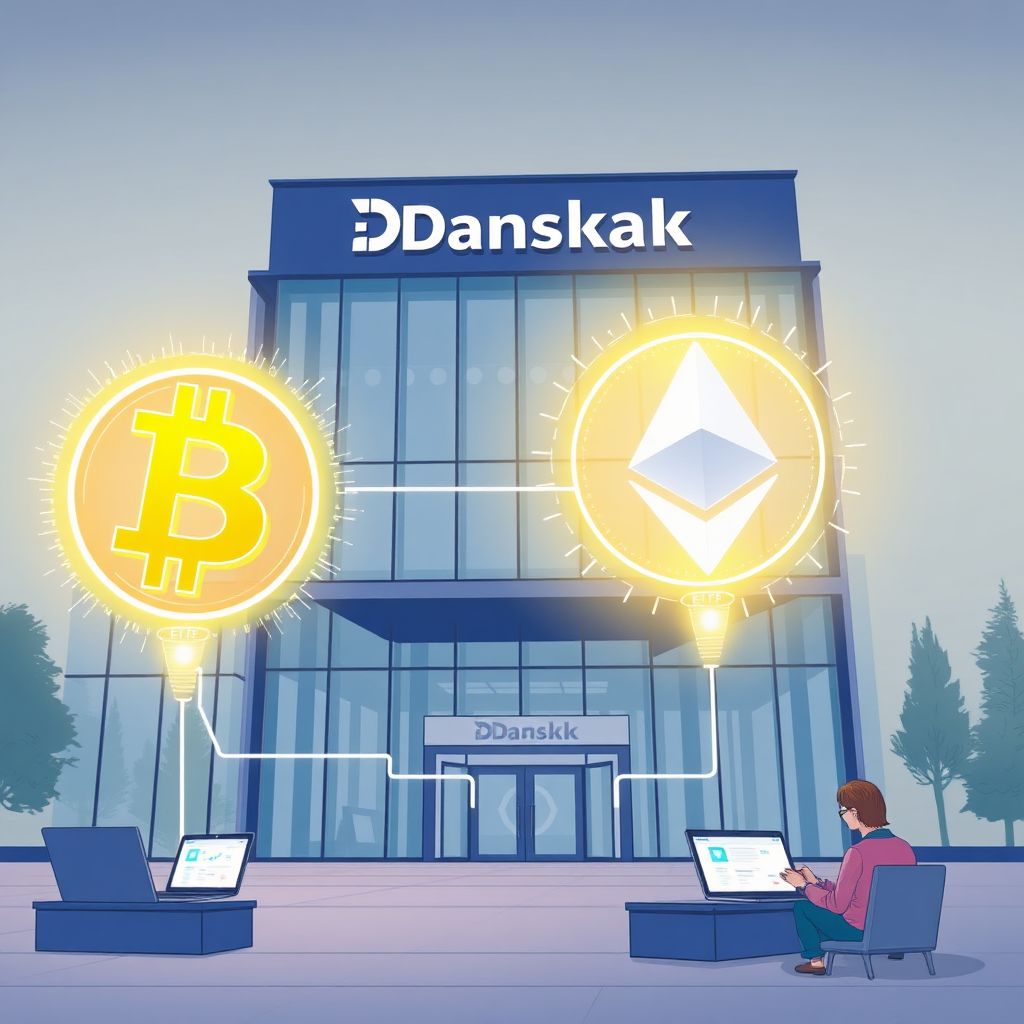
Danske Bank, Denmark’s biggest lender, has quietly reversed one of the most restrictive stances on digital assets in European banking, opening the door for clients to invest in Bitcoin and Ethereum—but only through exchange-traded products (ETPs), and with plenty of caveats attached.
After roughly eight years of effectively blocking most crypto-related services, the bank is now allowing customers using its Danske eBanking and Danske Mobile Banking platforms to gain exposure to the two largest cryptocurrencies via dedicated ETPs. These instruments track the price of Bitcoin or Ethereum but spare investors from holding or managing the underlying coins themselves.
Crucially, the bank stresses that this move should not be read as an endorsement of crypto as an asset class. It is not positioning Bitcoin or Ethereum alongside stocks, bonds, or funds it actively recommends to clients. Instead, the new offering is framed as a response to “growing customer demand” and the maturing of regulatory frameworks around digital assets.
The new products are being rolled out specifically to so‑called execution‑only clients—customers who use Danske’s trading tools to place their own orders without receiving personalized investment advice. In other words, if a customer has already decided independently to seek crypto exposure, the bank will now provide a regulated, exchange‑listed channel for doing so.
For Danske, the shift marks a significant departure from its earlier policy, under which the bank discouraged or outright restricted most forms of crypto trading and services. That de facto “ban” was initially justified by concerns over money laundering, investor protection, and the lack of robust regulation and market transparency in the crypto sector. Over the past few years, however, the environment has changed: supervisory authorities have introduced stricter rules, institutional-grade products have matured, and crypto has steadily moved into the financial mainstream.
By choosing ETPs as the vehicle, Danske is opting for a structure familiar to traditional investors. Crypto ETPs are listed and traded on regulated exchanges, with underlying assets typically held in custody by specialized providers. Investors buy and sell them through their regular brokerage or banking interface, just like they would a stock or an ETF. That format helps consolidate reporting, taxation, and compliance processes inside a framework banks already understand.
At the same time, the bank is taking pains to emphasize that cryptocurrencies remain highly volatile and speculative. The decision to avoid actively recommending crypto products is a clear signal that Danske still sees substantial risk in the segment. Clients attracted by the recent price rallies in Bitcoin or Ethereum will be reminded that sharp corrections are common and that digital assets can lose value quickly.
This careful balancing act—enabling access while keeping an arms-length advisory stance—illustrates how many large financial institutions are now trying to handle crypto. Completely excluding digital assets has become harder as customer interest rises and competitors integrate crypto services. Yet fully embracing them exposes banks to reputational, regulatory, and market risks if things go wrong.
For investors, the key benefit of Danske’s move is convenience and perceived safety. Instead of opening accounts with offshore exchanges or specialized crypto platforms, clients can now initiate and monitor their Bitcoin or Ethereum exposure from the same banking environment they use for stocks and bonds. That reduces friction for first‑time entrants and may particularly appeal to more conservative investors who were previously deterred by the operational complexity of self‑custody and private keys.
However, using ETPs also means ceding certain freedoms. Investors do not hold the underlying coins and therefore cannot directly use them in decentralized finance applications, move them to personal wallets, or engage in staking where applicable. They are buying a financial product that mirrors the price performance of the asset rather than the asset itself. For those whose interest in crypto is more ideological or technology‑driven—such as using Bitcoin as peer‑to‑peer money—this setup will feel limited.
From a strategic perspective, Danske’s pivot is also about staying competitive in a landscape where global banks and asset managers increasingly integrate crypto exposure into their offerings. With spot Bitcoin and Ethereum products gaining traction internationally and regulatory recognition slowly expanding, sitting on the sidelines carries its own cost. Customers who cannot find what they want at one institution often move assets elsewhere.
Risk management remains a central theme in the bank’s messaging. Even though ETPs operate within a regulated framework, the underlying volatility does not disappear. Prices of Bitcoin and Ethereum can react violently to macroeconomic shifts, regulatory announcements, security incidents, or market sentiment changes. Danske is therefore expected to pair the new access with prominent risk warnings, emphasizing diversification and the possibility of substantial losses.
Regulators in Europe have also pushed in the direction of greater clarity and investor safeguards. New rules on crypto service providers, tighter anti‑money‑laundering standards, and more rigorous oversight of market infrastructure have all made it easier for conservative institutions to justify a controlled level of engagement. Danske’s decision can be seen as a direct response to that institutionalization of crypto markets.
In practical terms, the introduction of Bitcoin and Ethereum ETPs through Danske’s digital channels is likely just the first iteration of its updated policy. If client interest proves sustained and regulatory conditions remain supportive, the bank could eventually broaden the menu to include additional crypto‑linked products or funds. For now, though, focusing on the two largest and most liquid cryptocurrencies allows the bank to limit complexity while addressing the bulk of investor demand.
For customers considering whether to use these new products, several questions matter more than the headline about the “end of a ban”:
– What percentage of their overall portfolio are they willing to allocate to such a volatile asset class?
– Are they comfortable with indirect exposure through ETPs rather than direct coin ownership?
– How would a severe drawdown in Bitcoin or Ethereum prices affect their financial plans and risk tolerance?
Thoughtful answers to these questions are likely to matter more to long‑term outcomes than the specific channel—be it a bank, a broker, or a crypto exchange—through which the exposure is obtained.
Danske Bank’s move ultimately reflects a broader shift in mainstream finance: the idea that ignoring crypto is no longer an option, even for the most conservative institutions. By offering Bitcoin and Ethereum exposure through tightly controlled, exchange‑traded products, the bank is trying to meet its customers halfway—acknowledging their interest while still signaling caution about the risks that come with this young and often turbulent market.