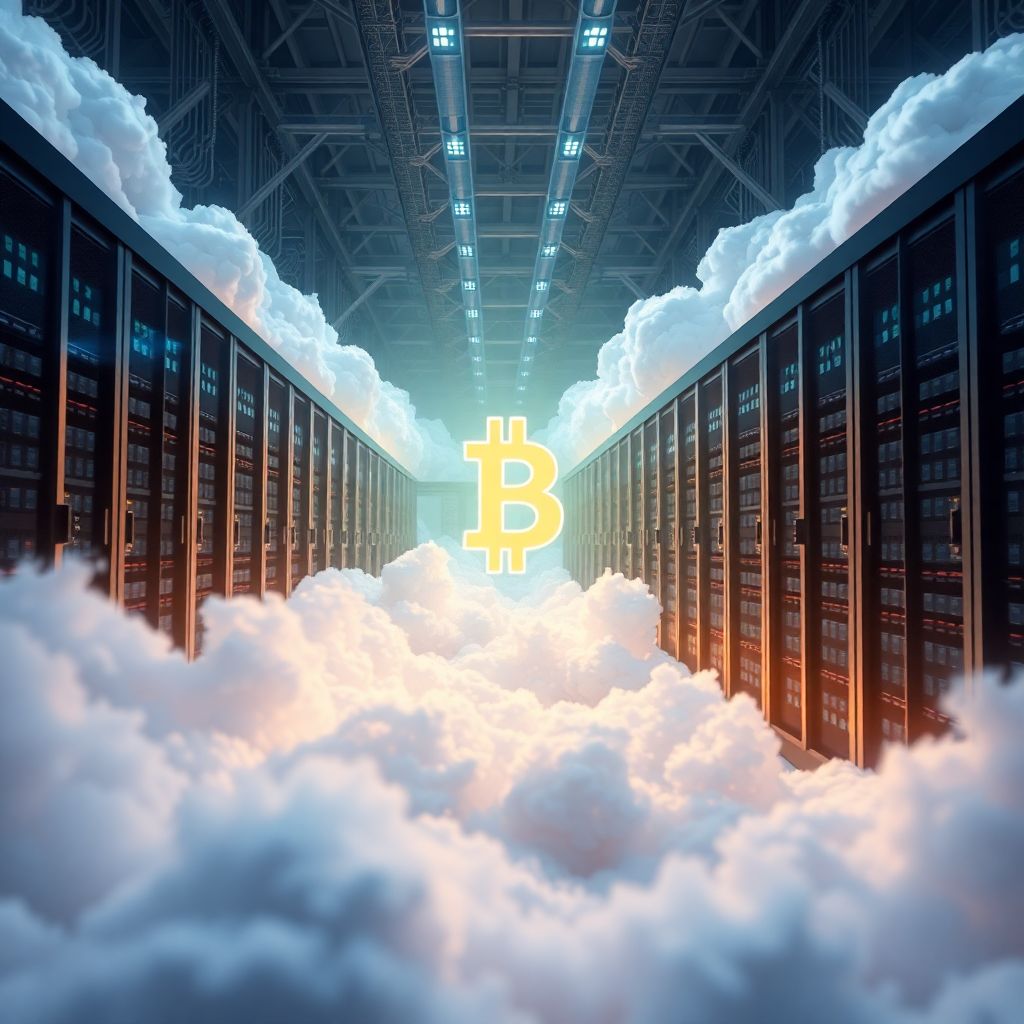
Crypto tech outlook: Quantum-powered DeFi cloud mining unlocks up to $20,000 in daily yield for BTC and XRP holders
As Bitcoin (BTC) trades in a broad consolidation band shaped by global macro uncertainty and Ripple’s XRP strengthens its position in cross-border payment rails, a quiet but profound shift is taking place in digital asset markets. Long-term spot holders are increasingly facing a stark dilemma: remain sidelined while capital sits idle, or take on higher risk in search of meaningful yield.
In this environment, NOW DeFi – positioning itself as an automated “wealth infrastructure” for digital assets – has rolled out a new architecture it calls Quantum Computing Cloud Mining. The platform claims that by aggregating and distributing quantum-grade computing power via the cloud, it can transform dormant BTC, XRP, and other major coins into a stream of automated hashrate-based returns, with potential payouts reportedly reaching up to $20,000 per day for top-tier participants.
The “profit vacuum” facing spot holders
On-chain data and Q1 technical analysis highlight a shared feature across both BTC and XRP: elevated levels of supply lock-up. Large portions of circulating supply are held by long-term investors and institutional players, which contributes to reduced free float and, over time, underpins bullish narratives.
However, this same lock-up dynamic creates friction for everyday holders. During sharp intraday swings or long consolidation phases, retail investors are exposed to mark-to-market losses on paper, while their capital generates no compounding effect. The emotional cost rises as holders constantly monitor price charts, waiting for elusive breakouts that may or may not materialize.
Traditional DeFi yields – once the primary escape valve for idle capital – have contracted dramatically. Many yield farming and staking models are either unsustainably risky or no longer competitive on a risk-adjusted basis. This has created what industry observers increasingly describe as a “profit vacuum”: a gap between risk tolerance and realistically attainable returns.
NOW DeFi’s quantum thesis: Turning idle capital into hashrate
NOW DeFi targets this vacuum by marrying quantum computing with high-frequency node verification and algorithmic arbitrage. The central premise is that quantum-optimized computation can process complex hash collisions and multi-market arbitrage strategies far faster than conventional setups, generating a distinct performance edge.
Instead of asking users to purchase or manage hardware, the platform consolidates quantum-level computing resources into a cloud-based hashrate pool. It then “shards” that pool into standardized contracts. Holders of BTC, XRP, and other mainstream assets convert a portion of their holdings into what the project calls hashrate fuel. In return, they receive automated hashrate outputs that are designed to function independently of bull or bear market conditions.
According to the project, this structure enables investors to bypass the need for manual trading, chart-watching, or complex strategy design. The system is marketed as fully automated, with quantum nodes working in the background to optimize yield opportunities around the clock.
Core hashrate contract matrix: From retail to institutional flows
A key component of NOW DeFi’s model is what it describes as a “core hashrate contract matrix.” This framework segments computing power into different tranches, each calibrated for a particular investor profile – from small retail accounts to high-net-worth and institutional participants.
Retail users can reportedly start with relatively modest amounts, gaining access to a share of the quantum cloud pool without having to understand the underlying math or infrastructure. More sophisticated investors can cluster larger allocations into high-frequency hashrate packages, aiming to amplify compounding returns through reinvestment mechanisms.
The platform suggests that, over time, compounding these hashrate outputs can create an exponential growth curve in digital asset holdings, especially for those who choose to roll profits back into additional hashrate contracts rather than withdrawing them immediately.
How NOW DeFi says users can generate passive income
NOW DeFi promotes a simplified on-ramp, positioning its quantum hashrate offering as accessible even for non-technical participants. While the exact interface may vary, the workflow is framed around a handful of core steps:
1. Asset allocation: The user designates an amount of BTC, XRP, or other supported coins to be converted into hashrate fuel.
2. Contract selection: The investor chooses a hashrate contract type aligned with their risk appetite and time horizon, from conservative, lower-yield options to higher-octane clusters.
3. Activation of quantum nodes: Once the contract is active, the capital is deployed into the quantum cloud infrastructure, which executes hashing, verification, and arbitrage strategies behind the scenes.
4. Automated yield distribution: Hashrate-derived outputs are periodically credited to the user’s account, with an option to reinvest or withdraw depending on personal strategy.
The company emphasizes that users do not need to purchase mining rigs, rent data center space, or manage software configurations. The entire process, from deployment to yield capture, is packaged as a “set-and-forget” system.
BTC, XRP, and the evolving macro backdrop
The timing of NOW DeFi’s launch is not accidental. Bitcoin’s current consolidation zone is shaped by interest rate expectations, geopolitical tensions, and shifting institutional adoption patterns. In such an environment, explosive upside can be delayed for months, while downside volatility remains ever-present.
XRP, meanwhile, continues to carve out a role in cross-border settlements, remittances, and liquidity provisioning between banking networks and digital asset rails. As liquidity deepens and regulatory perspectives evolve across different jurisdictions, XRP holders are similarly grappling with the question of how to put their holdings to work without overextending into speculative trading.
By targeting BTC and XRP – two assets with strong narratives but often long stretches of sideways price action – NOW DeFi is betting that a large cohort of holders would prefer to convert passive exposure into active yield, provided the operational burden and technical complexity are kept low.
The promise and challenges of quantum in DeFi
Integrating quantum computing into DeFi infrastructure is an ambitious proposition. In theory, quantum-enhanced algorithms can evaluate far more possible states and paths than classical systems, which could translate into faster arbitrage detection, more efficient routing of transactions, and optimization of hashing tasks.
However, meaningful questions remain about scalability, security, and reliability. Quantum hardware is still an emerging field, with limited access, high costs, and non-trivial error rates that must be corrected algorithmically. For a DeFi platform, this means designing robust risk controls, redundancy mechanisms, and transparent reporting so users can understand how their capital is being deployed and what variables influence performance.
If these challenges are managed effectively, quantum tools could become a new competitive frontier in crypto infrastructure – much like high-frequency trading reshaped traditional markets. If not, the gap between marketing claims and real-world results could widen over time.
Risk, reward, and realistic expectations
The projected figure of up to $20,000 in daily returns will naturally capture attention, but it should not be interpreted as a guaranteed outcome. As with any crypto-based yield strategy, performance depends on multiple factors: market volatility, liquidity conditions, algorithmic efficiency, fee structures, and counterparty or protocol risk.
Investors considering such products should evaluate:
– Capital at risk: What portion of their BTC or XRP holdings can they afford to allocate to experimental or higher-yield strategies?
– Lock-up terms: Are funds accessible on demand, or are there fixed contract durations and penalties for early withdrawal?
– Transparency: Does the platform provide intelligible metrics on hashrate performance, success rates of strategies, and historical yield ranges rather than headline numbers alone?
– Security posture: How are private keys, smart contracts, and infrastructure safeguarded against exploits or operational failures?
High-return narratives should always be weighed against these fundamental questions. No strategy, quantum-based or otherwise, eliminates risk.
Toward a “safe-haven” consensus for digital capital
NOW DeFi describes its overarching mission as building a global “safe-haven consensus” for capital seeking shelter from spot market turbulence. In practical terms, this means offering a framework in which investors can step away from constant trading decisions and instead rely on an automated, infrastructure-driven approach to yield.
If the model gains traction, it could signal a broader transition in crypto: from speculative, trade-centric behavior to infrastructure-centric income generation, where underlying computation and network participation become the primary profit engines. BTC and XRP, as highly liquid and widely held assets, are natural starting points for such an evolution.
At the same time, any claim to safe-haven status must be earned through demonstrated resilience across market cycles, transparent governance, and verifiable performance data – not just through branding.
Strategic positioning for the “quantum era” of crypto
Looking ahead to 2026 and beyond, digital asset markets are expected to grow more complex, with overlapping layers of DeFi, real-world asset tokenization, institutional participation, and emerging cryptographic standards. In this context, technical analysis alone – focused purely on price charts and indicators – may no longer suffice as the primary decision-making tool for serious investors.
Instead, a hybrid approach is emerging: combining macro and on-chain analysis with an assessment of infrastructure trends, including technologies like quantum computing, advanced encryption, and cross-chain interoperability. For participants who believe in this trajectory, reallocating a portion of spot holdings into infrastructure-based yield vehicles is seen as a way to exit what some call “senseless gambling” on short-term price moves and enter a more structured, strategy-driven track.
NOW DeFi’s quantum cloud mining platform positions itself as one such track – a way to harness next-generation computing power in service of yield generation, rather than pure speculation.
Final note: Education and due diligence remain essential
While the narrative around quantum-powered DeFi is compelling, it does not remove the responsibility of each investor to understand where their capital is going and why. Thorough research, comparison with alternative products, examination of underlying mechanisms, and critical evaluation of risk disclosures are all essential steps before committing funds.
This material is intended for informational and educational purposes only and does not constitute financial, investment, or trading advice. Every investor should independently assess their objectives, risk tolerance, and time horizon, and consult qualified professionals where appropriate, before engaging with any crypto asset or yield-generating platform.